
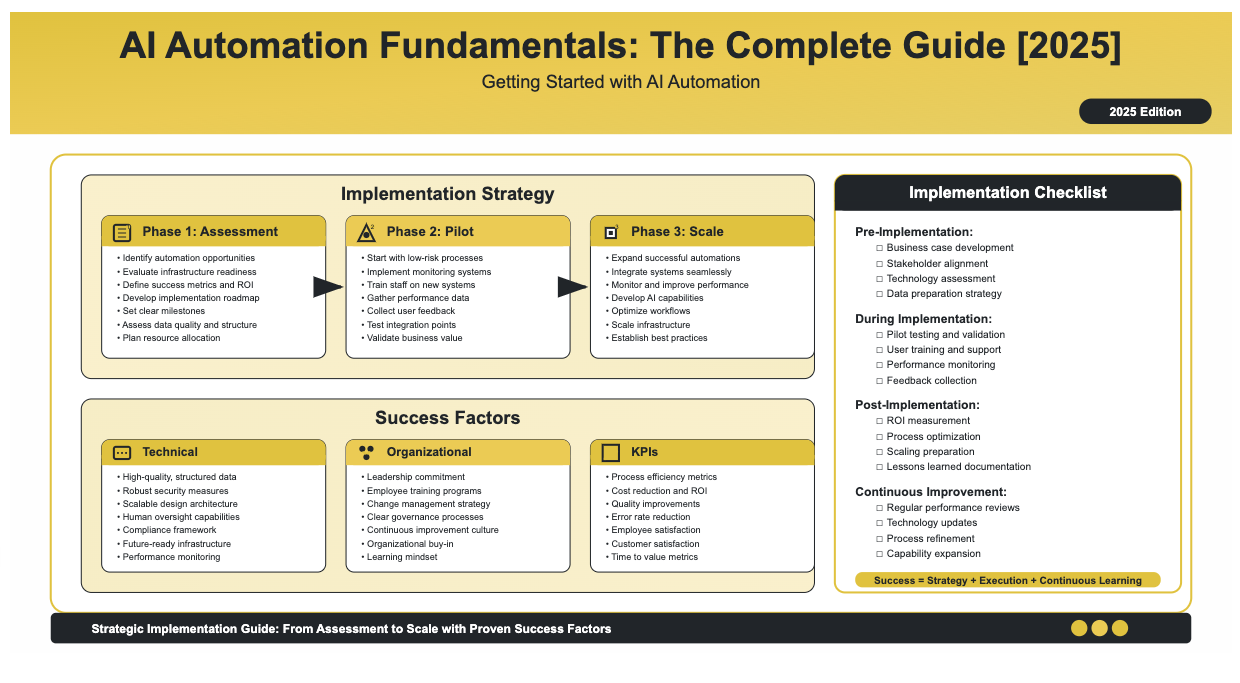
AI Automation Fundamentals: Complete Guide 2025
AI Automation Fundamentals: Complete Guide 2025
Estimated reading time: 18 minutes
Key Takeaways
- AI automation integrates intelligence with automation for end-to-end efficiency in 2025.
- It is transforming diverse industries, from healthcare to finance and manufacturing.
- Benefits go beyond cost reduction to scalability, personalization, and innovation enablement.
- Successful implementations require robust data, governance, and ethical considerations.
- Growing demand for AI automation skills is creating new career paths with competitive salaries.
Table of Contents
- AI Automation Fundamentals: Complete Guide 2025
- Key Takeaways
- 1. Introduction
- 2. Definition of AI Automation
- 3. History and Evolution of AI Automation
- 4. Key Technologies in AI Automation
- 5. Applications of AI Automation in Various Industries
- 6. Benefits of AI Automation
- 7. Challenges and Limitations of AI Automation
- 8. Future Trends in AI Automation
- 9. Impact of AI Automation on Employment
- 10. Ethical Considerations in AI Automation
- 11. Career Opportunities and Salaries in AI Automation
- 12. Education and Certification Pathways
- 13. How to Use AI Automation: Practical Blueprints
- 14. What Are Three Examples of Automation?
- 15. Case Studies of Successful AI Automation Implementation
- 16. Conclusion and Next Steps
- 17. Additional Resources
- Frequently Asked Questions
1. Introduction
AI automation blends artificial intelligence (learning, reasoning, perception) with automation (repeatable execution of tasks) to streamline both routine and complex work. This transformative technology is changing how businesses operate by combining intelligent decision-making with efficient task execution.
This guide serves as your comprehensive resource to understand ai automation in 2025, demystifying the technology, exploring its applications, and providing practical guidance for implementation. Whether you're a professional looking to advance your career or an organization seeking competitive advantage, mastering ai automation is essential for success in today's rapidly evolving digital landscape.
Understanding ai automation is crucial for competitiveness, productivity, and capturing market opportunities in 2025. As businesses face increasing pressure to optimize operations and deliver superior experiences, ai automation offers powerful solutions to these challenges.
In this guide, we'll cover everything from fundamental definitions to practical implementation strategies, including:
- Clear definition and key components
- Historical evolution and technological advances
- Industry applications and use cases
- Benefits and limitations
- Future trends and market growth
- Career opportunities and salary expectations
- Education pathways and certification options
- Step-by-step implementation blueprints
Let's begin by establishing exactly what ai automation means in 2025.
2. Definition of AI Automation
AI automation is the integration of AI's intelligent decision-making and learning with automation's reliable task execution to perform end-to-end processes with minimal human intervention. This technology combines the cognitive abilities of artificial intelligence with the efficiency of automated workflows, creating systems that can handle complex tasks while improving over time.
Unlike traditional automation that follows fixed rules without adaptation, ai automation learns from data, improves its decision-making, and handles variability and unstructured inputs like text, images, and speech. This fundamental difference enables ai automation to tackle more sophisticated challenges than conventional automation systems.
Key characteristics of ai automation include:
- Perception: Using natural language processing and computer vision to understand unstructured data
- Prediction: Employing machine learning and analytics to anticipate outcomes and needs
- Decision-making: Applying policies and optimization to determine the best course of action
- Execution: Implementing decisions through RPA, workflow bots, and other automation tools
- Learning: Continuously improving through feedback loops and new data
The power of ai automation comes from combining these elements into cohesive systems that can perceive, think, act, and learn—capabilities that make it fundamentally different from traditional automation approaches.
https://www.moveworks.com/us/en/resources/blog/guide-to-ai-and-automation
https://www.flowforma.com/blog/ai-automation
https://www.salesforce.com/artificial-intelligence/ai-automation/
https://www.simplilearn.com/what-is-ai-automation-article
3. History and Evolution of AI Automation
The journey of ai automation has progressed through distinct phases, each building upon previous innovations to create increasingly sophisticated systems.
Early Automation Era
The early 2010s saw the rise of Robotic Process Automation (RPA), which focused on automating simple, rule-based tasks in back-office functions. These systems could follow predefined steps but lacked intelligence and adaptability, limiting their application to structured processes with clear rules.
RPA tools enabled organizations to automate basic tasks like data entry, file transfers, and simple customer service responses, delivering early efficiency gains in areas with repetitive workflows.
Transition to Intelligent Automation
As technology evolved, the industry shifted toward Intelligent Automation (IA), which integrated RPA with AI capabilities and Business Process Management (BPM) for comprehensive workflow optimization. This combination allowed systems to handle more complex scenarios involving judgment and unstructured data.
Key Milestones
The evolution of ai automation has been marked by several important developments:
- Early 2010s: Adoption of RPA for repetitive office tasks, providing the foundation for more advanced automation
- Late 2010s: Integration of machine learning and natural language processing, enabling dynamic workflows and the ability to process unstructured data
- 2020s: Widespread implementation across customer service, analytics, and strategic operations, elevating automation to a board-level priority
Today's ai automation solutions build upon these foundations, combining multiple technologies to create powerful systems that can tackle increasingly complex business challenges.
https://www.flowforma.com/blog/ai-automation
https://www.simplilearn.com/what-is-ai-automation-article
https://www.salesforce.com/artificial-intelligence/ai-automation/
https://www.soraia.io/blog/how-ai-automation-is-transforming-business-operations-in-2025
4. Key Technologies in AI Automation
The power of ai automation comes from the integration of several cutting-edge technologies, each contributing unique capabilities to create comprehensive solutions.
Machine Learning (ML)
Machine learning algorithms form the core intelligence of ai automation systems. These algorithms learn patterns from data to classify information, forecast outcomes, and optimize processes. ML comes in several forms:
- Supervised learning: Algorithms trained on labeled data to make predictions
- Unsupervised learning: Systems that find patterns in unlabeled data
- Reinforcement learning: Models that learn optimal actions through trial and error
ML enables automation systems to improve their performance over time as they process more data, making them increasingly accurate and effective.
Neural Networks and Deep Learning
Neural networks, particularly deep learning models, provide ai automation with sophisticated pattern recognition and decision-making capabilities. Key types include:
- Convolutional Neural Networks (CNNs): Specialized for image processing and visual data
- Recurrent Neural Networks (RNNs): Designed for sequential data like text or time series
- Transformer models: Powering advanced language understanding and generation
These technologies enable ai automation systems to understand complex inputs and make nuanced decisions based on multilayered analysis.
Natural Language Processing (NLP)
NLP allows automation systems to understand and generate human language, enabling:
- Chatbots and virtual assistants that can hold natural conversations
- Document analysis systems that extract information from unstructured text
- Voice-enabled interfaces that respond to spoken commands
To explore more about how NLP is applied in real-world scenarios, visit AI Checker: The Ultimate Guide to Detecting AI-Generated Content in 2024.
NLP capabilities are crucial for automating processes that involve communication and text analysis.
Robotic Process Automation (RPA)
RPA provides the execution layer for many ai automation implementations, using software robots to:
- Interact with user interfaces just as humans would
- Execute repeatable tasks across multiple applications
- Process structured data according to defined rules
When enhanced with AI, RPA bots can handle unstructured data and make decisions based on learned patterns rather than just following rigid rules.
For more on the best workflow automation tools, check out Workflow Automation Tools: Transforming Business Operations in 2025.
Predictive Analytics
Predictive analytics uses statistical models and machine learning to forecast future events and recommend actions. Applications include:
- Predictive maintenance for equipment
- Customer behavior forecasting
- Risk assessment and fraud detection
This technology helps automation systems anticipate needs and problems before they occur, enabling proactive responses.
The most effective ai automation solutions combine these technologies within an architectural framework that includes:
- Data pipelines for information collection and preprocessing
- Model training and serving infrastructure
- Workflow orchestration engines
- Connectors and APIs for system integration
- Monitoring and observability tools
- Human-in-the-loop oversight mechanisms
- Governance and compliance controls
By integrating these components, organizations can create robust ai automation systems capable of handling complex business processes.
https://www.salesforce.com/artificial-intelligence/ai-automation/
https://www.simplilearn.com/what-is-ai-automation-article
https://www.flowforma.com/blog/ai-automation
5. Applications of AI Automation in Various Industries
AI automation is transforming operations across multiple sectors, with customized applications addressing industry-specific challenges and opportunities.
Healthcare
In healthcare, ai automation streamlines administrative and clinical processes:
- Patient data management and record keeping
- Diagnostic triage and preliminary analysis
- Appointment scheduling and resource allocation
- Medical document processing and coding
These applications help healthcare providers reduce administrative burden, accelerate diagnoses, and improve patient experiences. For example, automated triage systems can reduce assessment times by 40%, directing patients to appropriate care more quickly.
https://www.simplilearn.com/what-is-ai-automation-article
Finance
Financial institutions leverage ai automation for:
- Fraud detection and security monitoring
- Risk assessment and credit scoring
- KYC (Know Your Customer) and AML (Anti-Money Laundering) processes
- Invoice processing and payment reconciliation
These systems enhance security while reducing processing times and operational costs. For instance, automated fraud detection systems can identify suspicious transactions in milliseconds, protecting customers and institutions from financial losses.
https://www.simplilearn.com/what-is-ai-automation-article
Manufacturing
Smart manufacturing facilities implement ai automation for:
- Equipment monitoring and predictive maintenance
- Quality control and defect detection
- Inventory optimization and supply chain management
- Production planning and scheduling
These applications help manufacturers minimize downtime, reduce waste, and optimize resource utilization. Predictive maintenance systems, for example, can reduce unplanned downtime by up to 50% by identifying potential failures before they occur.
https://www.flowforma.com/blog/ai-automation
https://www.soraia.io/blog/how-ai-automation-is-transforming-business-operations-in-2025
Retail and eCommerce
Retailers use ai automation to enhance customer experiences and operations:
- Personalized product recommendations based on browsing and purchase history
- Dynamic pricing adjusted to demand, competition, and inventory levels
- Supply chain visibility and demand forecasting
- Automated marketing campaigns and customer segmentation
These capabilities help retailers deliver relevant experiences while optimizing pricing and inventory management. Personalization engines can increase conversion rates by 15-30% by showing customers products that match their preferences.
https://www.salesforce.com/artificial-intelligence/ai-automation/
Customer Service and IT Support
Service departments benefit from ai automation through:
- AI chatbots and virtual agents handling common inquiries
- Automated ticket classification and routing
- Self-service knowledge bases with intelligent search
- Proactive issue identification and resolution
Learn more about advanced AI-driven customer support solutions in Agentic AI: How It’s Revolutionizing Technology and Transforming Industries.
These solutions improve response times while reducing support costs. Virtual agents can handle up to 80% of routine inquiries without human intervention, allowing support staff to focus on complex issues.
https://www.moveworks.com/us/en/resources/blog/guide-to-ai-and-automation
https://www.soraia.io/blog/how-ai-automation-is-transforming-business-operations-in-2025
Across all industries, successful ai automation implementations share common characteristics:
- Clear focus on specific business outcomes
- Thoughtful integration with existing workflows
- Appropriate human oversight and intervention points
- Continuous monitoring and improvement
By tailoring automation solutions to industry-specific needs, organizations can achieve significant operational improvements and competitive advantages.
6. Benefits of AI Automation
Organizations implementing ai automation realize numerous advantages that extend beyond simple cost reduction. These benefits drive the technology's rapid adoption across industries.
Increased Efficiency and Throughput
AI automation dramatically improves operational efficiency by:
- Processing high volumes of transactions without fatigue
- Reducing task completion times through parallel processing
- Minimizing manual workload for routine activities
- Decreasing cycle times for complex processes
For example, invoice processing that might take hours with manual methods can be completed in minutes with ai automation, allowing companies to handle more transactions with the same resources.
https://www.flowforma.com/blog/ai-automation
https://www.soraia.io/blog/how-ai-automation-is-transforming-business-operations-in-2025
Cost Savings
Significant cost reductions come from multiple sources:
- Labor reallocation from routine to higher-value tasks
- Error reduction and associated rework costs
- Faster processing leading to operational savings
- Optimized resource utilization
Organizations typically report 40-70% cost reductions in processes where ai automation is successfully implemented, with financial services firms saving millions annually on document processing alone.
https://www.flowforma.com/blog/ai-automation
https://www.soraia.io/blog/how-ai-automation-is-transforming-business-operations-in-2025
Scalability
AI automation provides unmatched scalability advantages:
- Handling volume surges without additional staffing
- Maintaining consistent quality regardless of workload
- Operating continuously without breaks or shifts
- Expanding to new processes or locations with minimal incremental cost
This scalability enables businesses to grow without proportional increases in operational costs or respond to seasonal demands without temporary staffing challenges.
https://www.moveworks.com/us/en/resources/blog/guide-to-ai-and-automation
https://www.soraia.io/blog/how-ai-automation-is-transforming-business-operations-in-2025
Personalization at Scale
AI automation enables individualized experiences across large customer bases:
- Tailored marketing communications based on behavior patterns
- Customized product recommendations and offers
- Personalized service responses reflecting customer history
- Adaptive user interfaces for different user preferences
This level of personalization would be impossible to deliver manually at scale, yet automation makes it both feasible and cost-effective.
https://www.flowforma.com/blog/ai-automation
Innovation Enablement
By freeing teams from routine tasks, ai automation creates space for innovation:
- Employees focus on creative and strategic initiatives
- Faster experimentation and learning cycles
- New service offerings enabled by automation capabilities
- Increased agility in responding to market changes
This benefit often proves the most valuable long-term, as it allows organizations to evolve their business models and create new sources of competitive advantage.
https://www.soraia.io/blog/how-ai-automation-is-transforming-business-operations-in-2025
https://www.unleash.ai/embracing-ai-and-automation-what-to-expect-in-2025/
Organizations that fully embrace ai automation typically experience a virtuous cycle where initial efficiency gains fund further automation initiatives, leading to compounding benefits over time. The most successful implementations focus not just on cost reduction but on creating superior customer and employee experiences.
7. Challenges and Limitations of AI Automation
While ai automation offers significant benefits, organizations must navigate several challenges to achieve successful implementation and sustainable results.
Technical Barriers
Implementing ai automation involves overcoming various technical hurdles:
- Complex integration with legacy systems and data sources
- Data availability and quality issues affecting model performance
- Ensuring model reliability in production environments
- Managing model drift as conditions change
Organizations often underestimate these technical challenges, leading to delayed or underperforming implementations. Successful projects typically involve thorough technical assessment and realistic timeline planning.
https://www.simplilearn.com/what-is-ai-automation-article
Cost and ROI Timing
Financial considerations present significant challenges:
- Substantial upfront investments in technology and expertise
- Cloud computing costs for model training and deployment
- Talent acquisition and development expenses
- Phased ROI realization that may take months or years
While ai automation generally delivers positive returns, organizations must be prepared for initial investments and patience during the implementation and optimization phases.
https://www.soraia.io/blog/how-ai-automation-is-transforming-business-operations-in-2025
Integration and Change Management
Organizational challenges often prove as difficult as technical ones:
- Resistance to changing established processes
- Redesigning workflows to incorporate automation
- Securing stakeholder alignment across departments
- Managing the transition period with hybrid operations
Successful implementations require strong change management practices and clear communication about goals, benefits, and implementation timelines.
https://www.simplilearn.com/what-is-ai-automation-article
Security and Privacy Concerns
AI automation introduces new security considerations:
- Data governance requirements for training and operational data
- Compliance with industry regulations and privacy laws
- Increased attack surface from automated workflows
- Potential for system manipulation or data poisoning
Organizations must implement robust security practices, including access controls, encryption, and ongoing vulnerability assessments.
https://www.simplilearn.com/what-is-ai-automation-article
Mitigation Strategies
To address these challenges, consider implementing this practical checklist:
- Start with pilot projects to validate concepts before scaling
- Build human-in-the-loop checkpoints for critical processes
- Conduct thorough compliance reviews during design phases
- Implement comprehensive monitoring and alerting systems
- Develop clear rollback plans for automation failures
- Create transparent performance metrics and success criteria
- Establish cross-functional governance teams
By anticipating challenges and planning mitigation strategies, organizations can navigate the complexities of ai automation implementation while minimizing risks.
8. Future Trends in AI Automation
The ai automation landscape continues to evolve rapidly, with several key trends shaping its future development and application.
Generative AI Integration
Generative AI is revolutionizing automation capabilities:
- Content creation tools automatically generating text, images, and video
- Code assistance systems helping developers build applications faster
- Document understanding technologies extracting meaning from complex materials
- Autonomous agents coordinating multiple tasks with minimal supervision
Discover how autonomous AI agents are transforming industries in Agentic AI: How It’s Revolutionizing Technology and Transforming Industries.
These capabilities enable automation of previously untouchable creative and analytical processes, dramatically expanding the scope of what can be automated.
https://www.flowforma.com/blog/ai-automation
https://www.soraia.io/blog/how-ai-automation-is-transforming-business-operations-in-2025
Multimodal AI Systems
Next-generation systems will seamlessly process multiple data types:
- Combined analysis of text, images, audio, and numerical data
- Integrated reasoning across different information formats
- Context-aware processing that considers all available inputs
- Cross-modal learning that transfers knowledge between domains
This multimodal approach creates more robust automation systems capable of handling complex real-world scenarios where information comes in varied formats.
https://www.soraia.io/blog/how-ai-automation-is-transforming-business-operations-in-2025
Market Growth and Investment
The economic impact of ai automation continues to expand:
- Market size estimated to reach $1.3 trillion by 2030
- Rapid expansion of the vendor ecosystem across all technology layers
- Increased investment in specialized vertical solutions
- Growing adoption across mid-market and small businesses
This growth reflects the proven value of ai automation and its expanding accessibility to organizations of all sizes.
https://www.flowforma.com/blog/ai-automation
Emerging Applications
Innovation is opening new frontiers for ai automation:
- Self-managing factories with minimal human supervision
- Hyper-personalized sales experiences adapting in real-time
- Predictive healthcare logistics optimizing patient care
- Autonomous business processes spanning organizational boundaries
These applications represent not just efficiency improvements but fundamental business model innovations that will reshape competitive landscapes.
https://www.salesforce.com/artificial-intelligence/ai-automation/
https://www.soraia.io/blog/how-ai-automation-is-transforming-business-operations-in-2025
Organizations should monitor these trends closely and develop strategies to incorporate advancing capabilities into their automation roadmaps. The competitive advantages available to early adopters will continue to drive investment and innovation in ai automation technologies.
9. Impact of AI Automation on Employment
AI automation is significantly reshaping the employment landscape, creating both challenges and opportunities for the workforce.
Job Displacement
Some roles face significant transformation or reduction:
- Repetitive manual roles being automated or substantially changed
- Administrative positions reimagined with automation components
- Middle management layers thinned as reporting and analysis automate
- Process-heavy roles restructured around exception handling
Organizations must recognize these impacts and develop responsible approaches to workforce transition, including reskilling programs and career path alternatives.
https://www.unleash.ai/embracing-ai-and-automation-what-to-expect-in-2025/
New Role Creation
Simultaneously, ai automation creates entirely new career opportunities:
- AI specialists designing and implementing automation systems
- Data analysts interpreting results and improving models
- MLOps professionals maintaining production AI systems
- AI automation engineers and specialists building solutions
- Product and process owners managing automated workflows
These roles often offer higher compensation and greater job satisfaction than the positions they replace, though they require different skill sets.
https://www.unleash.ai/embracing-ai-and-automation-what-to-expect-in-2025/
Skill Shifts
The workforce is experiencing a fundamental shift in valued capabilities:
- Creativity and innovation becoming more important
- Domain expertise combined with technical understanding
- Data literacy and analytical thinking
- Prompt engineering and AI interaction skills
- Change leadership and adaptation abilities
Educational institutions and professional development programs are adapting to these changing requirements, offering new credentials and learning paths.
https://www.unleash.ai/embracing-ai-and-automation-what-to-expect-in-2025/
Productivity Enhancement
AI automation increasingly serves as a productivity multiplier:
- Humans focusing on judgment, creativity, and relationship building
- AI handling information processing and routine execution
- Collaborative human-AI workflows combining strengths of both
- Overall productivity gains enabling economic growth
This “copilot” model represents the most promising path forward, with humans and AI systems working together rather than AI simply replacing humans.
https://www.unleash.ai/embracing-ai-and-automation-what-to-expect-in-2025/
Organizations that approach workforce transformation thoughtfully—investing in employee development, creating clear transition paths, and designing human-AI collaboration models—will navigate this shift more successfully and build stronger competitive positions.
10. Ethical Considerations in AI Automation
As ai automation becomes more prevalent, organizations must address important ethical considerations to ensure responsible implementation and use.
Bias and Fairness
AI systems can inadvertently perpetuate or amplify biases:
- Dataset biases reflecting historical inequities
- Algorithm design choices that favor certain groups
- Deployment decisions that create unequal access or outcomes
- Feedback loops that reinforce existing patterns
Organizations should implement bias testing, ensure representative datasets, conduct algorithm audits, and establish governance frameworks to promote fairness.
https://www.simplilearn.com/what-is-ai-automation-article
Privacy and Data Protection
Automation systems often require extensive data, raising privacy concerns:
- Appropriate handling of personally identifiable information (PII)
- Clear consent mechanisms for data collection and use
- Data minimization principles to limit collection scope
- Responsible retention policies and access controls
- Regular privacy impact assessments
Implementing privacy by design principles and staying current with evolving regulations helps organizations maintain trust while leveraging data for automation.
https://www.simplilearn.com/what-is-ai-automation-article
Accountability and Transparency
Organizations must establish clear responsibility for automated decisions:
- Documented decision logic and model development processes
- Model cards explaining system capabilities and limitations
- Explainability techniques for complex models
- Human oversight mechanisms for critical processes
- Clear escalation paths when systems produce unexpected results
These practices help maintain appropriate accountability even as more decisions become automated.
https://www.simplilearn.com/what-is-ai-automation-article
Regulatory Compliance
The regulatory landscape for AI continues to evolve:
- Alignment with emerging AI regulations and industry standards
- Regular risk assessments for automated systems
- Data Protection Impact Assessments (DPIAs)
- Documentation of compliance measures and testing
- Monitoring of regulatory developments across jurisdictions
Proactive engagement with regulatory requirements helps organizations avoid compliance issues while building sustainable automation programs.
https://www.simplilearn.com/what-is-ai-automation-article
By addressing these ethical considerations systematically, organizations can build trust with customers, employees, and regulators while realizing the benefits of ai automation. Ethical implementation is increasingly becoming a competitive advantage as stakeholders prioritize responsible technology use.
11. Career Opportunities and Salaries in AI Automation
The growing adoption of ai automation is creating substantial career opportunities across various roles, with strong demand for skilled professionals.
AI Automation Engineer
This role forms the technical backbone of automation initiatives:
- Responsibilities: Designing, building, and maintaining AI-driven workflows; architecting data and model pipelines; integrating with RPA and BPM systems; implementing MLOps practices; monitoring system performance
- Daily tasks: Conducting process discovery; building proofs-of-concept; training models; designing API integrations; establishing governance frameworks; optimizing cost and performance
- Required skills: Python programming; ML frameworks; LLM/NLP techniques; RPA tools; cloud platforms; CI/CD methodologies; security fundamentals; prompt engineering; BPMN knowledge
- AI automation engineer salary: Compensation varies significantly by location, experience level, and industry. Entry-level positions typically start at $80,000-100,000 in the US, while experienced engineers can earn $120,000-180,000+ depending on specialization and employer.
The demand for these engineering roles continues to grow as organizations implement more sophisticated automation solutions.
https://www.flowforma.com/blog/ai-automation
https://www.soraia.io/blog/how-ai-automation-is-transforming-business-operations-in-2025
AI Automation Specialist
These professionals focus on business applications and implementation:
- Responsibilities: Assessing business processes for automation potential; configuring automation tools; orchestrating bots and workflows; managing change; training end users
- Skills: Process mapping; low-code platform expertise; vendor-specific tools; analytics and ROI measurement; business analysis; stakeholder management
- AI automation salary: Specialists typically earn $75,000-140,000 depending on experience and location. Certifications and domain expertise often serve as salary multipliers, with specialized knowledge in healthcare, finance, or manufacturing commanding premium compensation.
Specialists often serve as bridges between technical teams and business stakeholders, making them valuable for successful implementations.
AI Automation Jobs Landscape
The broader ecosystem includes various related positions:
- Sample titles: AI developer, machine learning engineer, RPA developer, automation consultant, solutions architect, data engineer, prompt engineer
- Hiring industries: Financial services, healthcare, manufacturing, retail, technology services
- Entry paths: Internships in data science or automation; project portfolios demonstrating relevant skills; certifications in AI or RPA tools; networking within professional communities
Most professionals enter the field through related technical roles, then specialize in automation as they gain experience.
The career outlook for ai automation professionals remains exceptionally strong, with demand outpacing supply in most regions. Organizations are competing intensely for talent, creating favorable conditions for job seekers and career advancement.
12. Education and Certification Pathways
Building expertise in ai automation requires a structured approach to education and professional development. Here's a guide to building your knowledge and credentials.
AI Automation Course Recommendations
A comprehensive curriculum should include:
- Machine learning fundamentals and applied techniques
- Natural language processing and conversational AI
- Robotic Process Automation (RPA) methodologies
- Data engineering and pipeline development
- API integration and microservices architecture
- Cloud platforms and deployment options
- MLOps and model lifecycle management
- Security, ethics, and governance
- Business Process Management (BPM)
Look for courses that balance theoretical foundations with practical, hands-on projects that demonstrate real-world applications.
AI Automation Certification Value
Industry certifications validate your skills and enhance employability:
- Vendor certifications from companies like UiPath, Automation Anywhere, or Microsoft demonstrate tool proficiency
- Platform certifications in cloud services (AWS, Azure, GCP) verify deployment knowledge
- AI-specific credentials from organizations like IBM or NVIDIA establish core competencies
For those interested in specialized engineering roles, see How to Become a GTM Engineer in 2025: Roles, Skills, Salary, Educational Pathways, and Jobs.
The most valuable certifications combine theoretical assessment with practical demonstrations of capability. When evaluating certification programs, consider their recognition within your target industry and their focus on current, relevant technologies.
Learning Timeline
When asked “How long does it take to learn AI automation?”, the answer varies by background and intensity:
- Typical timeline: 6-18 months with structured learning and projects
- For those with programming backgrounds: Faster progression possible (3-6 months)
- Accelerated paths: Intensive bootcamps can compress learning into 3-4 months
- Practical mastery: Continues to develop through hands-on experience
A recommended study plan includes:
- Months 0-3: Build foundations in programming, machine learning, and RPA
- Months 4-6: Complete 2-3 applied projects in different domains
- Months 7-12: Pursue specialization and certification
- Beyond: Develop a capstone project integrating multiple technologies
Free Learning Resources
Google offers several free AI courses that provide excellent starting points:
- Machine Learning Crash Course provides a solid foundation in ML concepts
- TensorFlow tutorials build practical implementation skills
- Google Cloud AI resources demonstrate enterprise-scale deployment
These resources offer high-quality instruction without financial commitment, making them ideal for beginners exploring the field.
https://developers.google.com/machine-learning/crash-course
https://ai.google/education/
Continuous learning is essential in ai automation given the rapid evolution of technologies and methodologies. Successful professionals typically maintain a regular learning practice, combining formal education with hands-on experimentation and community involvement.
13. How to Use AI Automation: Practical Blueprints
Implementing ai automation requires a structured approach. This section provides practical guidance for getting started with automation projects.
How to Automate Using AI: Step-by-Step Process
Follow this systematic approach to implement successful automation:
- Process Selection
- Choose high-volume, rules-heavy, measurable processes
- Map current inputs, outputs, and exception scenarios
- Define clear success metrics and expected ROI
- Secure stakeholder alignment on goals and timeline
- Data Scoping
- Inventory required data sources and access methods
- Assess data quality, completeness, and representativeness
- Define labeling requirements and ground truth standards
- Establish data governance and security protocols
- Tooling Selection
- Choose appropriate ML/NLP models for your use case
- Select RPA and workflow platforms that match your needs
- Plan API and webhook architecture for integration
- Design governance frameworks and controls
- Prototype Development
- Build a minimum viable solution for a process subset
- Implement human-in-the-loop checkpoints for validation
- Test with real data in controlled environments
- Gather feedback and performance metrics
- Integration Implementation
- Connect to systems of record and data sources
- Define service level agreements and performance expectations
- Implement retry logic and exception handling
- Establish fallback procedures for automation failures
- Validation and Testing
- Conduct A/B testing or pre/post implementation comparisons
- Measure key metrics: cycle time, accuracy, cost per transaction
- Perform user acceptance testing with stakeholders
- Document outcomes and learnings
- Monitoring and Operations
- Implement drift detection and model performance tracking
- Establish error budgets and alerting thresholds
- Create observability dashboards for key metrics
- Define incident response procedures
- Scaling and Iteration
- Expand automation scope to additional processes
- Retrain models with new data to improve performance
- Add enhanced safeguards and compliance documentation
- Share success stories to build organizational support
How to Use AI Automation to Make Money
Several business models leverage ai automation for revenue generation:
Freelance Services
- Offering document processing automation solutions
- Implementing and configuring chatbots and virtual assistants
- Building custom analytics dashboards and reporting
- Packaging services as fixed-price engagements or retainers
Consulting Opportunities
- Conducting process discovery and optimization assessments
- Developing ROI models and business cases
- Advising on vendor selection and implementation
- Providing change management and training support
Product Development
- Creating micro-SaaS tools for specific automation needs
- Developing industry-specific automation templates
- Offering usage-based pricing for automation services
- Building connector libraries for popular platforms
Internal Value Capture
- Reducing operational expenses through efficiency gains
- Improving throughput without additional headcount
- Enhancing customer experience through faster service
- Capturing market share through superior operations
Each approach requires different skills and investment levels, but all can generate significant returns when executed effectively.
How to Use AI as a Side Hustle
For individuals looking to generate supplementary income:
Niche Automation Ideas
- Creator tooling to streamline content production
- E-commerce operations bots for inventory and pricing
- Lead generation and enrichment for local businesses
- Document processing for tax preparation or legal services
Service Packaging
- Offering fixed-scope automation packages with clear deliverables
- Providing monthly retainer services for maintenance and updates
- Creating templates and playbooks for common automation needs
- Building proof-of-concept demos to showcase capabilities
Risk Management
- Implementing usage caps to control resource costs
- Establishing comprehensive logging for troubleshooting
- Building robust error handling into all automations
- Setting clear SLA expectations with clients
Starting small with focused solutions allows side hustlers to build expertise while generating income, potentially growing into full-time businesses over time.
14. What Are Three Examples of Automation?
Here are three common examples of ai automation that demonstrate the technology's versatility and impact:
1. AI-Powered IT Support Chatbots
Modern help desk systems use natural language processing and machine learning to understand user questions, troubleshoot issues, and automate resolutions for common problems. These systems can:
- Instantly respond to employee queries 24/7
- Automatically reset passwords and unlock accounts
- Troubleshoot common device and software issues
- Create and route tickets when human intervention is needed
Organizations implementing these systems typically see 50% reductions in response times and significant decreases in support costs.
https://www.moveworks.com/us/en/resources/blog/guide-to-ai-and-automation
2. Automated Invoice Processing
Financial departments use combined ML and RPA systems to transform invoice management:
- Intelligent document processing extracts key data from invoices
- Machine learning validates information against purchase orders
- RPA bots enter data into financial systems
- Workflow automation routes approvals based on business rules
These systems reduce processing times from days to minutes while improving accuracy and providing better visibility into financial obligations.
https://www.salesforce.com/artificial-intelligence/ai-automation/
3. Smart Factory Equipment Monitoring
Manufacturing facilities implement predictive maintenance systems that:
- Continuously monitor equipment sensors for anomalies
- Use machine learning to identify patterns preceding failures
- Automatically schedule maintenance before breakdowns occur
- Optimize parts inventory based on predicted needs
These systems reduce unplanned downtime by 30-50% and extend equipment life, delivering substantial ROI through improved production reliability.
https://www.soraia.io/blog/how-ai-automation-is-transforming-business-operations-in-2025
These examples represent just a small sample of the diverse applications of ai automation across industries. The common thread is the combination of intelligence (understanding, predicting, deciding) with execution capabilities (processing, routing, scheduling) to deliver measurable business value.
15. Case Studies of Successful AI Automation Implementation
Examining real-world implementations provides valuable insights into effective ai automation strategies and outcomes.
Enterprise IT Support Automation
A global technology company with over 50,000 employees implemented an AI-driven support automation system to handle the growing volume of IT help desk tickets.
Challenge
The company faced increasing ticket volumes, long response times, and high support costs across multiple time zones and languages.
Solution
The organization deployed an AI automation platform that combined:
- Natural language understanding to interpret employee requests
- Knowledge graph technology to connect issues with solutions
- Machine learning for ticket classification and routing
- Integration with existing IT systems for execution
Results
• Response times decreased by 50% on average
• First-contact resolution rates increased to 65%
• Support costs reduced by approximately 35%
• Employee satisfaction scores improved by 28%
Key Lessons
Clear service level agreements, continuous retraining with new data, and maintaining human oversight for complex issues were critical success factors.
https://www.moveworks.com/us/en/resources/blog/guide-to-ai-and-automation
Financial Services Data Processing Automation
A mid-sized financial institution implemented ML-driven automation to transform its document processing operations.
Challenge
Manual data entry from diverse financial documents was slow, error-prone, and costly, with a 7% error rate causing downstream issues.
Solution
The company built an intelligent document processing system that:
- Used computer vision and NLP to extract data from various documents
- Applied validation rules to verify information accuracy
- Integrated with core banking systems via RPA
- Maintained human review for exceptions and edge cases
Results
• Manual entry errors reduced by 90%
• Processing time decreased from 15 minutes to 45 seconds per document
• Staff redeployed to higher-value advisory roles
• Annual savings exceeded $2.5 million
Key Lessons
Comprehensive data labeling and robust exception handling proved essential for success in this regulated environment.
https://www.salesforce.com/artificial-intelligence/ai-automation/
Healthcare Document Processing
A large healthcare provider implemented NLP-driven automation to improve the processing of clinical documentation.
Challenge
Clinical notes contained valuable information buried within unstructured text, making timely diagnosis and treatment planning difficult.
Solution
The organization developed an NLP system that:
- Extracted key medical entities and relationships from clinical notes
- Identified potential diagnoses and recommended tests
- Populated structured fields in the electronic health record
- Flagged high-risk patients for immediate review
Results
• Diagnostic turnaround time improved by 33%
• Clinician documentation time reduced by 2 hours per day
• Critical findings were identified 45% faster
• Compliance with treatment protocols increased by 28%
Key Lessons
Rigorous privacy controls and validation against clinical guidelines were essential for deployment in this highly regulated context.
https://www.simplilearn.com/what-is-ai-automation-article
These case studies illustrate common success patterns:
- Starting with well-defined problems and clear success metrics
- Combining multiple technologies for end-to-end solutions
- Including appropriate human oversight and exception handling
- Measuring and reporting outcomes to build organizational support
- Continuously improving based on operational feedback
Organizations can apply these lessons to increase the probability of success in their own ai automation initiatives.
16. Conclusion and Next Steps
AI automation represents a transformative approach to business operations, combining intelligent decision-making with reliable task execution to deliver efficiency, cost savings, scalability, personalization, and innovation. As we've explored throughout this guide, the technology continues to evolve rapidly, creating both challenges and opportunities for organizations and individuals.
The successful implementation of ai automation requires careful attention to technical integration, privacy considerations, and governance frameworks. Organizations must balance the drive for efficiency with ethical considerations and appropriate human oversight to create sustainable automation programs.
Looking ahead, the continued advancement of generative AI, multimodal systems, and autonomous agents promises to further expand the scope and impact of automation across industries. Those who develop expertise in these areas will be well-positioned to lead digital transformation initiatives and capture significant career opportunities.
To move forward with ai automation:
- Identify one promising pilot project in your organization or industry
- Measure current performance to establish a baseline for ROI calculation
- Develop a skills development plan focused on both technical and domain expertise
- Stay informed about emerging trends like generative agents and multimodal AI
By taking a thoughtful, measured approach to ai automation, organizations and individuals can navigate this technological shift successfully and unlock substantial value.
https://www.moveworks.com/us/en/resources/blog/guide-to-ai-and-automation
https://www.flowforma.com/blog/ai-automation
https://www.soraia.io/blog/how-ai-automation-is-transforming-business-operations-in-2025
17. Additional Resources
Deep Dive Sub-Pages
For more specialized information on key topics, explore these dedicated resources:
- Machine Learning Fundamentals: A comprehensive guide to core ML concepts, algorithms, and model selection for automation applications
- NLP in Automation: Detailed exploration of prompts, retrieval-augmented generation, and evaluation frameworks
- Automation Technologies Compared: Understanding the differences between RPA, AI automation, Intelligent Automation, and Hyperautomation
- AI Governance Framework: Essential tools and practices for managing risk and ensuring compliance in automation initiatives
- Careers in AI Automation: In-depth coverage of roles, career roadmaps, portfolio development, and ai automation jobs
Learning Resources
To build your ai automation skills, consider these educational options:
- AI Automation Courses: Structured learning paths covering machine learning, NLP, RPA, and integration techniques
- Vendor Certifications: Credentials from major platform providers that validate specific technical skills
- Google AI Learning Hub: Free foundational courses covering machine learning fundamentals and practical implementation
https://developers.google.com/machine-learning/crash-course
https://ai.google/education/
Salary Research
When researching compensation for roles like ai automation engineer or ai automation specialist:
- Consult industry salary surveys from organizations like Robert Half or Glassdoor
- Review job boards to understand current market rates in your region
- Participate in professional communities where compensation discussions occur
- Consider the impact of certifications, specialized skills, and domain expertise
Remember that compensation varies significantly by location, experience level, and industry, so focus on understanding the salary range for your specific situation rather than general averages.
By leveraging these resources, you can continue to develop your understanding of ai automation and position yourself for success in this rapidly evolving field.
Frequently Asked Questions
What is the AI automation?
AI automation is the combination of artificial intelligence capabilities (such as learning, reasoning, and perception) with automation technologies that execute tasks. This integration creates systems that can perceive information, make decisions, take actions, and improve over time through experience. Unlike traditional automation that follows fixed rules, ai automation adapts to changing conditions and handles unstructured data like text, images, and speech.
What is ai automation?
AI automation combines artificial intelligence with process automation to create systems that can understand data, make decisions, and execute tasks with minimal human intervention. It uses technologies like machine learning, natural language processing, and robotic process automation to handle both structured and unstructured information, automating complex processes that previously required human judgment.
How long does it take to learn AI automation?
Learning ai automation typically takes 6-18 months of dedicated study and practice. The timeline varies based on:
• Your existing technical background (programming, data science)
• Learning intensity (part-time vs. full-time)
• The breadth of technologies you need to master
Accelerated learning is possible through intensive bootcamps (3-4 months), while building deep expertise often requires ongoing learning and practical experience beyond the initial learning period.
How to automate using AI?
To automate using AI, follow these steps:
1. Select high-value processes with clear inputs, outputs, and success metrics
2. Gather and prepare relevant data, ensuring quality and permissions
3. Choose appropriate AI and automation tools for your specific use case
4. Build a prototype with human oversight checkpoints
5. Integrate with existing systems and define error handling
6. Validate results through controlled testing and measurement
7. Implement monitoring and observability systems
8. Scale gradually and continuously improve performance
Start with smaller, well-defined processes before tackling more complex automation challenges.
How to use AI automation to make money?
You can monetize ai automation skills through several approaches:
• Offer freelance services building automation solutions for specific business problems
• Provide consulting on process optimization and automation strategy
• Develop specialized automation tools for niche industries or functions
• Create and sell templates or components that accelerate automation projects
• Build automation skills to advance your career in high-demand roles
The most successful monetization strategies combine technical expertise with deep understanding of specific business domains and problems.

