Field note
May 16, 2026
AI automation with no restrictions: operator version
Most pages ranking for this query are about uncensored chatbots and creative-writing AI without content filters. That is not the same thing as automation infrastructure you actually own. Here is what an operator means by no restrictions, and how to build it.

If you searched "ai automation tools with no restrictions" expecting a list of business-grade automation platforms, the results were probably weird. The page-one results lean uncensored AI chatbots and NSFW creative generators, not operator infrastructure. That is because two completely different markets adopted the same phrase, and Google has not split them yet.
This post is the operator version. I build AI automation systems for $1 to 20M businesses, mostly with self-hosted n8n, Claude, and a Supabase backend. I have shipped over 500 production-grade workflows that do not need babysitting. When I say "no restrictions," I do not mean a chatbot that will write anything. I mean a system where the vendor cannot rate-limit, charge per task, hold your credentials, or change the terms.
The keyword has two very different meanings
 The search "ai automation tools with no restrictions" surfaces two markets that have almost nothing in common:
- Uncensored chat and creative AI. Tools like Venice.ai, NoLimitGPT, ZenCreator, KoboldAI. These remove content filters on generated text and images. Audience is roleplay, fiction writers, NSFW image generation, and people who hit safety guardrails on ChatGPT.
- Self-hostable workflow automation. Source-available platforms like n8n plus open-source LLM runners like Ollama. Audience is operators, engineers, and agencies who want infrastructure they control.
If you are running a business, only the second category is relevant. The rest of this post is about that one.
What "no restrictions" actually means for an operator
Three things, and only three:
No external metering on tasks. Zapier charges per task. Make charges per operation. Most managed workflow tools have a price curve that punishes you for scaling. Self-hosted n8n on a $20 VPS does the same work for a flat infrastructure bill. The cost curves cross around 50,000 tasks per month, which I broke down in Self-hosted n8n vs n8n Cloud.
Credentials stay on your server. A managed automation platform stores your API keys, OAuth tokens, and customer data on infrastructure you do not own. For regulated industries (healthcare, legal, government, finance) that is a non-starter. For everyone else it is a future deplatforming risk. Self-hosted means the credentials sit in a Postgres instance you control.
Any API you can document, you can integrate. Managed platforms only let you talk to the integrations they have built. Self-hosted n8n has a Code node and an HTTP Request node. If the vendor publishes a REST API and webhooks, you can integrate with it the same afternoon. No marketplace approval, no waiting for a connector roadmap.
None of those three need an uncensored model. You can hit Claude or GPT through their normal APIs and get production-grade output. The "restriction" you are escaping is the workflow vendor, not the model provider.
The honest stack that earns the name
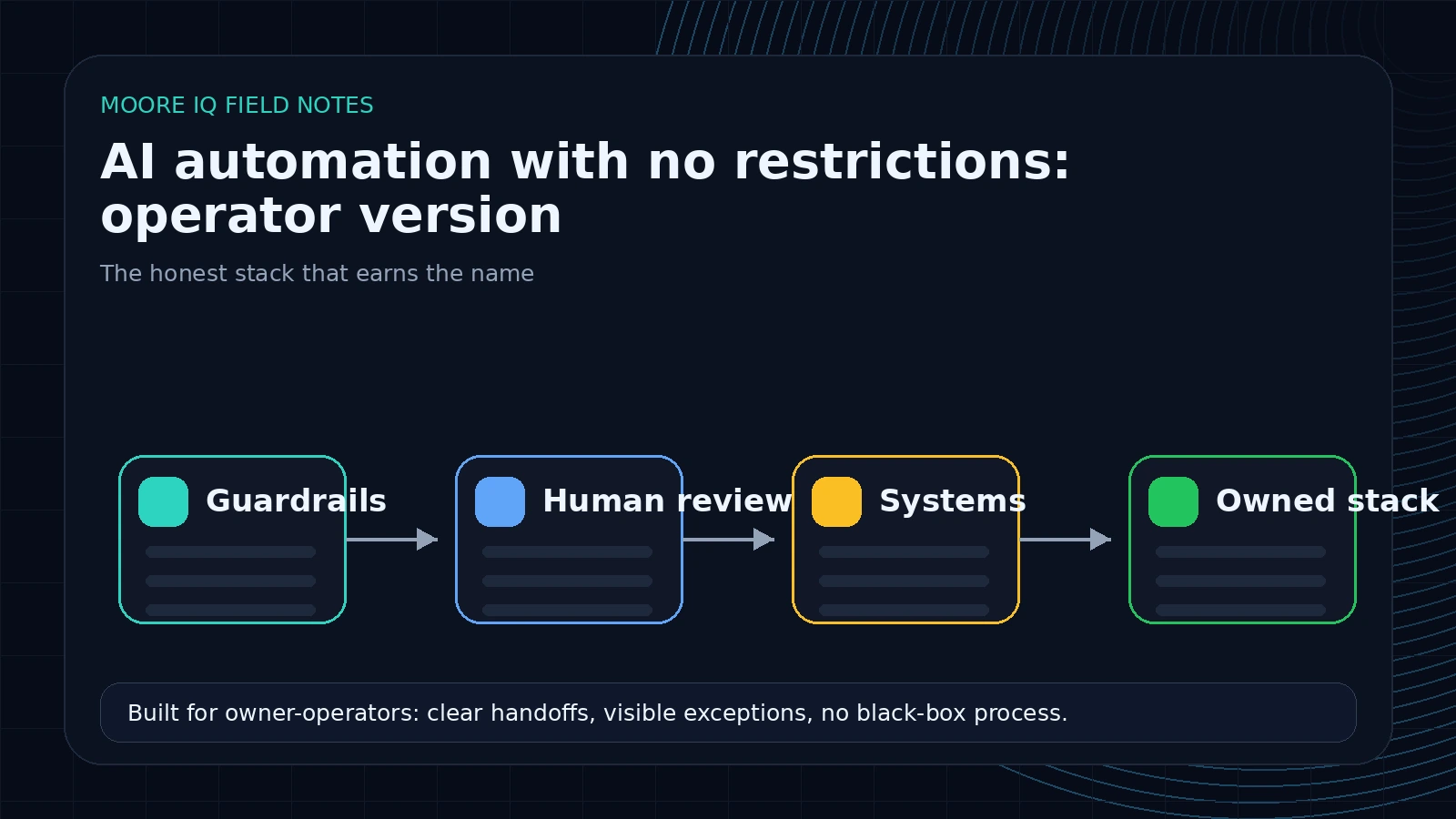 This is what I actually deploy when a client wants real infrastructure ownership:
- Compute: A $12 to $20 per month VPS from Hetzner or DigitalOcean. Ubuntu, Docker, ufw. Nothing exotic.
- Workflow: n8n self-hosted in Docker. The Apache 2.0 source-available license covers internal use without payment.
- State: Supabase for any table-shaped data or vector store. Free tier covers most clients.
- Inference: Claude through the Anthropic API for almost everything. For air-gapped or fully-private cases, Ollama running Llama 3 or Mistral on the same box.
- Credentials: Stored in n8n's encrypted credentials table, which lives in Postgres on your VPS. Optionally Bitwarden for team-shared API keys.
- Auth and tunnels: Cloudflare Tunnels for any service that needs a public webhook endpoint, so the VPS firewall stays closed.
I recently shipped this exact stack for a cybersecurity team that needed a local LLM in a non-internet environment, with a RAG system and OCR for log analysis. Same pattern, with Ollama swapped in for Claude on the inference step. Nothing left the box.
What you give up vs what you gain
You give up:
- A vendor success rep who calls you when your workflow breaks
- The Zapier app marketplace and its 7,000-plus prebuilt connectors
- One-click installs (you will SSH and run
docker compose up) - Auto-applied security patches (you patch your own server)
You gain:
- Flat infrastructure cost, regardless of task volume
- Code and data ownership at every layer, with a named AI automation manager responsible for operating control
- The ability to integrate any API the vendor has not blessed yet
- No monthly retainer to me or anyone else (when I ship a build, you own the build)
This is the trade I recommend to every operator with at least 10,000 monthly automation tasks, sensitive credentials, or a roadmap item that the managed platforms do not support. Under those thresholds, Zapier or Make is usually the right answer. Pretending otherwise is just dogma about self-hosting.
When this isn't for you
I will talk a client out of this stack if any of the following are true. When this isn't for you, the managed-platform fee is buying you something real and you should just pay it:
- They have fewer than ten active automations and no plans to grow
- No one on the team can SSH and read a
docker logsoutput - They have never owned a VPS before and do not want to learn
- The workflows they need are all in the Zapier marketplace and do not exceed the free tier
- They are in a hurry and need something live tomorrow
In those cases the managed platform's price is buying you something real: a learning curve, an ops team, a support phone number. That is worth the per-task fee. The honest stack only pays off when you have the volume or compliance requirement to amortize the operational work.
How to start without committing to the full build
You do not need to flip the whole stack to test this:
- Spin up a $20 Hetzner VPS and run n8n in Docker. One evening of work.
- Migrate one Zapier flow to it. Use the n8n HTTP Request node for any integration that does not have a native node.
- Run them in parallel for two weeks. Compare error rates and run time.
- If n8n holds, migrate the next flow. If not, you learned for $20.
Do not try to migrate everything at once. The reason managed platforms feel easier is not that they are technically better, it is that all the operational decisions have already been made for you. Taking those decisions back is real work and you should sequence it.
If you want help mapping the full migration, including which flows are worth moving and which to leave on the managed tier, the 90-second AI Operations X-Ray on this site will spit out a prioritized list. Or read Why the tool stack rarely is the problem first if you suspect the issue is architecture and not Zapier.
FAQ
Frequently asked questions
- 01Which AI automation tool has no limits?
- If you mean self-hostable and open source, n8n is the most flexible. It runs on a $20 per month VPS, supports custom code nodes, and lets you wire any API the vendor has not blessed. If you mean uncensored chat, that is a different product category and a different audience.
- 02Which AI system has no restrictions?
- No production AI system is restriction-free. Self-hosted open-source models like Llama 3 or Mistral remove vendor content policies but you still hit hardware limits, context windows, and your own internal compliance rules. The honest framing is fewer external gates, not zero limits.
- 03Can I run AI automation without sending data to a third party?
- Yes. Run n8n on your own server, use a local model through [Ollama](https://ollama.com/) for the inference step, and keep your credentials in the VPS. Nothing leaves your machine. I have done this for a military client where the box was not on the public internet.
- 04Self-hosted n8n or n8n Cloud?
- Cloud if you do under 5K executions per month and want a vendor success rep. Self-hosted past that, or any time credentials must stay on your infrastructure. The full cost breakdown is in [Self-hosted n8n vs n8n Cloud](/blog/n8n-self-hosted-vs-cloud-cost-breakdown).
- 05Why does this query return so many NSFW results?
- Because the literal phrase has been adopted by the uncensored-chatbot market. The B2B automation meaning of the same words is the minority intent. That is a search-engine problem, not an evidence that uncensored AI is the right answer for your business.