Field note
May 26, 2026
Integrated management system: one operating truth
An integrated management system helps operators connect CRM, delivery, billing, and exceptions so the business stops running on copied updates.


An integrated management system sounds like something an enterprise vendor says before quoting a six month rollout and naming every module after a noun. For an operator, the useful version is much simpler. It is the system of rules that tells the business where the truth lives, what happens when something changes, and who owns the next action when the normal path breaks.
That matters because most growing companies do not fail from a lack of tools. They fail from copied updates.
The lead is in the CRM, but the real note is in the inbox. The job is marked done, but billing is waiting on a photo. The customer approved the quote, but the owner found out two days later. The report says the pipeline is healthy, but half the next steps are living in someone's memory.
An integrated management system is how you stop asking people to carry the business in their heads.
What an integrated management system actually does
An integrated management system connects the operating record across the tools that already run the company. It does not have to mean replacing the CRM, the field app, the spreadsheet, the accounting tool, and the inbox in one heroic software migration. Please do not do that unless you enjoy expensive meetings with very confident implementation partners.
For most operators, the practical job is to define four things:
- Which system owns each important record.
- Which event should trigger a next action.
- Which work should move automatically.
- Which exception should route to a human.
That is the difference between software integration and operational integration. Software integration moves data. Operational integration makes the handoff usable.
The same idea shows up in more formal management frameworks. ISO's management system standards focus on repeatable processes and accountability. NIST's Cybersecurity Framework is not an operations playbook, but it is a useful reminder that every system needs clear identify, protect, detect, respond, and recover loops. QuickBooks app integrations show the practical small-business side of the same problem: accounting is usually part of the operating workflow, not a separate island. The buyer question is not whether tools can connect. The buyer question is whether the connection creates a trustworthy operating record.
If the CRM says a lead is qualified, delivery should know what was promised. If delivery marks work complete, billing should know whether the invoice is ready. If billing is blocked, the person who can unblock it should see the exact reason, not a vague task called "follow up."
This is why you do not have a tool problem, you have an architecture problem is still the right starting point. The stack matters, but the ownership map matters more.
Start with the source-of-truth map
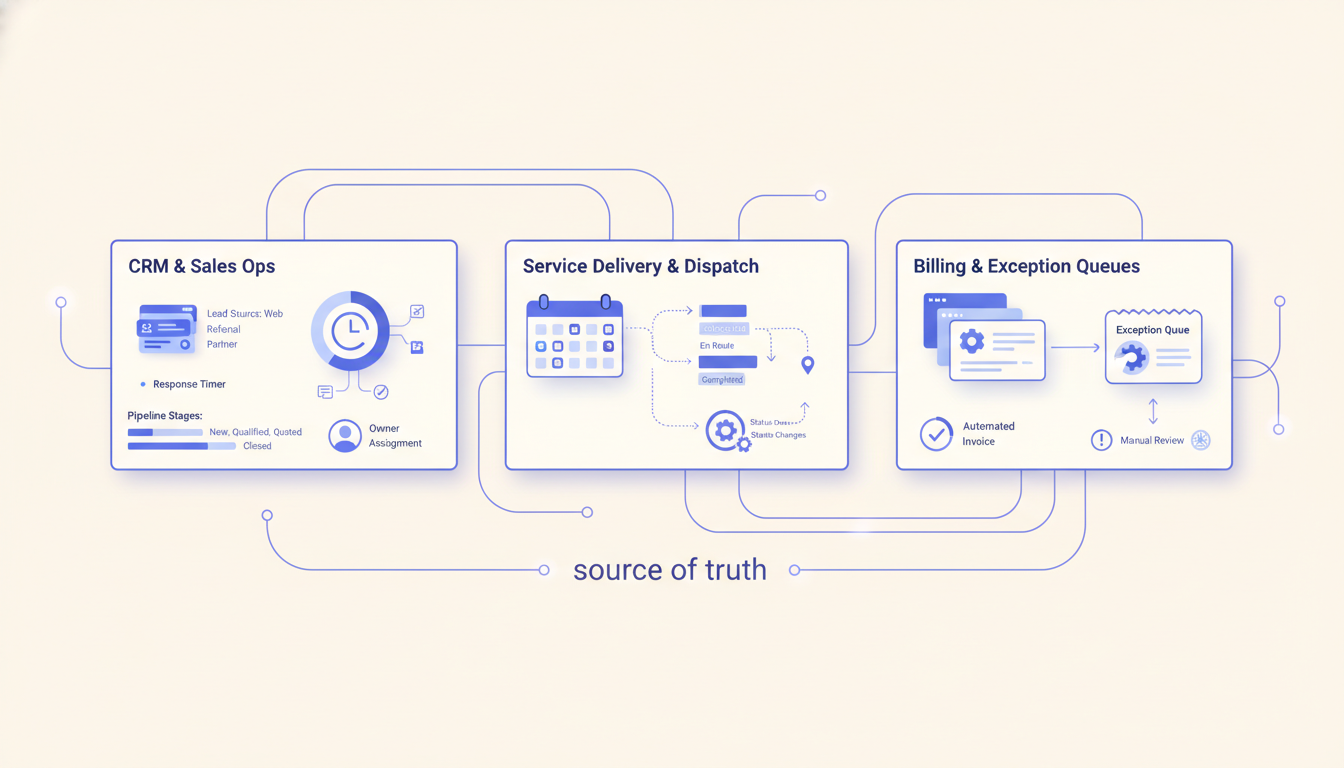
Before you automate anything, write the source-of-truth map. This is not a giant technical diagram. It is a plain English operating decision.
For each workflow, answer:
- Where does the record start?
- Where is the current status trusted?
- What field decides the next action?
- What system should never be manually edited?
- Who owns the exception when the data is missing?
The last question is the one most teams skip. That is also why the integration fails.
A clean source-of-truth map might say the CRM owns lead stage, the project system owns delivery status, QuickBooks owns invoice state, and a shared exception queue owns blocked handoffs. That is not glamorous. It is also the kind of boring clarity that saves hours every week.
Without that map, every automation becomes a debate. The workflow fires, someone says the wrong system updated, another person changes a spreadsheet, and now the business has three truths and a very tired office manager.
Where integration pays off first
The best first integrated management system project is not the biggest one. It is the handoff where delay creates a cost.
Look for these signals.
Lead response is slower than the buyer expects
A lead enters a form, inbox, marketplace, referral sheet, or ad platform. Someone needs to qualify it, assign it, and respond. If that routing depends on a person checking five places, the business is losing speed before the first conversation.
The integrated version can create the CRM record, classify the request, assign an owner, send the right acknowledgment, and flag anything that needs judgment.
That does not mean a robot should sell the job. It means the lead should not disappear because the intake path was messy.
Delivery status is not visible to the office
The work may be moving, but the office does not know what changed. That creates status meetings, customer update gaps, and owner interruptions.
A useful integration turns delivery events into operating signals. Complete. Blocked. Missing approval. Waiting on customer. Ready for billing. Needs review.
The goal is not more notifications. The goal is fewer status questions.
Billing waits on operational proof
Invoice readiness is one of the cleanest places to find money trapped in handoffs. The work is done, but the invoice waits for notes, photos, approvals, parts, time entries, or a final customer response.
An integrated management system can check the required fields, route missing items to the right owner, and create the billing task only when the record is ready. That is better than asking accounting to become a detective every Friday.
The owner is the exception queue
If every odd case escalates to the owner, the business does not have an exception process. It has a human patch.
That can work at small volume. It breaks when the team grows.
The integrated version should define which exceptions go to sales, delivery, billing, support, or the owner. The owner should see the cases that require judgment, not every case where a field was blank.
Build the exception queue before the executive dashboard
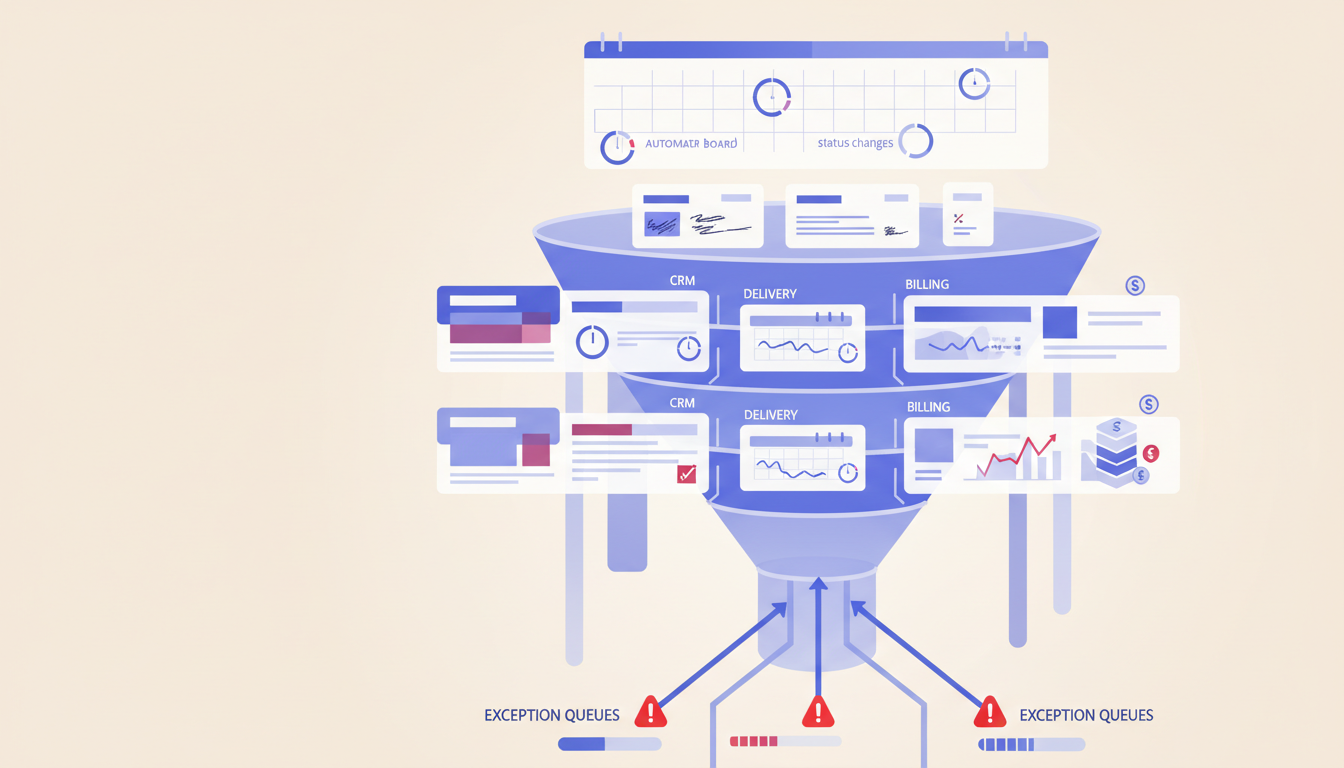
Dashboards are tempting because they feel like control. The problem is that many dashboards only report the mess after it already happened.
Build the exception queue first.
A useful exception queue shows:
- What changed.
- Why the normal path stopped.
- Who owns the next action.
- When it needs to be resolved.
- Which system will update after resolution.
That is the operating layer. It keeps automation honest because it admits that not every case should run straight through.
For example, a quote above a certain value might route to the owner if it sits for 24 hours. A completed job with missing proof might route to the field lead. A billing record with an unmatched customer name might route to admin. A support complaint from an active opportunity might route to sales before the next follow-up goes out.
That is not advanced AI. It is clear ownership at the point where work usually gets fuzzy.
What not to integrate yet
Do not integrate a process nobody can explain. If three managers describe the same workflow three different ways, the integration will hard-code confusion.
Do not integrate data that nobody trusts. If the team already ignores a field, wiring that field into more actions will not make it true.
Do not integrate around a political problem. If sales and operations disagree on ownership, the automation will become the place where that conflict shows up.
And do not hire us if the problem is just one simple native connector. If one form needs to create one row and send one email, use the cheapest built-in automation that already exists. Custom architecture is useful when the work crosses tools, owners, rules, and failure paths.
A practical first rollout
The first rollout should be boring on purpose.
Pick one workflow. Lead intake, delivery status, quote follow-up, invoice readiness, or support escalation are all reasonable starting points.
Then define:
- The trigger.
- The source system.
- The normal path.
- The exception path.
- The owner for each exception.
- The log that proves what happened.
- The review period before the rule becomes permanent.
Run the first version in review mode if the action is sensitive. Let it create tasks, flags, or recommendations before it starts making irreversible updates. That gives the team a chance to tune the rule without turning the business into a bug report.
This is also where benefits of automated workflow becomes practical. The benefit is not that automation exists. The benefit is that normal work moves without babysitting and abnormal work gets surfaced before it becomes expensive.
The buyer test for an integrated management system
A good integrated management system should pass five tests.
First, a new employee should know where to look for the current truth. Second, a manager should know which exceptions need action today. Third, billing should not need to chase operational proof manually. Fourth, customers should not wait because two internal systems disagree. Fifth, the owner should spend less time checking whether work moved.
If the system does not improve those things, it may be integrated technically but not operationally.
That distinction matters. A business does not need more connected software for its own sake. It needs a cleaner way to run the work.
The practical version is simple: one source of truth for each record, clear triggers for each handoff, and an exception queue that gives humans the right work at the right time.
If your company has outgrown copy-paste operations but is not ready for a giant software replacement, that is exactly where Moore IQ fits. Start with the AI Operations X-Ray, or look at n8n consulting if you already know the workflow that needs a real operating layer.
FAQ
Frequently asked questions
01What is an integrated management system for a small business?
It is a connected operating system across the tools that run the business, such as CRM, delivery, inbox, reporting, billing, and exception queues. The value is not one screen. The value is one clear source of truth for each handoff.
02Is an integrated management system the same as ERP?
Not always. ERP can be part of the stack, but many smaller companies need a lighter operating layer that connects the tools they already use and defines ownership across workflows.
03What should operators integrate first?
Start where delay changes money or customer trust. Common first targets are lead response, job status, quote follow-up, invoice readiness, and exception routing.
04When is integration not worth it?
It is not worth it when the process is still changing every week, the team cannot agree which system is authoritative, or there is no owner for exceptions.
05Does Moore IQ replace existing software?
Usually no. The practical path is to keep the useful tools, define the operating rules between them, and build the automation layer where handoffs break.