Field note
Jun 17, 2026
Automated quoting for equipment dealers
Automated quoting for equipment dealers should protect margin, speed up handoffs, and keep a human owner on every exception.

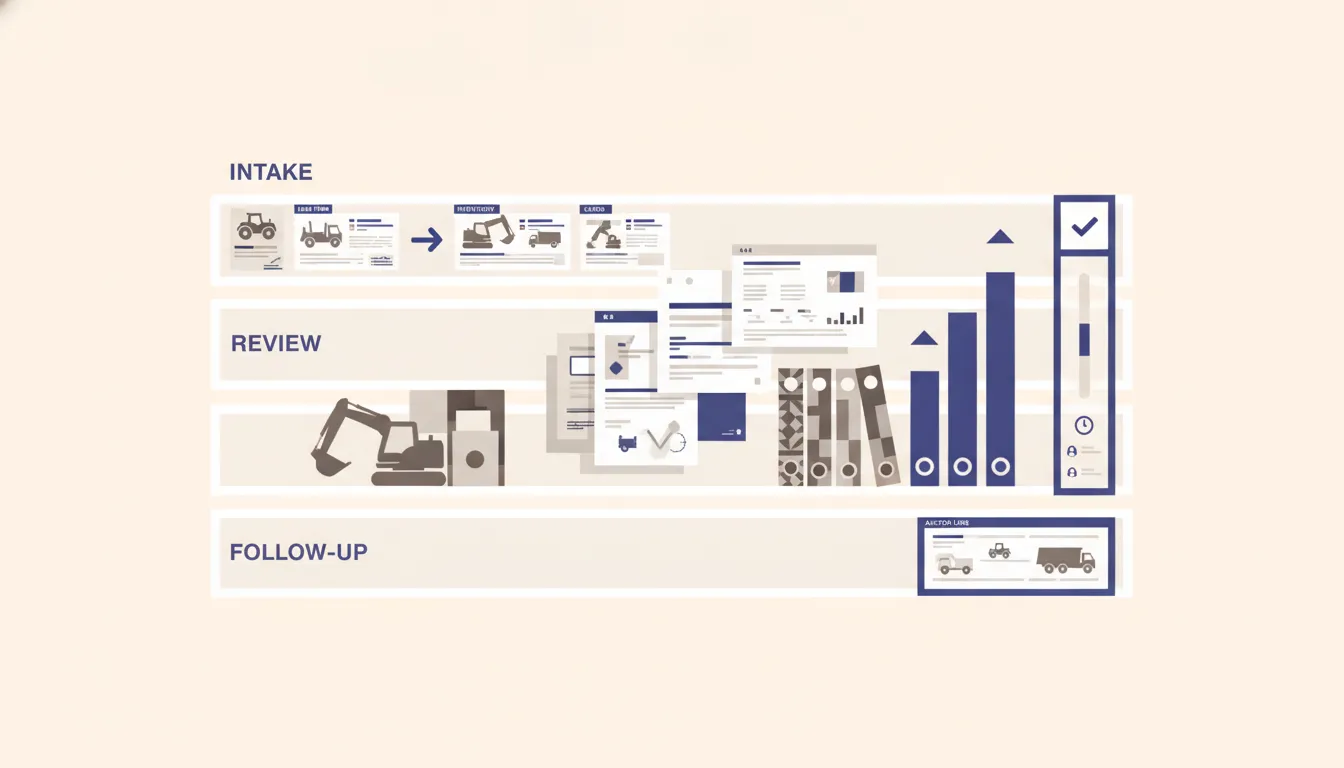
Automated quoting for equipment dealers is not about replacing the rep who knows the machine.
It is about replacing the waiting, retyping, hunting, and second-guessing that happens before that rep can send a clean quote.
That matters because equipment quotes rarely live in one tidy system. The request may start in email, a web form, a phone note, a CRM task, or a text from a field rep. The answer may depend on model specs, options, attachments, freight, availability, financing notes, discount limits, trade constraints, and manager approval. A quote generator that skips those controls is not automation. It is a faster way to create a margin problem.
I have seen the before-state on dealer builds plenty of times: spreadsheets, whiteboards, word of mouth, and stuff like that. That is the operating pattern automated quoting has to fix. Not the spreadsheet as a file. The real problem is that no one can tell which request is ready, which quote is waiting on specs, and which discount needs approval.
Our Backlot build is grounded in the same audience: an AI operations assistant install for US equipment and machinery dealers. Each dealer picks their worst three modules from intake automation, daily ops brief, quote and document generation, system glue, and inbound triage. That is the right frame for quote automation. Quoting is not a standalone writer. It is one module inside the way the dealership receives demand, checks reality, and follows up.
Start with the quote desk, not the model
The first mistake is asking, "Can AI write our quotes?"
The better question is, "What does a clean quote need to know before a rep is allowed to send it?"
For an equipment dealer, that answer usually includes:
- Customer and account status.
- Machine type, model, year, usage, or application.
- Required attachments, options, parts, or service scope.
- Availability or lead time.
- Freight, setup, delivery, and installation rules.
- Financing or payment assumptions.
- Discount threshold and gross margin check.
- Approval owner for exceptions.
- Expiration date and next follow-up step.
That list is why automated quoting belongs next to business process automation, not next to generic copywriting. The quote is the output. The system underneath it is intake, data lookup, rule checks, approval routing, and proof. NIST's AI Risk Management Framework is useful here because it frames trustworthy AI around governance, mapping, measurement, and management, not just model output.
A useful first build does not need to touch every quote type. Pick one lane where the rules are repeatable and the delay is expensive. Repeat parts quotes, standard service packages, attachment bundles, and rental add-ons are often better first targets than complex custom machine configurations.
My own delivery pattern supports that phased approach. On a scoped build, I knock out the first automation, then use a three-month retainer to build at least three agents a month. That is how quote automation should grow: one controlled lane first, then the next lane after the team trusts the first one.
Map the quote inputs before writing prompts
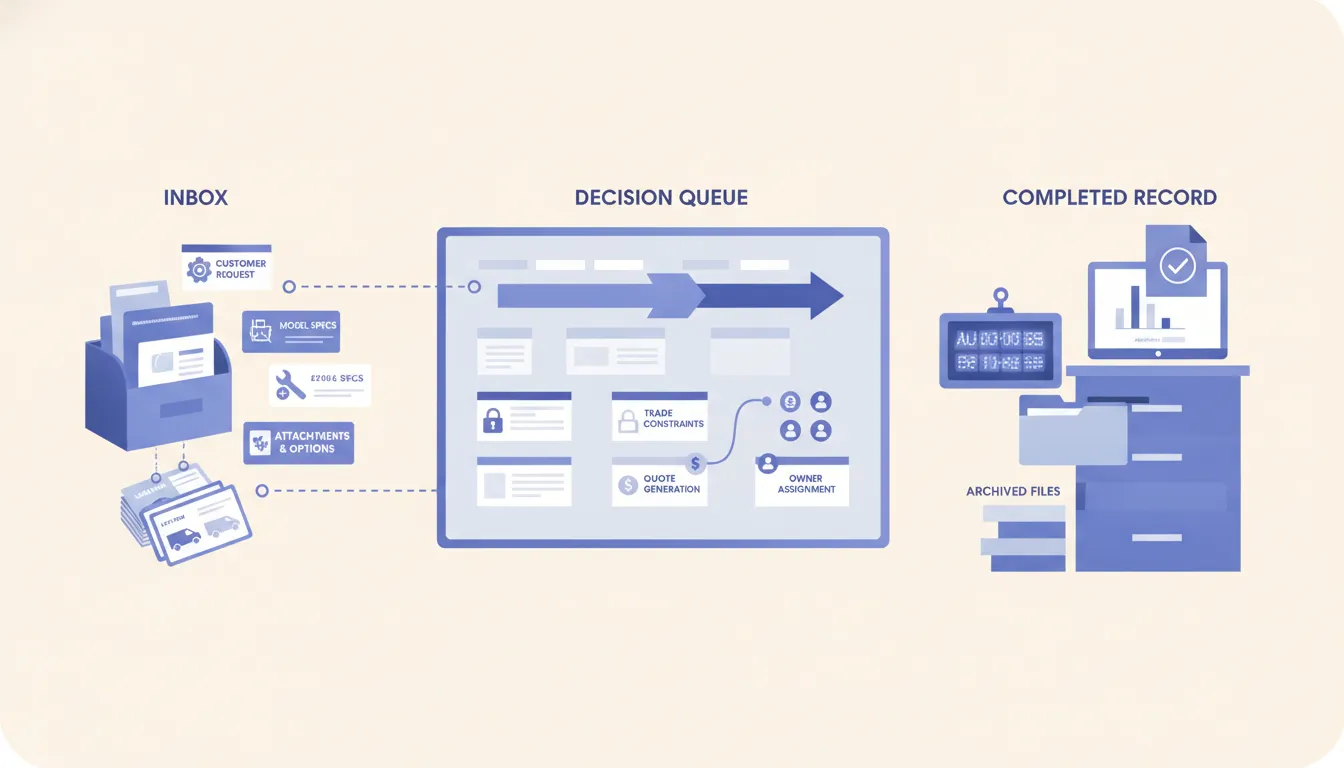
A quote workflow fails when the AI is asked to guess what the dealership never mapped.
Before drafting, define the quote intake record. The intake record should collect the fields a salesperson would normally hunt across inboxes, notes, PDFs, spreadsheets, and legacy systems. It should also show which fields are required, which fields can be inferred, and which fields block the quote.
On a recent equipment quoting build, the interface was AI-assisted quoting where a rep describes a job in natural language. That is a good interface, but only if the natural-language request is converted into structured fields before it becomes a customer quote.
A rep should be able to write something like:
Customer needs a compact excavator package for utility trenching, wants hydraulic thumb, delivery to the south yard, and asked if we can include a service kit.
The automation should not just turn that sentence into prettier sales copy. It should extract the machine class, attachment request, delivery note, add-on request, and missing fields. Then it should ask for what it does not know.
That is where business process architecture matters. The quote workflow needs to know which system owns each field. CRM may own account status. Inventory may own availability. Accounting may own credit terms. A pricing sheet may own base rates. A manager approval table may own discount limits. If those records disagree, the automation should flag the conflict instead of hiding it. ISO 8000 frames data quality around whether data is fit for use, which is the exact standard a quote desk needs before a number leaves the building.
Keep margin guardrails visible
Fast quoting is only good when the dealer can still defend the number.
That means automated quoting should show its work:
- Which source record supplied the base price.
- Which option or attachment rules were applied.
- Which freight or delivery assumption was used.
- Which discount threshold was checked.
- Which margin rule passed or failed.
- Which approval owner is required.
This is where an operator-focused system differs from a document generator. A document generator gives the rep a nice PDF. An operator system gives the rep a quote draft plus the reason it is safe to send.
The ownership principle behind this is one I do not bend on: everything runs on the VPS you own, all code, all data. Credentials stay on your server. No lock-in, no recurring fees back to me, open source tools throughout. For quote automation, the same idea applies at the business level. The dealer should own the rules, the data, the approval trail, and the final decision.
The AI can draft. It can assemble fields. It can compare a request against quote rules. It can mark a quote as ready for review. It should not silently invent a price, hide a source conflict, or send a quote that skipped approval.
Build the approval lane before the customer email
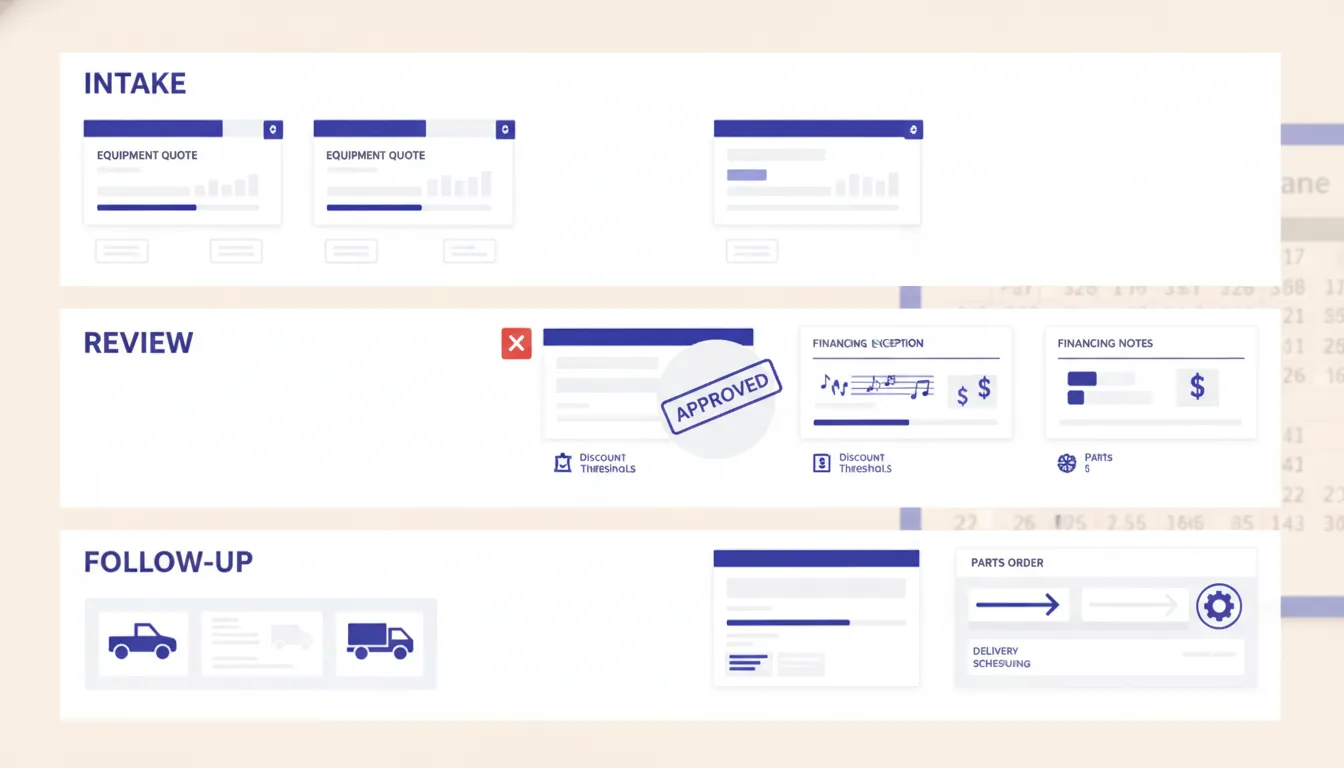
The fastest path to a bad quote is a system that only cares about speed.
Approval lanes protect the dealership from predictable misses:
- Discount exceeds the rep's threshold.
- Requested attachment is unavailable.
- Delivery distance changes freight assumptions.
- Customer terms require finance review.
- Trade condition affects the final number.
- Parts availability changed after the first draft.
- Quote is older than the allowed window.
A good quote automation system routes those exceptions before the customer sees the number. It can send the standard quote to the rep, the margin exception to the manager, and the credit exception to finance. The important part is that the automation names the owner and records the decision. NIST SP 800-53 is a security control catalog, but the operating lesson travels well: approval, auditability, and accountability need to be designed into systems instead of added after something goes wrong.
That is why this workflow should borrow from workflow management for operators. Every quote needs a current state: intake incomplete, ready to draft, waiting on manager, waiting on finance, ready to send, sent, followed up, won, lost, or expired. Without states, the dealership just creates a faster inbox.
The same logic connects to report automation. Once quote states are real, the dealer can review aging quotes, approval bottlenecks, lost reasons, and rep follow-up without another manual spreadsheet.
What the first version should do
The first version should be boring enough to trust.
It should:
- Capture the request in a structured intake record.
- Extract fields from emails, notes, forms, or rep descriptions.
- Pull known customer and account context.
- Check the selected quote lane against documented rules.
- Draft the quote in the dealer's approved format.
- Display source fields, missing fields, and exceptions.
- Route approval when the quote crosses a threshold.
- Save the final quote and follow-up task back to the system of record.
That is also where AI agent workflow for operators fits. The agent is not trusted because it sounds confident. It is trusted because it has a narrow job, a source-of-truth map, approval gates, and proof of work.
For dealers with older systems, the quote workflow may sit around the existing stack instead of replacing it. That is usually the right starting point. Legacy system modernization does not always mean ripping out the system. Sometimes it means adding a controlled layer that reads the old records, writes back clean outputs, and gives managers the approval trail they were missing.
When this is not worth automating
Do not hire us for automated quoting if leadership will not name the pricing owner, document the approval thresholds, or decide which system wins when records disagree.
It is also not worth automating if the only problem is that one senior rep writes quotes slowly because every deal is a one-off engineering decision. In that case, the first project should be knowledge capture, quote standards, and approval rules. Automation comes after the operating model exists.
A quote system can make a good desk faster. It can make a messy desk more visible. It cannot fix a dealership that refuses to decide who owns price, margin, and approval.
The operator test
Before building automated quoting, ask five questions:
- Which quote lane repeats often enough to matter?
- Which fields are required before a quote can be drafted?
- Which systems own price, availability, customer status, and approval?
- Which exceptions block customer delivery?
- What proof should a manager see before trusting the workflow?
If those answers are clear, the first version can be narrow and useful. If they are not clear, start with a quote-desk map.
Our equipment dealer automation page frames the outcome simply: specs in, real-data quote out, no rep retyping. The path to that outcome is not a giant AI rewrite of the sales process. It is a controlled quote workflow with source records, owner decisions, approval gates, and visible proof.
If you want to find the first quote lane worth fixing, run the AI Operations X-Ray. It is built to identify the handoff where automation is useful before anyone starts wiring systems together.
FAQ
Frequently asked questions
01What is automated quoting for equipment dealers?
Automated quoting for equipment dealers is a controlled workflow that turns request details, equipment specs, attachments, price rules, and approval thresholds into a draft quote that a human can review before it goes to the customer.
02Should quote automation send prices without a salesperson?
No. The safer first build drafts the quote, explains the source data, flags margin or availability issues, and routes the quote to the right owner for approval.
03Where should an equipment dealer start?
Start with the quote type that already has repeatable rules and painful delays, such as repeat parts quotes, rental add-ons, standard attachments, or common service packages.
04When is quoting not worth automating?
It is not worth automating when every quote is a one-off engineering decision, pricing is not documented anywhere, or leadership is not willing to name who owns approvals.