Field note
Jun 19, 2026
Why CPQ software doesn't fit equipment dealers
CPQ software usually fails equipment dealers when it treats quoting like product configuration instead of a messy operating workflow.

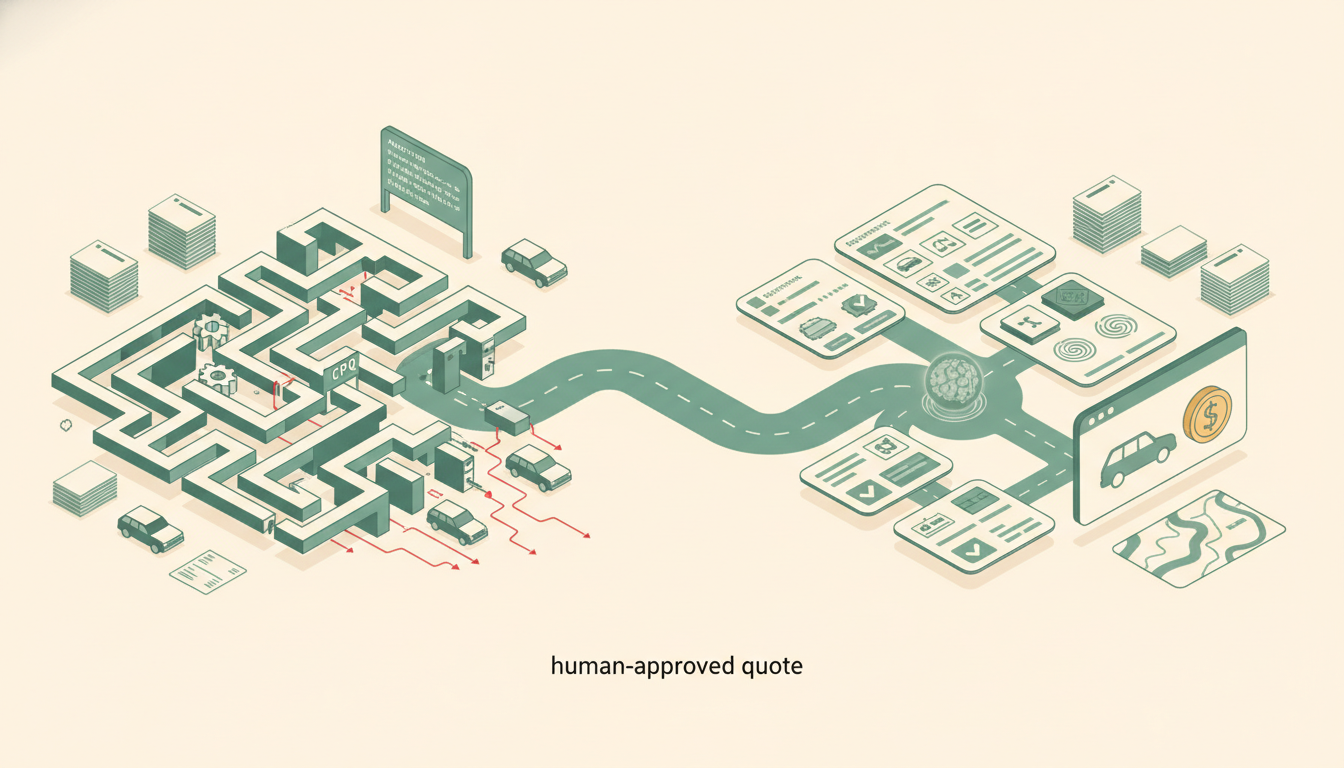
CPQ software doesn't fit many equipment dealers because the dealership is not really trying to configure a product.
It is trying to decide whether a quote is safe to send.
That is a different job.
A standard CPQ frame works best when the business can describe clean products, valid options, pricing rules, discount limits, and approval paths ahead of time. That can be useful for a narrow catalog. It breaks down when the dealer's quote depends on a used machine condition, an attachment question, a delivery constraint, a service add-on, a financing note, or a manager who knows why this account gets a different answer.
I have seen the before-state on dealer builds plenty of times: spreadsheets, whiteboards, word of mouth, and stuff like that. That is the real problem. The dealership is not missing a prettier configurator. It is missing a visible operating lane that shows what is known, what is missing, who owns the exception, and what proof exists before the number goes out.
Our Backlot build is made for that audience: US equipment, machinery, and trailer dealers with 5 to 100 staff. It covers five possible modules, and each dealer picks the worst three: intake automation, daily ops brief, quote and document generation, system glue, and inbound triage. That is the right frame for CPQ decisions. Quote generation is one module inside the operating system, not the whole system.
CPQ assumes the quote is mostly known
CPQ means configure, price, quote. The premise is that the configuration path can be expressed as rules: if the customer selects this product, these options are valid, this price applies, and this approval is required. Salesforce describes CPQ around accurate pricing and quote generation for configured products. That is not a bad category. It is just often the wrong first category for an equipment dealer.
An equipment dealer quote might begin with a vague request:
Customer needs a compact machine for a utility job, wants a hydraulic thumb, might need delivery, asked about financing, and wants the quote today.
A CPQ screen wants the rep to pick valid options. The dealer first needs to know whether the request has enough information to become a quote at all.
That difference matters because the quote desk has to check:
- Which machine or attachment is actually available.
- Whether the request matches a new unit, a used unit, rental inventory, parts, or a service package.
- Which source owns price, cost, freight, and delivery assumptions.
- Whether the account needs finance review.
- Whether the discount or margin needs manager approval.
- Whether the rep is quoting a package the dealership can actually fulfill.
That is why the first move usually belongs under business process automation, not a CPQ replacement project. The quote is the output. The system underneath it is intake, source lookup, exception handling, approval routing, and proof. The NIST AI Risk Management Framework is useful here because it frames AI work around governance, mapping, measurement, and management instead of model output alone.
The mismatch shows up at the edges
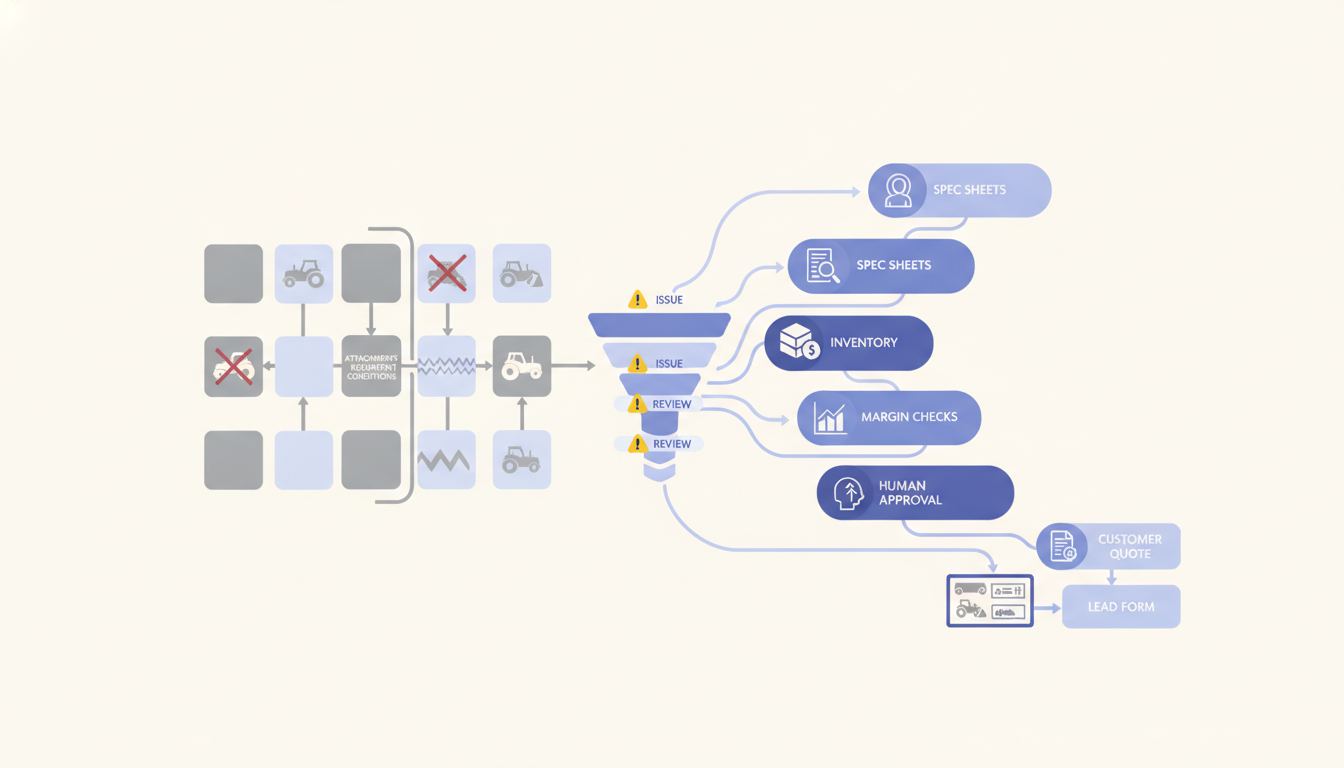
CPQ feels attractive because it promises standardization. The problem is that equipment dealer quoting often becomes valuable exactly where standardization gets uncomfortable.
The mismatch shows up in four places.
First, the request is incomplete. A web form, phone note, email, or field rep message rarely arrives with every field the configurator wants. The system has to ask for missing facts instead of guessing.
Second, the source records disagree. CRM may know the customer. Inventory may know availability. Accounting may know terms. A spreadsheet may know a price rule. A manager may know the exception. Business process architecture matters here because the quote workflow needs a source-of-truth map before it needs a product tree. ISO 8000 frames data quality around whether data is fit for use, which is the standard a quote desk needs before a price leaves the building.
Third, the approval is contextual. A discount threshold is not just a number. It may depend on a stale unit, a strategic account, freight assumptions, or a service bundle. A rigid CPQ gate can block the wrong deals or let the wrong deals through if the dealership never mapped the exception logic.
Fourth, the follow-up lives outside the quote. A sent quote still needs a task, a follow-up date, a status, and a reason if it stalls. Workflow management for operators is the missing layer when the quote gets generated but no one owns the next state.
I have watched the same cadence problem play out. In one manual environment, 20 accounts with zero automation got checked only once or twice a day. With automation, the same process can run four or five times a day with around the clock monitoring. The lesson is not that every dealer quote should run constantly. The lesson is that operating cadence improves when the system owns the handoff instead of waiting for someone to remember the queue.
Build the quote lane before buying the configurator
A better first version is not a giant CPQ project. It is a quote lane.
A quote lane says:
- This is the quote type we are fixing first.
- These fields are required before a quote can be drafted.
- These systems are allowed to supply facts.
- These exceptions block customer delivery.
- These approvals are required before send.
- This is where the final quote and follow-up task are stored.
That is the operating model behind automated quoting for equipment dealers. The automation should draft the quote, show the fields it used, flag missing information, and route exceptions to the right owner.
It should not silently invent a price. It should not hide a source conflict. It should not email the customer because the model sounded confident.
The ownership principle behind this is one I do not bend on: everything runs on the VPS you own, all code, all data. Credentials stay on your server. No lock-in, no recurring fees back to me, open source tools throughout. For quoting, the same principle applies at the business layer. The dealer should own the rules, the source records, the approval trail, and the final send decision.
What to automate instead of CPQ first
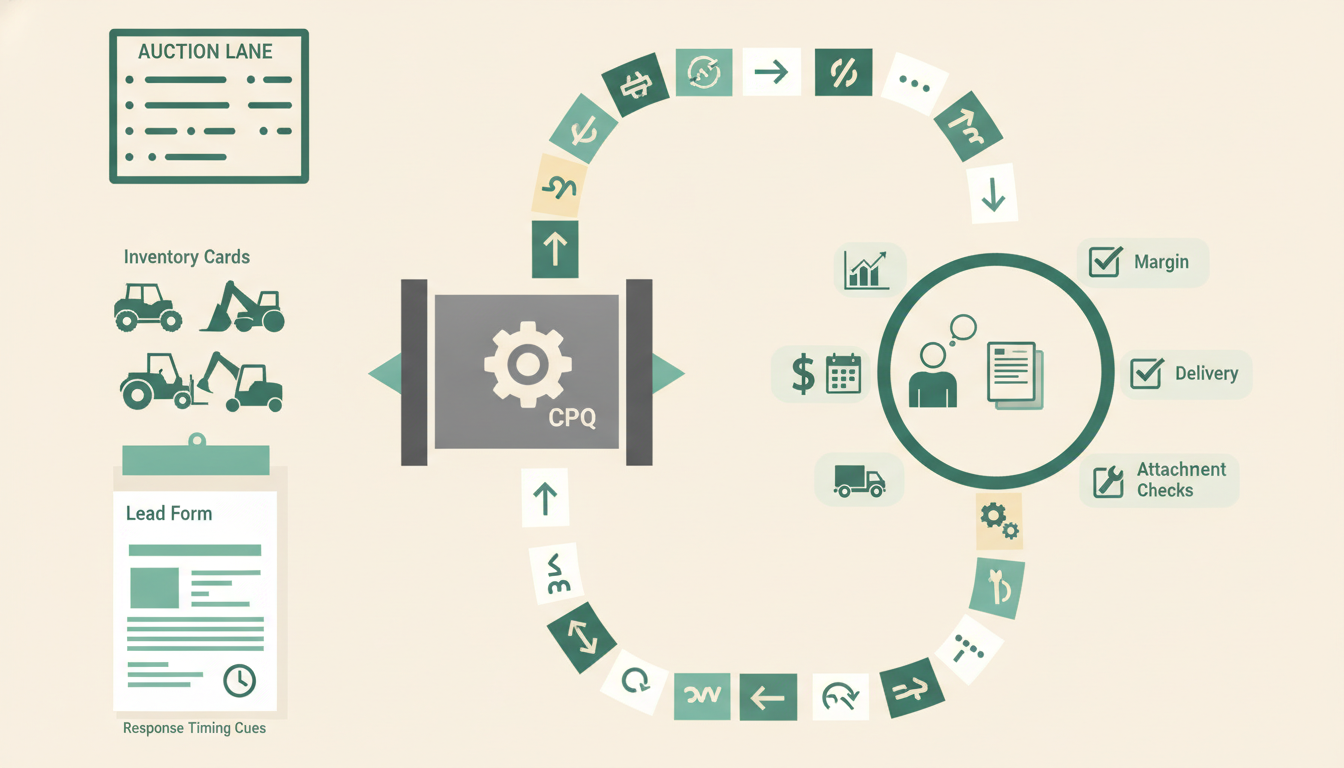
Before a dealer buys or rebuilds CPQ, automate the boring controls around the quote desk.
Start with intake. Every request should become a structured record with required fields, optional fields, attachments, customer context, and a current owner. If the request arrives by email or form, the automation can extract the obvious facts and ask for the missing ones.
Then connect source checks. The workflow should look up the records the team already uses: CRM, inventory, pricing sheet, service package, financing note, delivery zone, or legacy export. If the site still depends on older systems, legacy system modernization can mean wrapping those systems with a controlled workflow before anyone replaces them.
Next, define approval rules. The approval lane should name who reviews margin exceptions, financing exceptions, delivery exceptions, attachment mismatches, and quote age. The manager should see why the quote is blocked, not just receive another vague message.
Finally, store the proof. The quote record should keep the source fields, exception notes, approval decision, sent version, follow-up task, and outcome. That proof is what turns quote automation into an operating system instead of another document generator.
This is where AI agent workflow for operators fits. The agent should have a narrow job, a source-of-truth map, approval gates, and proof. It should not become an invisible rep that sends numbers without supervision.
When not to hire us for CPQ automation
Do not hire us for CPQ automation if the team has not named a pricing owner, documented approval thresholds, or decided which system wins when records disagree.
Do not hire us if leadership only wants a tool to make messy quote habits look more official. The first project should be quote desk cleanup, source-of-truth mapping, and approval design. Automation comes after the dealership agrees how a safe quote is supposed to move.
When CPQ does fit
CPQ can fit after the dealer has done the operating work.
It is a reasonable option when a quote lane has repeatable products, documented option rules, stable pricing, clear discount thresholds, and known approval paths. It can also help when the dealership wants reps to stop improvising packages that should already be standardized.
The warning is sequence. If the dealership cannot answer who owns price, which system wins when records disagree, and which exceptions require approval, CPQ will not fix the quote desk. It will just encode the confusion into a more expensive screen.
Use CPQ when the lane is ready to be standardized. Use an operator workflow when the lane still needs visibility, routing, and proof.
The operator test
Before buying CPQ, ask seven questions:
- Which quote lane repeats often enough to standardize?
- Which fields are required before a quote can be drafted?
- Which system owns customer status, inventory, price, cost, freight, and terms?
- Which exceptions block customer delivery?
- Who approves margin, financing, attachment, and delivery exceptions?
- Where does the final quote and follow-up task live?
- What proof should a manager see before trusting the workflow?
If those answers are clear, CPQ may help. If those answers are not clear, start with the operating lane.
Our equipment dealer automation page frames the outcome simply: specs in, real-data quote out, no rep retyping. The path to that outcome is not a bigger configurator first. It is a controlled quote workflow with source records, approval gates, human ownership, and visible proof.
If you want to find the first lane worth fixing, run the AI Operations X-Ray. It is built to identify the handoff where automation will help before anyone buys another tool.
FAQ
Frequently asked questions
01Why doesn't CPQ software fit equipment dealers?
CPQ software often assumes clean products, stable options, and complete pricing rules. Equipment dealers usually quote across inventory, attachments, service scope, delivery, financing, and exceptions that need human approval.
02Should equipment dealers avoid CPQ completely?
No. CPQ can work for narrow, repeatable quote lanes. It is risky when the dealer uses it to force messy equipment deals into a rigid product configuration model.
03What should equipment dealers build before CPQ?
Start with a quote workflow that captures required fields, checks source records, flags exceptions, routes approval, and stores proof before the customer receives the quote.
04When is CPQ worth revisiting?
Revisit CPQ after the dealer has documented quote lanes, pricing owners, approval thresholds, and system-of-record rules for the quote types it wants to standardize.