Field note
Updated Sep 30, 2026
Used car dealer management software: what to fix first
Used car dealer management software should be the record you trust for vehicles, deals and finance. Here is what to fix around your DMS before replacing it.


Used car dealer management software, usually called a DMS, should be the one record your store trusts for vehicles, deals and finance. Before you replace it, fix the handoffs around it: who owns each lead, trade-in and finance step, and who sees it when work goes stale. A dealership management system should be the place a dealer trusts, not another screen that hides who owns the next action.
That is the real problem.
Most independent dealers do not wake up asking for a new software category. They wake up with a customer asking if a car is still available, a trade-in lead that needs a real owner, a finance question sitting in the wrong inbox, a recon update that did not reach sales, and a manager trying to figure out which deal is actually ready to move.
For independent used-car dealers, I think the dealership management system should be treated as the system of record where it is strong, then wrapped with an operating layer where the store leaks time, speed, and accountability.
I have seen this in dealer-adjacent workflow work where the before state was spreadsheets, whiteboards, word-of-mouth, and people remembering where a vehicle or customer stood. I have also seen DMS and CRM stacks where one platform owned the record, another tool owned messaging, another owned shop work, and finance lived in its own lane. The hard part was not adding another automation. The hard part was making sure the store knew which system to trust.
On one build, a sync ran every six hours and took about three hours. That forced the real operating question: what can safely move on a schedule, what needs a human, and how does the store know when the record is stale?
My rule is simple: keep the record stable, but make the work visible.
Start with the lane that leaks revenue
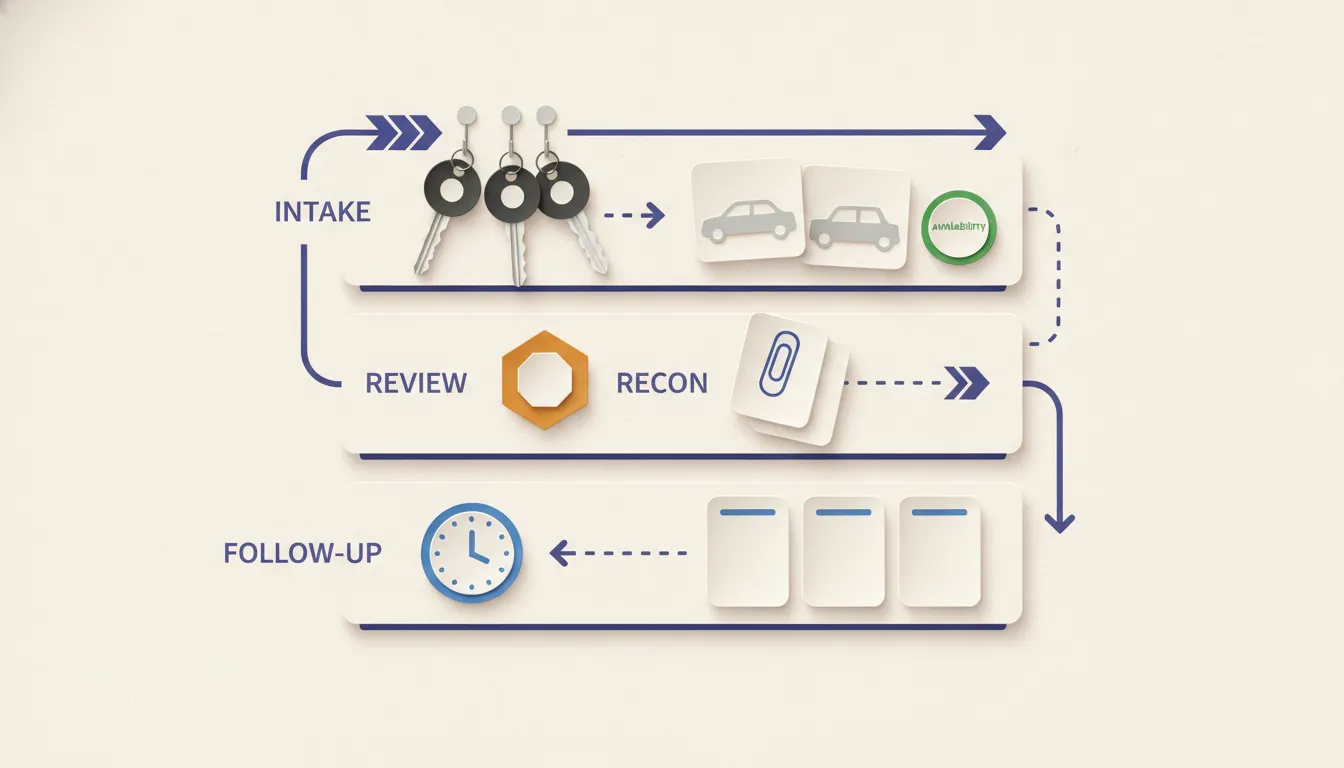
A dealership management system can touch inventory, CRM, accounting, F&I, desking, documents, vendor feeds, and reporting.
That breadth is useful, but it also creates a buying trap. When every problem gets labeled as a DMS problem, the store starts shopping for a platform before it has named the lane that is actually broken.
I would start narrower.
For an independent lot, the first questions are usually:
- Are incoming leads assigned to a real owner fast enough?
- Does sales know whether the vehicle is available, held, sold, in recon, or not ready?
- Does the trade-in request have a buyer, manager, or appraisal owner?
- Does finance know which customer needs which document next?
- Does the team know when a customer has gone stale?
- Does anyone review exceptions before they become lost deals?
That is why used-car lead response is often the cleanest first control. The first response window is where interest is fresh and accountability is easy to measure. If the store cannot prove who received the lead, what vehicle it mapped to, and who owns the next step, a bigger platform will not fix the process.
The FTC Used Car Rule is a good reminder that vehicle sales are not just a speed problem. Dealers also need clear records, disclosures, and customer-facing accuracy. The operating layer has to respect that. Fast follow-up that pulls from stale inventory, missing consent, or unclear finance status creates a new risk instead of solving the old one.
The first build should answer a practical question every time: what happened, where is the source of truth, who owns it now, and what happens if nobody touches it?
Do not confuse the DMS with the daily operating layer
A dealership management system is usually the official record.
That does not mean it is the best place for every daily action.
The DMS might own the vehicle, customer, deal jacket, finance status, and accounting handoff. The sales team might live in SMS, email, phone, marketplace leads, and a CRM view. The recon team might live in a shop system. The manager might live in a spreadsheet because it is the only place that shows the day clearly.
That is where business process automation fits. I do not want to replace the record just because the work is messy. I want to map the work around the record so every handoff is visible.
For example:
- The DMS owns vehicle and deal records.
- The lead source owns the original inquiry.
- The messaging tool owns customer conversation history.
- The shop or recon system owns readiness.
- The finance workflow owns application status and missing documents.
- The operating layer owns the queue, exceptions, stale items, and manager visibility.
The control point is not the software logo. The control point is the handoff.
If a customer asks about a vehicle that is still in recon, the automation should not confidently promise availability. It should check the record, show the uncertainty, and route the lead to the right owner. If a trade-in form comes in, the automation should not bury it inside a generic CRM task. It should identify the customer, vehicle, appraisal owner, and follow-up window.
That is also why I am careful with AI inside dealership operations. AI can classify, summarize, draft, and flag. It should not silently decide price, credit, compliance, or customer commitments without a named human in the lane.
I use the same boundary for equipment quote preparation and human review: approved rates can supply the draft, but the customer commitment still needs an owner.
Put finance and compliance exceptions in front of people
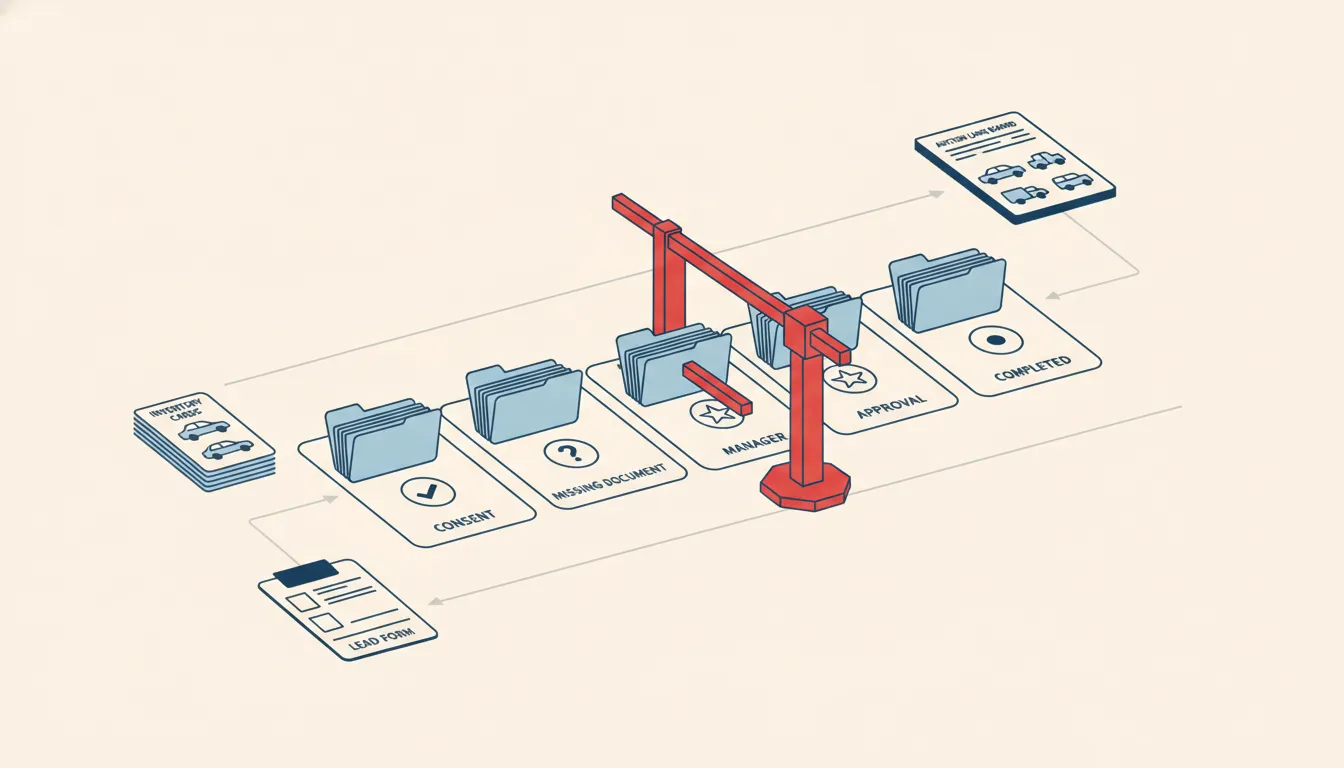
A DMS replacement conversation often sounds technical.
The real risk is operational.
A deal can look alive in one place and blocked in another. The customer thinks finance is moving. Sales thinks F&I has it. F&I is waiting on a document. A manager thinks the appointment is confirmed. The actual next step is stuck because no one owns the exception.
I like building exception queues before building big replacements.
A useful dealership management system layer should flag:
- Lead with no owner after a short response window.
- Vehicle inquiry where availability is uncertain.
- Trade-in request with no appraisal owner.
- Finance customer missing required documents.
- Deal with no recent customer touch.
- Sold or held vehicle still appearing in active follow-up.
- Customer message that needs a human compliance or pricing decision.
The CFPB Regulation B overview is another reminder that credit workflows carry compliance weight. The point is not to turn the blog into legal advice. The point is that finance handoffs should not be hidden inside loose tasks, half-updated fields, or private inboxes.
The same idea applies to vehicle records. The NHTSA odometer fraud guidance is a reminder that vehicle facts and customer-facing records need disciplined handling, not casual copying between tools.
For dealer sales teams, BDC replacement should not mean removing humans from the process. It should mean using automation to prepare the lane so the right human can act faster with better context.
That matters most when the customer is asking a buying question, a finance question, or a trade-in question. Those are not generic messages. Those are revenue moments with risk attached.
Build around your independent dealer DMS before replacing it
I do not like replacement projects that start with a software shortlist.
I like starting with a control map.
Before replacing a dealership management system, I would want the store to answer:
- Which records must the DMS own no matter what?
- Which daily actions are not visible enough today?
- Which handoffs are causing lost deals or rework?
- Which systems have APIs, exports, webhooks, or reports you can safely use?
- Which actions need approval before automation can move them?
- Which stale or exception states should a manager see every morning?
Sometimes the answer is replacement. A bad record system can limit the store. But a lot of independent dealers do not need a giant migration first. They need a layer that connects lead sources, vehicle status, customer messaging, finance tasks, and manager review without pretending every vendor will play nicely.
That is why I care about owned, inspectable systems. If the DMS has no useful API, the operating design has to admit that. If a shop tool has webhooks, use them. If a report export is the safest bridge, build around the schedule and its failure modes, the way my note on DMS integration with n8n and a CSV export lays out. If a sync takes hours, show the age of the data before anyone trusts the action.
The goal is not more automation for its own sake. The goal is fewer blind spots.
This is also where AI trade-in valuation connects to the broader DMS problem. A trade-in workflow is only useful if the store knows where the request came from, what vehicle the customer wants, who owns the appraisal, what information is missing, and when the customer needs a response.
When not to automate the dealership management system
There are times I would tell a dealer not to hire me for automation yet.
If the team cannot agree who owns leads, vehicles, finance documents, or stale follow-up, the first step is not worth automating. The store needs a simple owner map first. Automation should not turn unclear responsibility into faster unclear responsibility.
I would also pause if the inventory record is unreliable, if sales is promising vehicles that are not ready, or if managers do not want exception review. In that case, the better first move is a one-week operating cleanup: name the source of truth, remove duplicate work queues, and decide which exceptions need a human before any workflow sends messages or updates records.
My dealership management system scorecard
If I were reviewing a dealership management system setup for an independent lot, I would not start with feature count.
I would score the operating controls:
- Source of truth: can the team name the winning record for vehicle, customer, deal, finance, and recon status?
- Ownership: does every lead, trade-in, finance item, and stale follow-up have a named owner?
- Speed: can the store prove first response time without hunting across inboxes?
- Visibility: can a manager see blocked deals and stale items without logging into five tools?
- Exceptions: does the system slow down when inventory, consent, finance, or pricing is uncertain?
- Integration reality: does each tool have an API, webhook, export, report, or manual fallback that the store can actually maintain?
- Human approval: are pricing, credit, compliance, and customer commitments still owned by a real person?
That scorecard keeps the conversation honest.
A dealership management system should not become a black box where every workflow disappears. It should be part of an operating system that shows the store what is happening, what is blocked, and who owns the next move.
If the current DMS can support that, keep it and build the missing layer. If it cannot, replace it with a clear map of what the next system must own.
Either way, do not buy software to avoid naming the process.
Name the process first. Then automate the parts of the dealership that need speed, proof, and accountability.
If you want a second look at your current setup, the free AI Operations X-Ray shows where the first handoff leaks. My used car dealer page, linked just below, covers what I build for independent lots.
FAQ
Frequently asked questions
01What is a dealership management system?
A dealership management system is the core operating software a dealer uses to manage inventory, deals, customer records, finance workflows, accounting handoffs, and daily store activity.
02Should an independent dealer replace its DMS first?
Usually no. If the store is losing leads, misrouting trade-ins, or chasing finance handoffs, fix the operating lane around the current DMS before replacing the system of record.
03What should a dealer automate around the DMS first?
Start with the lane that leaks revenue fastest: new lead response, inventory availability checks, trade-in owner assignment, finance document status, missed-call follow-up, or stale deal review.
04Can AI run a dealership management workflow?
AI can classify leads, summarize context, check fields, draft responses, and flag exceptions, but a named human should still own pricing, compliance, finance, and final customer commitments.
05What is the best DMS for independent dealers?
I do not pick a brand first. The right DMS for independent dealers is the one that keeps vehicle, deal and finance records reliable and lets you get the data out through an API, a webhook or a scheduled report. If your current system does that, build around it before you shop.