Field note
Updated Sep 30, 2026
Legacy software modernization without a big bang
Legacy software modernization works best in small, safe steps. Here is how to find the first boundary to change without a risky big-bang replacement.


Legacy software modernization should remove a business constraint without creating a larger one. The safe way is to change the smallest boundary that blocks real work, not to replace everything at once. That sounds obvious, right up until somebody proposes replacing the database, interface, integrations, reporting, and operating process in one heroic weekend. I have learned to be suspicious of plans that require everyone to be brave at the same time.
I cover this as part of my legacy system modernization work.
On one recent build, I found the same publishing configuration hard-coded across nine scripts. The obvious answer was a broad refactor. The safer answer was smaller: preserve the command and file path every script already expected, then generate that file from one governed source of truth.
Nothing looked dramatic in the final design. That was the point. The team got one place to manage the connection, the existing tools kept working, and the business gained a clean path to replace more later.
My rule is simple: modernize the boundary before you replace the system.
Start with the operating constraint
A legacy system is not automatically bad because it is old. It becomes a business problem when it blocks a required outcome or makes the outcome too fragile to trust.
The useful first question is not, “What platform should replace this?” It is, “What operating promise can this system no longer keep?”
That promise might be:
- Every approved customer change reaches billing before the next invoice.
- Every completed job reaches the CRM with the correct owner and status.
- Every published page uses the approved configuration and credentials.
- Every order can be traced from request through receipt.
- Every manager can see exceptions without asking three people for a spreadsheet.
I map that promise with business process automation before I choose a migration path. The software is only one part of the lane. People, records, approvals, schedules, and recovery steps usually explain why the current setup survived this long.
If the real pain is one unsupported integration, replacing the whole system is probably too much. If the database cannot represent the business anymore, an adapter may only delay the necessary move. The boundary tells me which problem I actually have.
Inventory dependencies before changing them
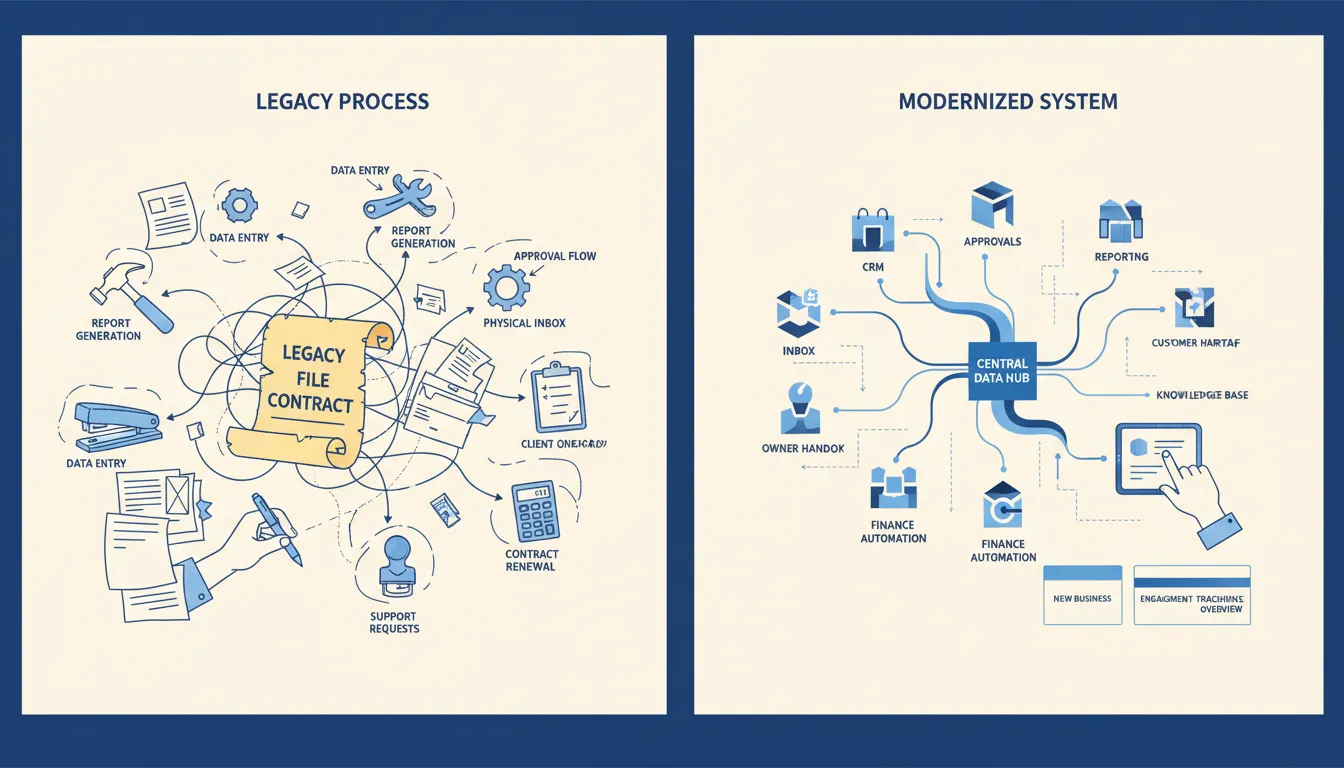
The dangerous part of legacy modernization is rarely the screen everyone complains about. It is the quiet dependency nobody remembered.
I build an inventory around five questions:
- Which records does the system own?
- Which other tools read from it or write to it?
- Which schedules, file paths, credentials, and field names are treated as contracts?
- Which people resolve conflicts when the data disagrees?
- What stops working if this component is unavailable for one business day?
NIST SP 800-53 includes configuration management and system component inventory controls. I use the same practical idea here. If I cannot name the components and their owners, I am not ready to change them.
This is where business process architecture earns its keep. I need more than a diagram of applications. I need to know which record wins, who owns an exception, and what evidence proves a handoff completed.
A useful inventory includes:
| Boundary | What I record | Why it matters |
|---|---|---|
| Data | Authoritative tables, files, fields, and identifiers | Prevents conflicting truths |
| Interface | Forms, exports, APIs, inboxes, and manual entry | Shows how work enters and leaves |
| Automation | Triggers, schedules, retries, and duplicate controls | Exposes hidden operating behavior |
| Authority | Approvers, administrators, and credential owners | Prevents the new path from gaining too much power |
| Recovery | Backups, replay rules, rollback steps, and named responders | Makes failure survivable |
Without this map, a clean new application can still produce dirty outcomes.
Choose a legacy system modernization strategy
I usually see four practical patterns, and the right strategy is the smallest one that removes the constraint.
Wrap the current system
Add an adapter, API layer, controlled import, or new interface around the stable core. This fits when the system still owns useful records but lacks a needed connection or a usable screen for the people doing the work.
The recent nine-script example used this pattern. I did not ask every script to learn a new contract. I kept the existing runtime artifact and changed how it was produced.
Replace one capability
Move one function, such as reporting, intake, search, approval routing, or document generation, while the current system keeps the rest. This fits when the old capability is clearly isolated.
Move one operating lane
Migrate one department, product line, record type, or workflow before expanding. This fits when dependencies are shared but the business can define a bounded cohort.
Replace the core
Move the authoritative data and primary operating logic to a new platform. This is necessary when the current model cannot represent the business, security support has ended, or the system cannot meet continuity requirements.
Microsoft’s Strangler Fig pattern describes gradually replacing specific functions while the old system continues operating. I like the pattern because it turns a migration into a series of testable boundaries instead of one date circled in red.
The pattern is not permission to keep two systems forever. Every temporary layer needs an owner, a retirement condition, and a decision date.
Preserve authority while data moves
Data migration is not just moving rows. It is moving meaning.
A customer status may look like a simple field until one system treats it as billing authority, another uses it for access, and a spreadsheet uses it for weekly reporting. Copying the value does not prove those meanings still match.
Before a cutover, I define:
- The authoritative record for each consequential field.
- The transformation rule between old and new formats.
- The owner for rejected or ambiguous records.
- The evidence required before a migrated record is accepted.
- The rule for edits made during the transition window.
- The rollback point after which the old path becomes read-only.
The membership platform and CRM sync case study shows why this matters. Reconciliation, backfill rules, and source ownership were more important than making the sync run.
I use the same authority-first approach in procurement automation. An automated handoff can prepare and move data, but it should not quietly invent a new approval rule because two records disagree.
Rehearse cutover and recovery together
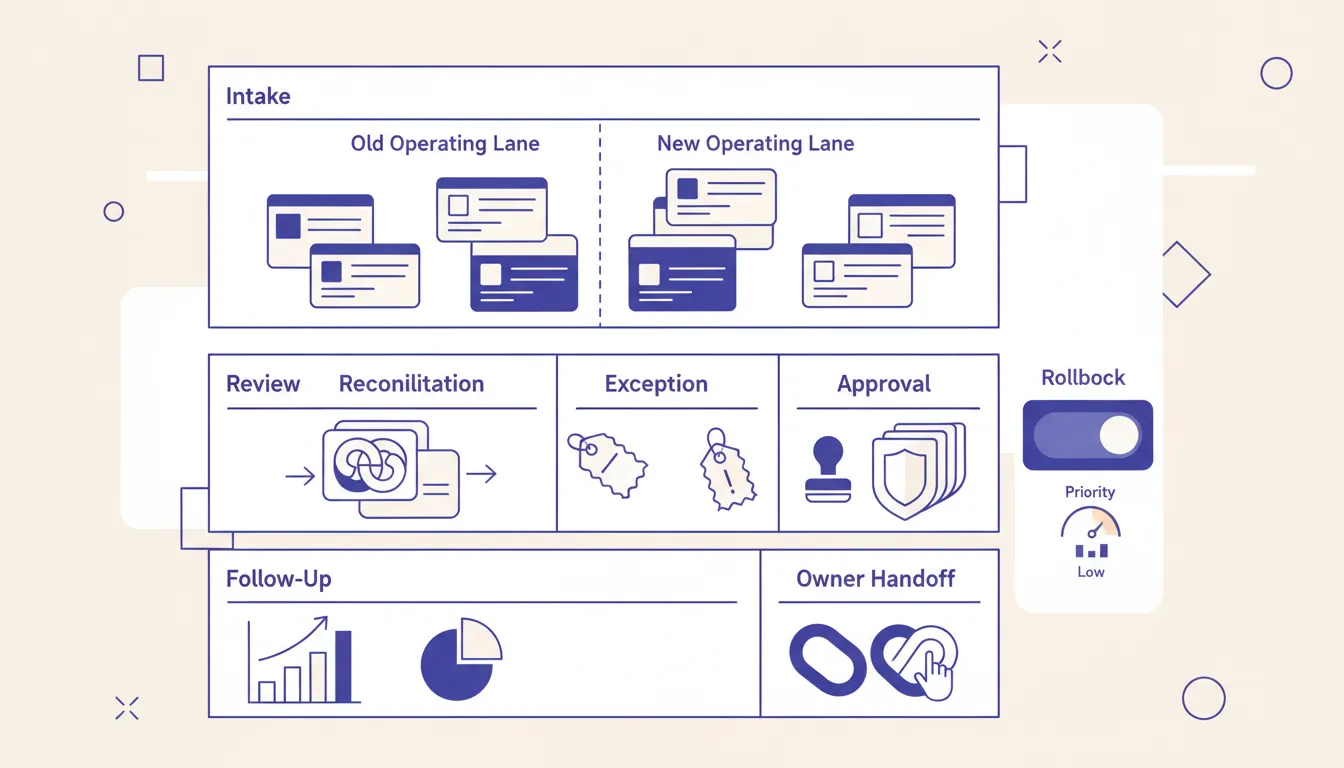
A migration test that only proves the new path works is incomplete. I also want proof that the team can detect failure, stop the path, repair the record, and recover without improvising.
My cutover rehearsal includes:
- A representative set of clean records.
- Missing and malformed inputs.
- Duplicate events and repeated imports.
- Conflicting updates from old and new interfaces.
- A downstream outage during processing.
- A credential or permission failure.
- A partial batch that must resume safely.
- A full rollback to the last accepted state.
I compare business outcomes, not just job status. Record counts should reconcile. Exceptions should have owners. Downstream systems should contain the expected state. Your team should be able to explain what happened without reading code.
The U.S. Government Accountability Office has repeatedly documented the cost and operational exposure around aging critical systems, including in GAO-19-471. The lesson I take is not that every old system needs immediate replacement. It is that critical systems need explicit ownership, risk visibility, and a credible modernization plan.
After launch, day-to-day workflow ownership matters as much as the technical cutover. Somebody must own alerts, exceptions, access, reconciliation, change requests, and the retirement decision for the old path.
When not to hire me for modernization
You do not need me if a supported vendor connector solves the problem, the current platform already has the required feature, or the pain is only cosmetic. Configure what you own and keep the system simple.
You also do not need a modernization project when nobody can name the business constraint. “The software feels old” is not enough. A migration without an operating promise becomes an expensive search for a reason.
A custom modernization layer makes sense when the system holds records the business still needs, replacement risk is high, and one controlled boundary can remove duplicate work, missing visibility, or integration failure.
Questions to answer before you buy
Before buying legacy system modernization services, I want clear answers to these questions:
- Outcome: Which business promise is currently failing?
- Boundary: What is the smallest component or lane that can fix it?
- Source of truth: Which records remain authoritative during the transition?
- Dependencies: Which tools, people, schedules, and files rely on the current contract?
- Authority: What may the new layer read, write, approve, or refuse?
- Reconciliation: How will old and new outputs be compared?
- Recovery: Who can stop, repair, replay, or roll back the change?
- Handoff: Who owns the system, credentials, documentation, and alerts after launch?
- Retirement: What evidence allows the old path to be removed?
If those answers are vague, I do not start with a replacement proposal. I start with legacy system modernization as a boundary exercise: map the operating promise, isolate the constraint, and prove the first safe change.
The best modernization project is not the one with the newest stack. It is the one where the business keeps operating, the records still mean what they meant, and the next change becomes easier instead of scarier.
If you are not sure which boundary to start with, the free AI Operations X-Ray maps the leak first.
More on this: Contract management automation: what to automate first and AI automation companies: how to compare them.
FAQ
Frequently asked questions
01What are legacy system modernization services?
Legacy system modernization services improve an aging or constrained business system through controlled replacement, integration, data migration, or a new operating layer while preserving required records and continuity.
02Does modernization require replacing the whole system?
No. A bounded adapter, new interface, reporting layer, or staged component replacement can remove the immediate constraint without a full migration.
03What should be modernized first?
Start with the boundary causing the clearest operating loss, such as duplicate entry, missing status, unsupported integration, fragile reporting, or an interface that blocks daily work.
04How do you reduce risk during a legacy migration?
Inventory dependencies, name authoritative records, preserve a rollback path, reconcile old and new outputs, and move one operating lane at a time.
05What is a good legacy system modernization strategy?
Pick the smallest boundary that removes a real operating constraint, then choose a pattern: wrap the current system, replace one capability, move one lane, or replace the core. Run old and new paths side by side until records reconcile. Give every temporary layer an owner and a retirement date.
06Is legacy application modernization different from legacy system modernization?
The words overlap. Application modernization usually means updating one program, while system modernization can also cover the data, integrations, and process around it. I scope either one by the business constraint, not by the label.