Field note
Updated Sep 30, 2026
AI automation companies: how to compare them
How to compare AI automation companies: give each the same real problem, then test ownership, approvals, failure recovery, and what you keep after launch.


The best AI automation companies deliver one controlled business result that you can inspect, recover, measure, and own. To compare them, give each the same real problem and judge how it handles failures, approvals, and handoff, not how good the demo looks.
I cover this as part of my business process automation services work.
They look easy to compare when the buying process stays at the demo level. One vendor shows an agent answering questions. Another shows a workflow creating records. A third promises an AI transformation across sales, service, finance, and operations.
The harder question is what happens on an ordinary Tuesday when the input is incomplete, the CRM rejects an update, a customer replies with an exception, or the person who designed the system is unavailable.
That is where I make the buying decision.
I have seen this gap in operations with 20 accounts and no automation. People were manually logging into each account once or twice a day because that was all the schedule allowed. The proposed system could monitor the work four or five times a day and run continuously outside working hours. The value was not the AI label. The value was faster visibility without asking the team to spend the day checking tabs.
But that value would disappear if the system could fail silently, send the wrong action, or lock you behind a vendor ticket. My rule is simple: if I cannot explain how the system stops, recovers, and proves what happened, it is not ready for a real business.
After building more than 500 production-grade workflows, I do not believe the best partner is the one with the longest tool list. The best partner is the one who can turn a messy operating lane into a controlled system that the business can understand and own.
Give every AI automation company the same problem
A broad request such as “help us use AI” creates broad proposals. Vendors fill the empty space with chatbots, agents, dashboards, content systems, and automation ideas. The buyer receives activity instead of a decision.
I start with one operating promise.
Examples include:
- Every qualified inbound request receives an owned next action within 15 minutes.
- Every completed field job has the evidence required for invoicing by the end of the day.
- Every recruiting reply is classified, attached to the correct record, and routed to one owner.
- Every finance exception appears in one review queue before the daily close.
- Every approved quote creates the correct downstream records without duplicate entry.
A promise gives the vendor something real to design around. It also creates a shared comparison. Each company should answer the same questions:
- What event starts the workflow?
- Which system owns the trusted record?
- Who owns the next action?
- Which actions require approval?
- What happens when information is missing?
- How do you prove the final update occurred?
This is the same foundation I use in business process automation. The point is not to automate everything. The point is to close one valuable operating gap without creating a second source of truth.
If a company cannot stay focused on one promise during discovery, I would not trust it with a larger transformation. Scope discipline is an operating control.
Test whether the company understands the workflow before the tools
Weak discovery sounds like a software intake form. Which CRM do you use? Do you have Zapier? Which model do you prefer? Do you want an agent?
Those questions matter later. First, I want to know how the work actually moves.
I ask the people doing the work to show me one recent item from beginning to end. I want to see the email, form, phone note, spreadsheet row, approval, record update, exception, and final proof. I also want the unofficial steps, because the unofficial steps are usually where the operation depends on memory.
The company should be able to map:
- The source of the request.
- The trusted system for each record.
- The human and system handoffs.
- The decision rules.
- The approval boundaries.
- The expected timing.
- The common exceptions.
- The evidence of completion.
That map should look more like a business process architecture than a diagram of vendor logos. Architecture explains ownership and state. A tool diagram only explains connections.
I prefer systems that fit into the software already working. Replacing a CRM, ERP, or line-of-business platform may be necessary, but it should not be the default. My legacy system modernization work starts from the same idea. Often the pain lives in intake, routing, follow-up, reconciliation, or reporting around the record system.
The right proposal tells the buyer which layer is changing and which systems remain authoritative.
Require ownership and a usable handoff
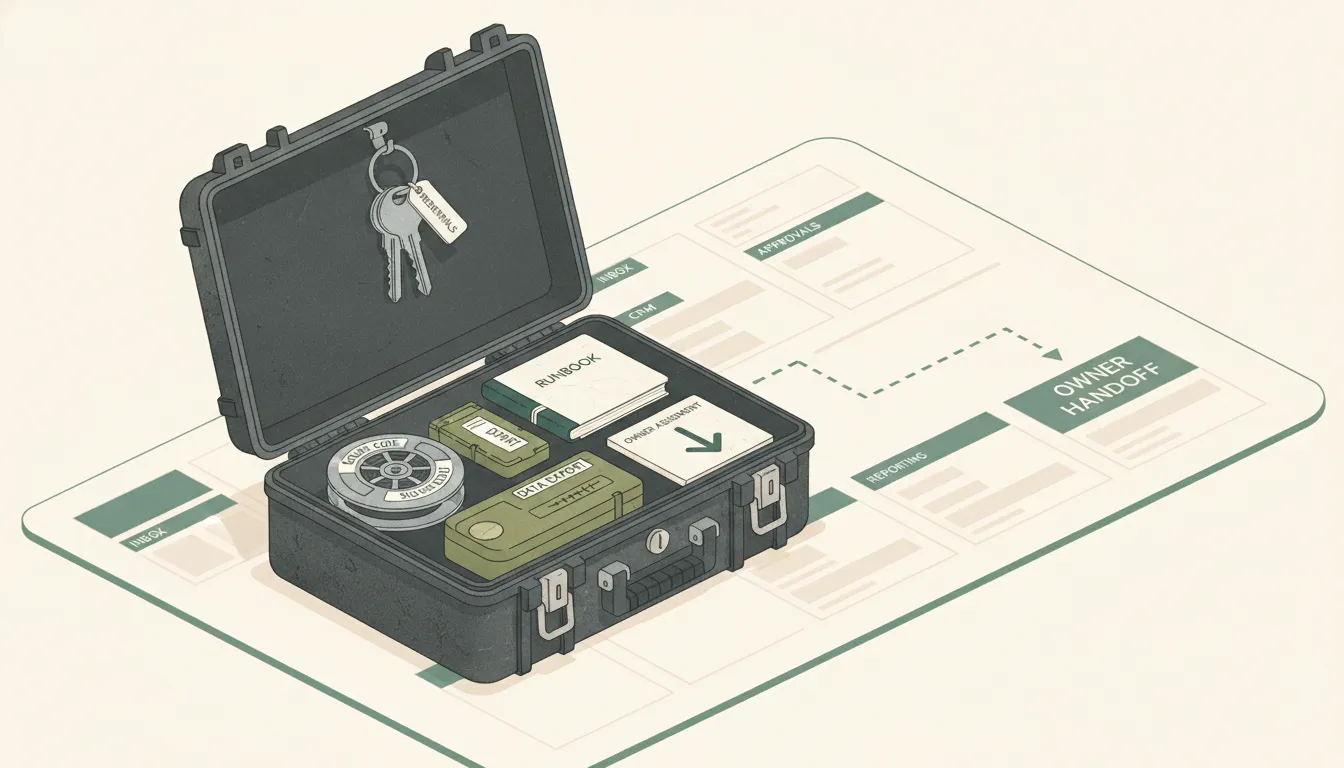
Ownership is not a sentence in the contract. It is a practical operating condition.
I want the buyer to know where the code runs, where data is stored, who controls credentials, how configurations are backed up, and what happens if the vendor relationship ends. All code, data, and credentials should remain under your control where possible. There should be no recurring lock-in back to the builder just to keep ordinary workflows alive.
I also expect a secure development process, not a security review added at the end. The NIST Secure Software Development Framework is a useful baseline for discussing how software is prepared, protected, produced, and reviewed across the lifecycle.
Before signing, ask for a handoff inventory:
- Source code and deployment location.
- Workflow exports and configuration files.
- Data schema and retention rules.
- Credential ownership and rotation process.
- Model, API, and infrastructure accounts.
- Runbook for normal operation.
- Runbook for common failures.
- Change process for business rules.
- Cost controls and usage limits.
- Named owner after launch.
- Export and shutdown procedure.
A company does not need to hand over unfinished assets before payment. It does need to describe the final handoff before work begins.
The difference matters because an AI system can become a black box quickly. It may have impressive capability, but the team has no visibility into what it is doing. I prefer an orchestration layer that makes schedules, decisions, failures, and retries inspectable. That is easier to manage than an invisible process that only the original builder can diagnose.
My AI operating system model uses the same test. The control layer is valuable only when records, approvals, and proof remain visible to the business.
Make approval boundaries explicit
AI automation companies should not answer “human in the loop” with a generic checkbox. The buyer needs to know which human, reviewing what, at which point, with what response time.
I use approvals when the action affects money, safety, customer trust, employment decisions, contractual commitments, or irreversible records. Lower-risk tasks can usually move faster. Extraction, classification, summarization, drafting, and exception detection are strong early uses because the system can prepare the decision surface without hiding the final decision.
The NIST AI Risk Management Framework is useful because it organizes the work around governance, mapping, measurement, and management. That matches how I evaluate an operating system. Risk is not handled once in a kickoff meeting. It is handled through visible rules, measurements, and owners.
For systems using generative models, the NIST Generative AI Profile adds a practical companion for risks that need to be considered across design, development, use, and evaluation.
Ask the vendor to label every action as one of these:
- Observe only.
- Draft for review.
- Act within a fixed rule.
- Act and notify.
- Require approval.
- Stop and escalate.
Then test uncertainty. If a model is unsure, does it guess, retry, ask for missing data, route to a queue, or stop? A vague answer means the approval design is not finished.
The practical sequence in an AI agent workflow is promise, ownership, approval, and proof. The agent comes after those controls, not before them.
Run a failure drill before launch
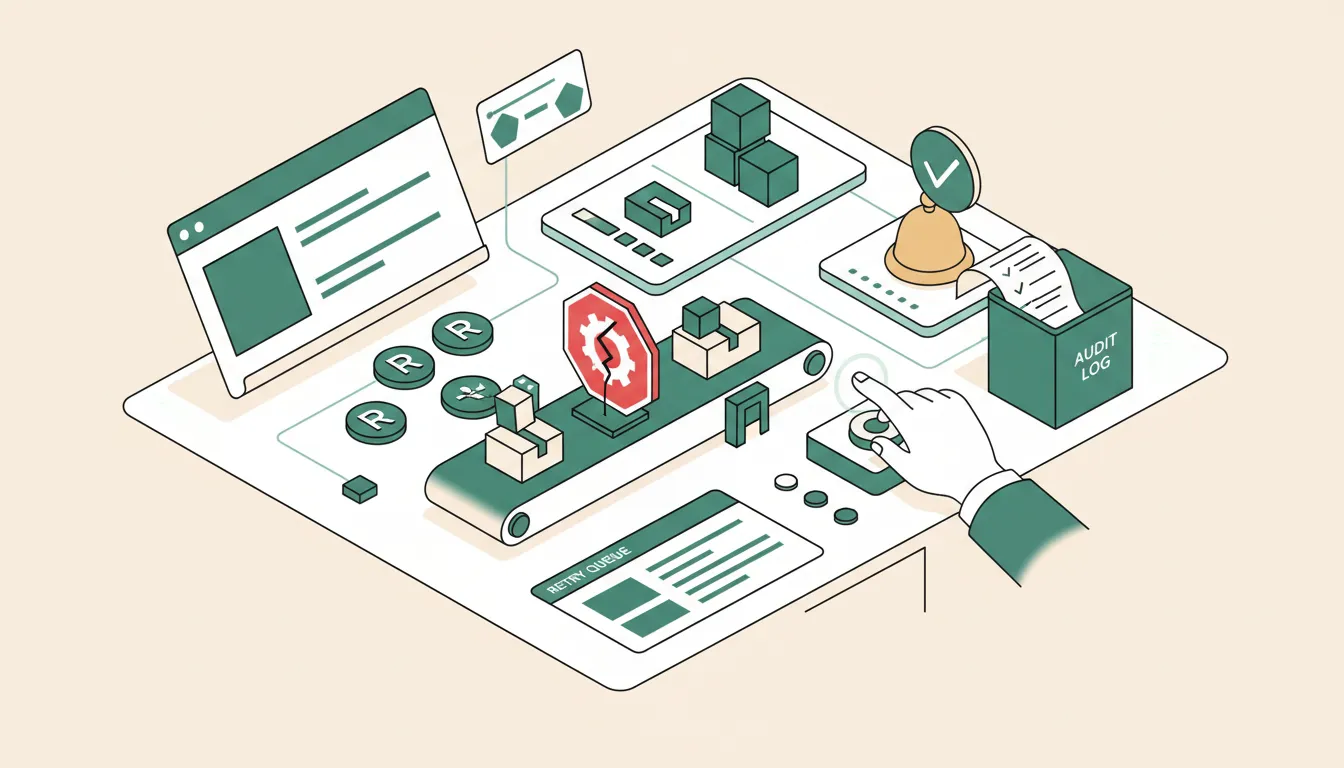
A successful demo proves the happy path. Operations spend more time dealing with the other paths.
Before launch, I run a tabletop drill with real examples:
- The source sends the same event twice.
- A required identifier is missing.
- The model returns malformed output.
- The CRM accepts the request but does not update the record.
- An API rate limit pauses processing.
- A vendor changes a field name.
- A customer replies while an outbound sequence is waiting.
- A manager changes an approval rule.
- A credential expires.
- The original builder is unreachable.
For each case, the company should show the expected state, the owner, the retry rule, the alert, and the evidence. “We log errors” is not enough. Your staff should not need to read raw logs to understand that five invoices are blocked or twelve leads were not routed.
The exception should be expressed in business language. It should name the affected record, what failed, what the system already tried, and the next action.
This is where workflow management becomes more important than the automation itself. A workflow is controlled when ownership and exceptions stay visible, not when the happy path runs quickly.
The vendor should also demonstrate a stop control. Can someone on your side pause outbound messages, disable one workflow, change a limit, or move the lane into manual review without shutting down the whole system?
If not, the business is not really in control.
Score the proposal on operating evidence
I use a zero-to-two score for each category. Zero means the proposal does not address it. One means it is described but not demonstrated. Two means the company shows the control with the buyer's scenario.
Business promise. Is one measurable operating result clear?
Source of truth. Does the design preserve record authority and prevent duplicate truth?
Ownership. Does every active item and exception have one current owner?
Approval. Are sensitive actions governed by explicit rules?
Failure recovery. Are retries, rejected updates, stale items, and manual recovery visible?
Proof. Can you verify that the downstream business event occurred?
Security. Are access, credentials, data handling, retention, and vendor dependencies documented?
Maintainability. Can the team inspect schedules, rules, usage, and common failures?
Portability. Can the buyer export code, configurations, records, and documentation?
Economics. Are build cost, recurring software cost, model usage, maintenance, and expected value separated?
A score below 16 out of 20 does not automatically disqualify a company. It identifies what the buyer is accepting as manual work, dependency, or risk. The important part is making that acceptance explicit before launch.
The AI Operations X-Ray can help identify the operating leak before a vendor comparison begins. I would rather narrow the problem first than ask several companies to propose against a vague transformation goal.
When not to hire me or any AI automation company
Do not hire me when the team cannot agree on the process, the record owner, or the approval authority. Automation will hard-code the disagreement.
Do not hire one to avoid a management decision. If no one owns customer follow-up, inventory exceptions, recruiting feedback, or invoice approval, a model cannot create accountability. It can only move the uncertainty faster.
Do not hire one because the demo looks intelligent. Ask whether the workflow produces a business event you can measure. If the result is more generated text, another dashboard, or a broad promise of efficiency, the use case is not finished.
I would also wait when the current volume is low, one person can see every exception, and a documented checklist solves the problem. Software should absorb meaningful overhead or risk. It should not be built to make a simple process look sophisticated. If you are still deciding between an agency, a freelancer, or your own staff, my agency vs freelancer vs in-house comparison covers that choice.
The right AI automation companies make the buying decision easier by reducing ambiguity. They show the operating lane, preserve ownership, define approvals, expose failure recovery, measure the outcome, and leave the buyer with the keys.
That is the standard I use. I am not buying a clever demo. I am buying a controlled operating result that can survive real work.
More on this: Contract management automation: what to automate first, AI automation consulting pricing: what moves the price and How to choose a workflow automation consultant.
If the lane you want to fix runs on n8n, my n8n consulting page shows how I build and hand over that kind of system.
FAQ
Frequently asked questions
01What should I look for in AI automation companies?
Look for evidence that the company can map one real workflow, preserve the source of truth, define approval boundaries, expose failures, measure business outcomes, and hand over a maintainable system.
02How do I compare AI automation proposals?
Give each vendor the same operating scenario and score the response on outcome clarity, ownership, exception handling, proof, security, maintainability, and total operating cost.
03Should an AI automation company replace my current software?
Not automatically. A good company should first identify whether the pain lives in the record system or in the handoffs around it. A narrow control layer may be safer than a full replacement.
04What is the biggest risk when hiring an AI automation company?
The biggest risk is buying a black box that looks impressive in a demo but leaves you unable to see failures, change rules, export data, or recover when the original builder is unavailable.
05How do I choose an AI automation company if I have never hired one?
Start with one problem you can measure, such as leads waiting too long for a reply. Give every AI automation company the same example and ask how it would handle missing data, a failed update, and the handoff. I would pick the one that explains failure and ownership in plain words, not the one with the best demo.