Field note
Jun 27, 2026
Contract management automation: operator controls
Contract management automation should give operators clean intake, approval owners, renewal proof, and source-of-truth control before it becomes a software replacement project.

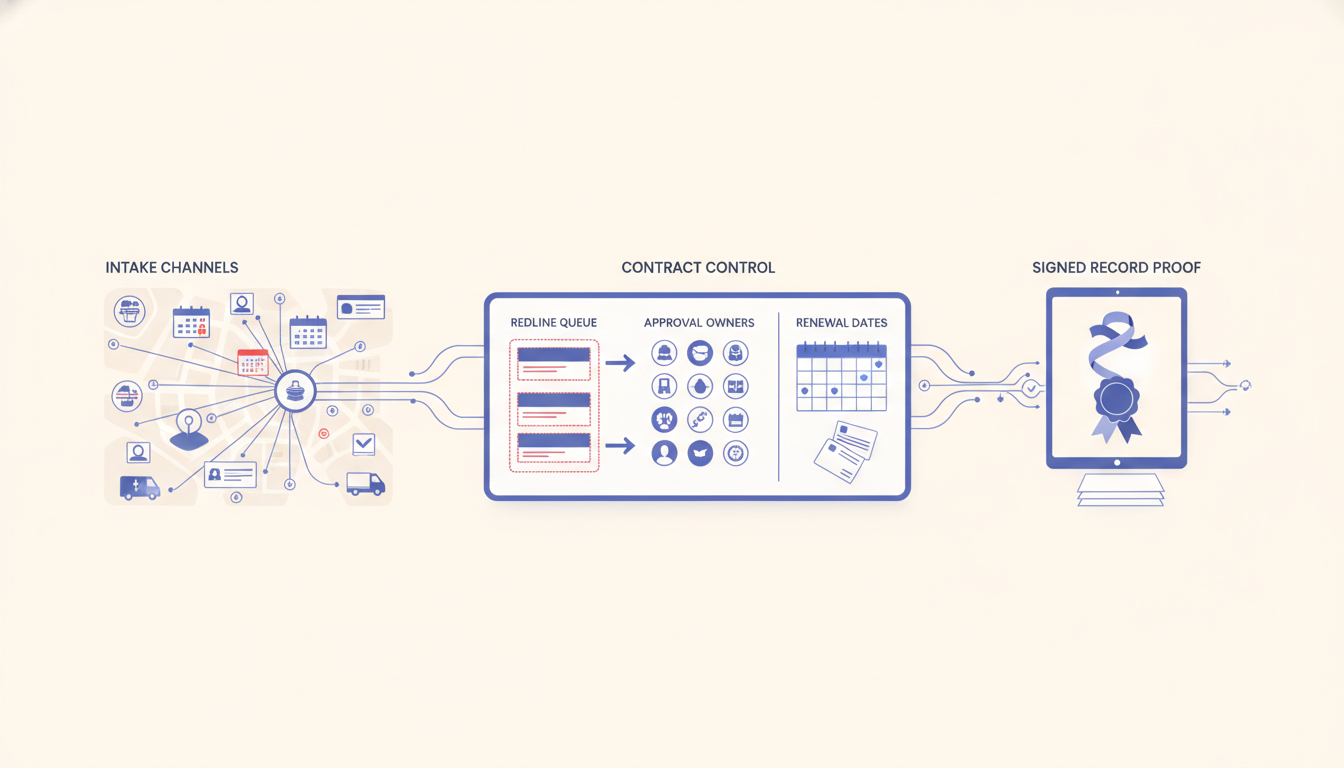
Contract management automation usually gets sold as a legal software problem.
That is too narrow.
The operating problem is bigger than signatures, templates, redlines, and storage. A contract touches sales, operations, finance, delivery, legal, billing, renewals, and customer success. If those teams do not agree on the lane, a new contract tool just gives the same confusion a cleaner screen.
DocuSign describes contract lifecycle management as managing the stages of a contract from creation through execution and renewal. That category matters. But when I look at contract automation from an operator seat, I care less about the category name and more about the control points.
Who requested the contract?
Which price or scope record is the source of truth?
Who approved the exception?
Where does the signed file live?
What happens to billing, onboarding, renewal, and fulfillment after signature?
For delivery businesses, professional services automation should carry approved scope into owned delivery and invoice readiness.
If those answers are fuzzy, contract management automation should start with operating control, not a tool shortlist.
I have built enough CRM and back office automations to see the same before-state show up in different clothes. A lead magnet or intake form creates a record. That record moves into GoHighLevel or another CRM. Contract information gets added into nurture, delivery, or customer workflows. The risky part is usually not the form itself. The risky part is everything that happens after the form when ownership is split across people, tabs, folders, and memory.
My rule is simple: automate the handoff, but keep the owner visible.
Start with the contract intake lane
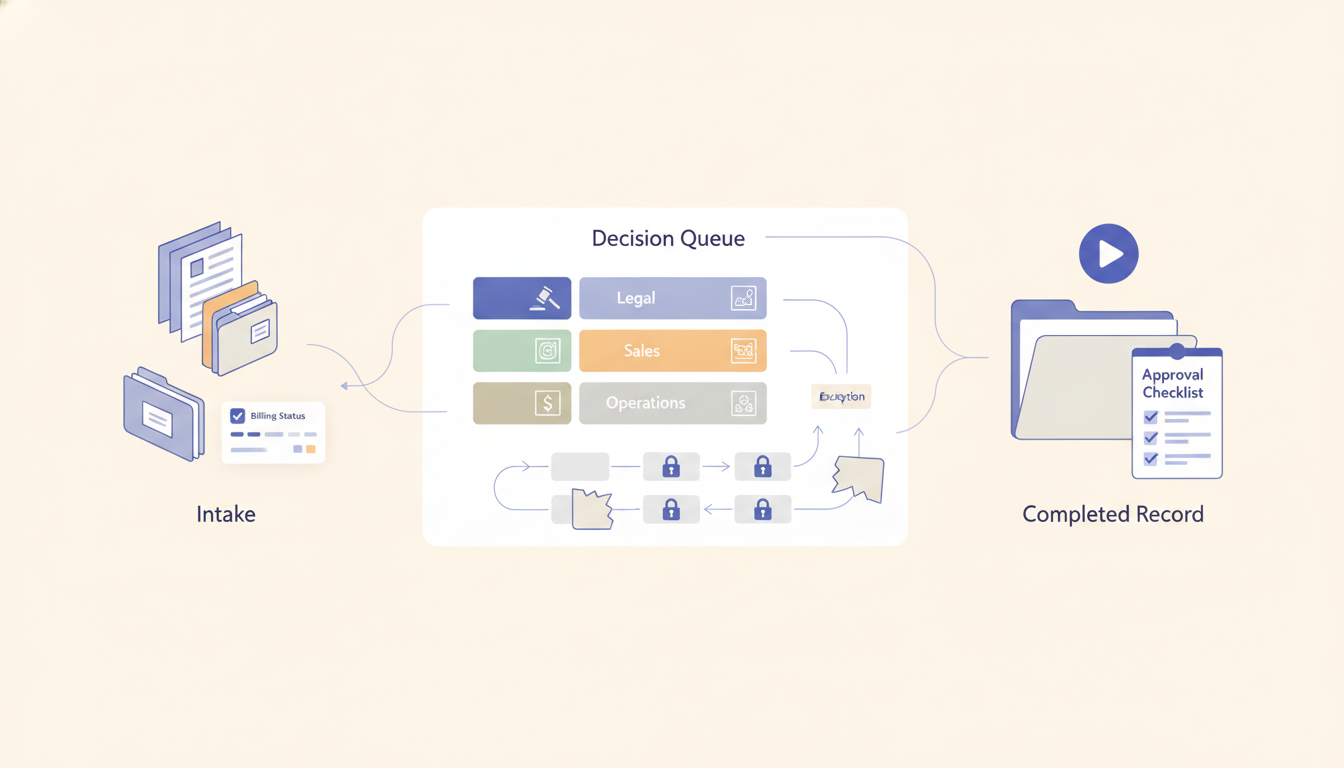
A contract request is not ready for automation just because someone typed a customer name into a form.
The intake lane has to answer the questions a real operator would ask before work moves forward:
- Who is requesting the contract?
- Which customer, deal, vendor, employee, or project does it belong to?
- Which template or agreement type applies?
- Which commercial terms are already approved?
- Which terms are exceptions?
- Who owns legal review, price approval, delivery review, and final send?
- Where will the signed record live after execution?
That is why business process automation belongs before contract tooling. The goal is not to make the contract process feel modern. The goal is to turn an incomplete request into a controlled queue.
A vague request like "send the standard contract" creates risk. Standard for whom? Standard price? Standard payment terms? Standard scope? Standard liability language? Standard renewal date?
The automation should slow down when those answers are missing. It should collect the right fields, route exceptions, and show the owner what cannot move without a decision.
This is where workflow management for operators becomes practical. The workflow is not a task board. It is the lane that tells the team what can move automatically, what needs review, and who owns the blocked item.
Do not confuse a repository with a system of control
Many teams already have a place where contracts live.
They have Google Drive, Dropbox, SharePoint, a CRM attachment field, an e-signature archive, a billing system, a spreadsheet, or a CLM tool. The problem is that none of those locations automatically proves the contract process is controlled.
A contract repository can answer, "Where is the file?"
It may not answer:
- Which version was approved?
- Which exception was accepted?
- Which manager approved the discount?
- Which scope line changed before signature?
- Which renewal date should the team trust?
- Which customer record was updated after signature?
- Which obligation needs a follow-up in 30 days?
That is a business process architecture problem. Before automation, the team has to name which system owns each truth.
For example:
- CRM owns the customer, deal, and account owner.
- Proposal or quoting system owns price, package, and scope.
- Contract tool owns agreement status and signed file.
- Billing owns invoice schedule and payment status.
- Delivery system owns kickoff and fulfillment.
- Reporting layer owns renewal, obligation, and exception review.
If no one can name the winning source, the automation will copy uncertainty from one system into another.
That is why I like owned, visible systems. All code, data, credentials, and operating rules should stay in infrastructure the operator can inspect. For contract management automation, that means the business should own the approval rules, routing logic, audit fields, and final records. The vendor can help. The workflow cannot be a black box.
Automate exceptions before automating everything
The worst contract automation projects try to make every contract move fast.
That is not the right target.
The right target is to make normal work boring and exceptions obvious.
A good first automation layer can:
- Check whether the required intake fields are present.
- Match the request to an approved template.
- Pull customer and deal context from the CRM.
- Flag non-standard price, scope, term, renewal, or liability language.
- Route exceptions to legal, finance, operations, or leadership.
- Draft the approval summary for a human reviewer.
- Store the signed file in the right customer record.
- Trigger billing, onboarding, renewal, or delivery follow-up.
That does not mean AI approves the contract. It means AI and workflow automation prepare the decision so the right person can approve it with context.
The NIST AI Risk Management Framework is a useful operating reminder here because it pushes teams to govern, map, measure, and manage AI systems. For contract work, that means showing the inputs, confidence, owner, and exception path instead of pretending the model is the approver.
I use the same principle in other operating systems. In one manual environment, 20 accounts with zero automation could only be checked once or twice per day. With automation, the process could be monitored four or five times per day with 24-7 visibility. The contract lesson is the same. The win is not replacing judgment. The win is making sure the queue is watched, routed, and reviewed before risk sits unnoticed.
Contract management automation should create that visibility. If a non-standard term appears, the system should show the term, the customer, the deal value, the approval owner, and the deadline. It should not bury the issue in a comment thread.
Renewal automation needs proof, not just reminders
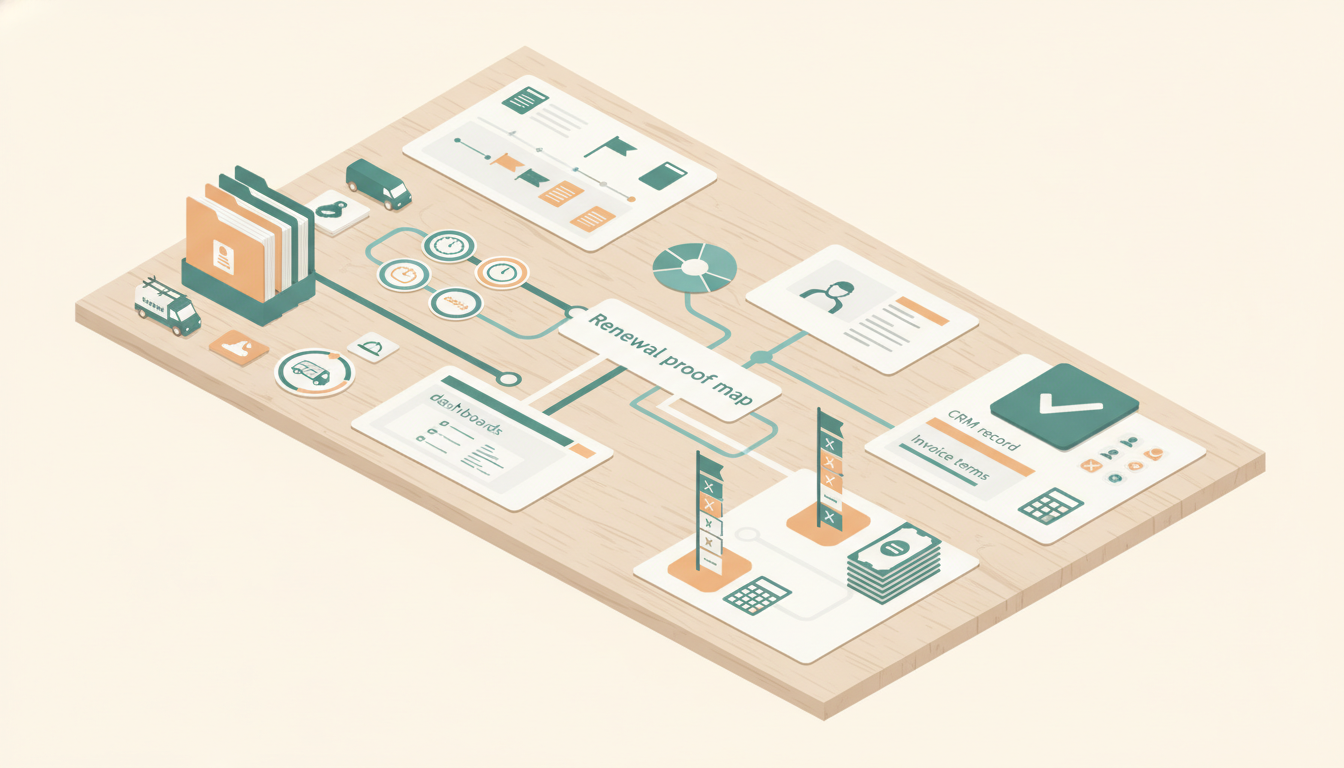
Renewal reminders are useful, but they are not enough.
A calendar ping that says "contract renews in 60 days" is only helpful if the operator can also see the proof around that renewal.
Before renewal automation goes live, the team should decide what the review packet needs to include:
- Signed agreement link.
- Renewal date and notice period.
- Current price and payment terms.
- Contract owner and account owner.
- Delivery status or fulfillment proof.
- Open support, billing, or performance issues.
- Exceptions from the original approval.
- Recommended next action.
That is where report automation fits. The renewal process should not depend on someone rebuilding a spreadsheet every month. It should produce a trusted review loop the team can use to decide whether to renew, renegotiate, expand, or exit.
The same idea applies to obligations. If the contract says a report is due monthly, a credential must be rotated quarterly, or a service window has to be met, that obligation should not sit inside a PDF waiting for someone to remember it.
Automation can extract the obligation, assign the owner, create the review cadence, and keep proof attached to the customer record. The operator still decides what to do when the obligation is missed or disputed.
Even in public procurement, Federal Acquisition Regulation 4.801 frames contract files around documenting the basis for decisions and actions. Private operators do not need to copy the government process, but the principle travels well: keep enough proof that someone can understand what happened later.
When not to hire us for contract automation
Do not hire us if the team only wants a contract software shortlist, a clause library, or a way to avoid naming approval owners.
Do not hire us if leadership wants every contract to move faster but will not decide which terms require human review. That is not an automation problem yet. That is an operating decision.
Hire us when the team is ready to define the lane, keep humans on exceptions, and automate the handoffs that waste time or hide risk.
When replacement is the wrong first move
Sometimes a real CLM platform is the right answer.
But I would not start there by default.
If the team cannot define intake, approval owners, source records, exception rules, signed-file storage, billing handoff, and renewal proof, a full platform replacement will inherit the same operating mess.
Start with legacy system modernization when the current stack is messy but still usable. A controlled automation layer can sit beside the CRM, e-signature tool, shared drive, billing system, and spreadsheet process while the business proves the contract lane.
That first layer might only handle one agreement type.
That is fine.
Pick the lane with the most obvious pain:
- Sales contracts waiting on discount approval.
- Vendor agreements with no renewal owner.
- Statements of work that do not trigger delivery kickoff.
- Customer contracts that never update billing.
- Signed PDFs that do not land in the customer record.
- Renewal dates trapped in folders or spreadsheets.
- Non-standard terms that leadership sees too late.
The smaller the first lane, the easier it is to prove the control model. Once that lane works, the business can decide whether to expand the automation layer or invest in a larger CLM replacement.
The operator scorecard before automating contracts
Use this scorecard before buying, replacing, or automating contract management.
Give each line a named owner.
- Intake: Which channels are allowed to request a contract?
- Agreement type: Who decides which template applies?
- Source of truth: Which system owns customer, price, scope, signed file, and renewal date?
- Exceptions: Which terms block automatic routing?
- Approvals: Who approves price, scope, legal risk, security risk, and final send?
- Proof: What evidence must be attached before the contract is considered complete?
- Handoff: What should happen in CRM, billing, onboarding, delivery, and reporting after signature?
- Renewal: Who owns notice periods, obligations, price changes, and renewal decisions?
- Reporting: What does leadership need to review weekly or monthly without rebuilding a spreadsheet?
- Maintenance: Who owns the rules after the automation is live?
If those answers are blank, do not start with software selection. Start with the operating lane.
If those answers are clear, contract management automation can become a practical build instead of another dashboard.
The next step is an AI Operations X-Ray. Use it to find the contract handoff that leaks the most time, risk, or proof. Fix that lane first. Then decide whether the contract system needs to be replaced, wrapped, or simply controlled better.
FAQ
Frequently asked questions
01What is contract management automation?
Contract management automation uses software and workflows to move contract requests, approvals, signatures, renewals, obligations, and proof records through a controlled process with less manual chasing.
02What should operators automate first in contract management?
Automate the lane with the clearest business risk first: intake completeness, approval routing, renewal reminders, signed-record storage, CRM updates, billing handoff, or obligation review.
03Is contract management automation the same as CLM software?
No. CLM software can be the system of record, but contract management automation can also wrap the existing CRM, storage, e-signature, billing, and spreadsheet process when replacement is not the right first move.
04Where should AI fit in contract operations?
AI should classify requests, extract fields, summarize changes, flag missing proof, draft updates, and prepare review queues. Humans should still own legal, pricing, exception, and approval decisions.