Field note
Updated Sep 30, 2026
Recruiting management system: what to test before you buy
A recruiting management system should control candidate truth, owners, approvals, and exceptions. Here is the control test I run before anyone buys one.


A recruiting management system is the software that runs candidate intake, records, interviews, decisions, and reporting across your recruiters and hiring managers. A good one keeps candidate truth, ownership, and the next action attached to every candidate from first contact through hire. The basic vendor definition of a recruiting management system covers tools that automate and manage recruiting and staffing operations, but that still leaves a harder question: does the system control the work?
I cover this as part of my recruiting automation work.
Most vendors still sell it as a feature bundle. Applicant tracking. Resume parsing. Interview scheduling. Candidate messaging. Reports. AI scoring.
That list does not tell me whether the system will protect a placement, speed up a decision, or stop a strong candidate from disappearing between a recruiter and a hiring manager.
I use a harder definition. A recruiting management system should keep candidate truth, ownership, next action, approval status, and decision evidence attached to the work from first signal through hire or reactivation. A vendor can call its product an RMS, ATS, CRM, staffing agency software, or a talent platform. I care about whether the operating lane stays controlled when real exceptions show up.
That is the buyer problem. The team does not need another place to store activity. It needs a system that makes dropped work hard to hide.
I saw this clearly while reviewing a recruiting intake workflow. One run surfaced 171 raw candidates. Only 18 cleared the seven-point fit threshold. The collection step worked, but raw volume was not the result. The useful result was a smaller queue the team could inspect, challenge, and act on.
My rule is simple: there is no point paying to collect, enrich, and message people who are outside the ICP. A recruiting management system should improve the quality of the operating queue before it increases the speed of outreach.
That is why I start with the workflow and cost model, not a software leaderboard.
Define the promise before comparing recruiting management systems
The system should begin with one business promise.
For a staffing firm, the promise might be: every qualified candidate receives a clear next action within one business day. For an internal talent team, it might be: every completed interview produces reviewable feedback before the next decision window. For an executive search desk, it might be: every market signal becomes an owned research or outreach task without creating duplicate records.
The promise matters because it creates a buying test. If the proposed system cannot show how it protects that outcome, the feature does not deserve much weight.
I want five answers before I watch a demo:
- What event starts the recruiting lane?
- Which record becomes the source of truth?
- Who owns the next action at each handoff?
- Which decisions require approval?
- What evidence proves the action happened?
If the team cannot answer those questions, software selection is premature. The operating rules are still living in personal habits.
The detailed recruitment workflow handoff model is useful here. It separates ATS stages from the actual work moving through sourcing, recruiter review, manager feedback, scheduling, offers, and reactivation.
Test the source of truth under real recruiting pressure
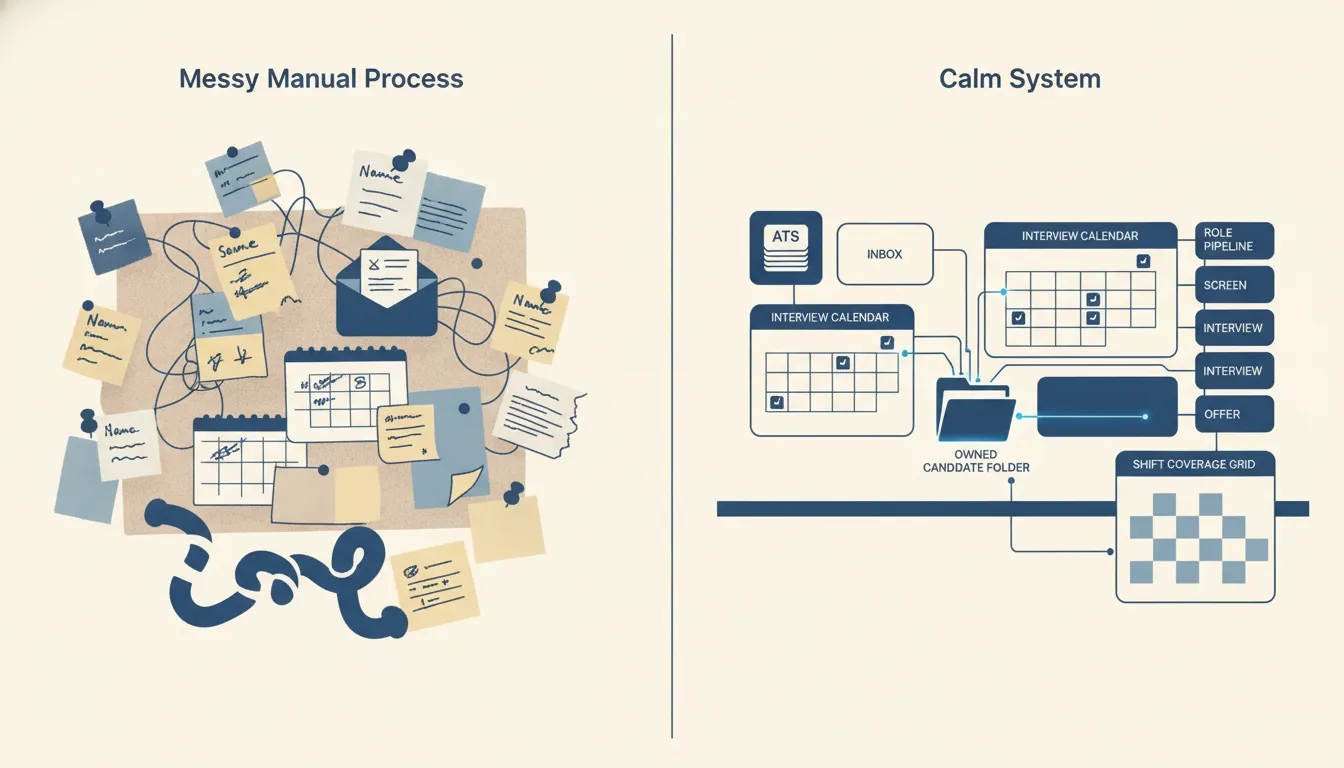
Most recruiting teams already have several partial truths.
The ATS holds the candidate record. The inbox holds the reply. The calendar proves the interview happened. The CRM holds the client relationship. Call notes hold a change in compensation or availability. A spreadsheet may still hold a sourcing list or a silver-medal pool.
A good recruiting management system does not have to replace every one of those tools. It does need a declared authority for each type of information and a reliable way to reconcile events.
I test this with uncomfortable cases:
- The same candidate enters from two sources with different email addresses.
- A candidate replies after the recruiter moved the record to inactive.
- An interview ends, but no scorecard arrives.
- A hiring manager changes a requirement in email.
- A positive reply lands outside business hours.
- A strong rejected candidate matches a newly opened role.
- An API accepts an update, but the ATS record never changes.
The system should not quietly guess through those cases. It should validate what it can, preserve the trusted record, and route ambiguity to a named owner.
This is where an operating layer can be more useful than a platform replacement. The team does not need every application to become one application. It needs intake, routing, review, and the next action to remain visible across their boundaries.
Separate the ATS, CRM, and workflow jobs
A recruiting management system often tries to cover three different jobs.
The ATS job is candidate recordkeeping and stage history. It should preserve applications, submissions, interviews, dispositions, notes, documents, and compliance evidence.
The CRM job is relationship development. It should help the team manage prospects, clients, hiring managers, warm signals, outreach, and future demand.
The workflow job is movement and control. It should react to events, validate data, assign owners, start timers, request approvals, create tasks, draft messages, and surface exceptions.
One product may cover all three well. Many do not.
I would rather keep a capable ATS and add a narrow workflow layer than force recruiters into a larger suite that creates duplicate entry or hides automation behind vendor rules. The automation options for recruiting firms should fit around the desk's real source systems, not require the team to pretend the existing operating history does not matter.
The decision comes down to control. Can the team inspect the rule? Can it change the threshold? Can it see failures? Can it export its data? Can it stop an action? Can it prove what happened?
If the answer is no, the system may be convenient, but it is not fully owned.
Give AI a bounded role in recruiting management software
AI is useful in recruiting management software when it reduces reading and routing work.
I use it for tasks such as:
- Extracting location, compensation, availability, certifications, and experience from candidate material.
- Comparing a resume and role against defined requirements.
- Detecting missing or conflicting information.
- Summarizing calls, interviews, and email threads.
- Classifying replies for recruiter review.
- Drafting candidate or hiring-manager follow-up.
- Preparing a short exception digest for the desk lead.
I do not treat an AI score as a decision explanation.
The problem with hidden screening is not only that a model can be wrong. It is that the team may not be able to explain which evidence mattered, whether the rule was consistent, or how a candidate can be reviewed. I have written separately about why AI resume screening can filter out strong candidates.
The safer design follows the same logic as the federal government's guidance on structured interviews: define the competencies, ask consistently, score against documented criteria, and keep the process legible.
My practical boundary is this: AI can prepare the decision surface, but a person should own sensitive selection decisions. The broader NIST AI Risk Management Framework is useful because it pushes teams to govern, map, measure, and manage risk instead of treating a model output as finished work.
The same boundary applies to an AI agent workflow. Start with a narrow promise, approval gates, and proof. Autonomy comes after repeatable evidence, not before it.
Run the recruiting management system control test

Before buying or building, I score the system from zero to two on each control.
Candidate truth. Can the team identify the trusted candidate record and reconcile duplicates?
Required information. Does the system stop or flag work when critical fields are missing?
Ownership. Does every active candidate, client request, and exception have one current owner?
Timing. Can the system start a service window from a real event and escalate when it expires?
Approval. Are external messages, dispositions, offers, and unusual actions governed by explicit rules?
Exceptions. Does ambiguous work move into one visible queue with context and a recommended next action?
Evidence. Can an operator see what changed, who approved it, and whether the downstream record actually updated?
Failure handling. Are integration errors, retries, and rejected payloads visible without reading code logs?
Portability. Can the company export its candidate, activity, and decision history in a usable format?
Review. Does the weekly operating review produce decisions about stalled work, data quality, and rule changes?
A score below 14 out of 20 does not automatically mean the product is bad. It means the buyer needs to understand which controls will remain manual or require another layer.
A sourcing system becomes useful when qualification is visible and auditable, not merely when it produces more names. The queue, criteria, and handoff are the product from the desk's point of view. Claims about its effect still need measured operating records.
When not to hire me or buy a new system
Do not hire me to automate a recruiting lane when the team has no shared intake rule, no agreed source of truth, and no owner for the next action. I would not recommend buying a recruiting management system in that situation either.
I would also hold off when the desk is low volume, the existing ATS is reliable, and one coordinator can see every exception without dropped follow-up. In that case, a documented checklist and a weekly exception review may be enough.
Do not automate disagreement. If recruiters interpret the same requirement differently, or managers will not commit to a feedback window, software will hard-code confusion and send faster reminders about an unresolved rule.
The better sequence is straightforward:
- Name the operating promise.
- Map the money-changing handoffs.
- Declare the source of truth.
- Set ownership and timing rules.
- Create one exception queue.
- Test the lane with real edge cases.
- Buy or build the smallest system that closes the control gaps.
A recruiting management system should not win because it has the longest feature list.
It should win because recruiters know what needs attention, hiring managers receive clear asks, candidates get timely answers, and the operator can prove that the hiring lane is working.
More on this: how to pick recruiting automation software.
If your hiring lane fails a few of these controls, Recruiting OS is the narrow pipeline layer I install to close those gaps.
FAQ
Frequently asked questions
01What is a recruiting management system?
A recruiting management system coordinates candidate intake, records, communication, interviews, decisions, offers, and reporting across recruiters, hiring managers, and software.
02How is a recruiting management system different from an ATS?
An ATS is usually the candidate system of record. A recruiting management system is the wider operating layer that also controls ownership, communication, approvals, exceptions, and proof across the hiring process.
03What should a recruiting management system automate first?
Start with a repeated handoff where delay changes revenue or candidate trust, such as sourced-candidate review, interview feedback, offer follow-up, or positive-reply assignment.
04Should a recruiting management system use AI to reject candidates?
AI can extract facts, detect missing information, route exceptions, summarize conversations, and draft next actions. Sensitive selection decisions should remain reviewable, consistent, and owned by a person.
05Is a recruitment management system the same as staffing agency software?
Mostly, yes. Recruitment management system, recruiting management software, and staffing agency software all describe the job of moving candidates from intake to placement with records, owners, and reports. Staffing agency software usually adds client and placement tracking, so I test those handoffs with real edge cases before anyone buys.