Field note
Jun 9, 2026
AI agent workflow for operators
An AI agent workflow should begin with one business promise, clear ownership, approval gates, and proof before any agent is trusted to act.

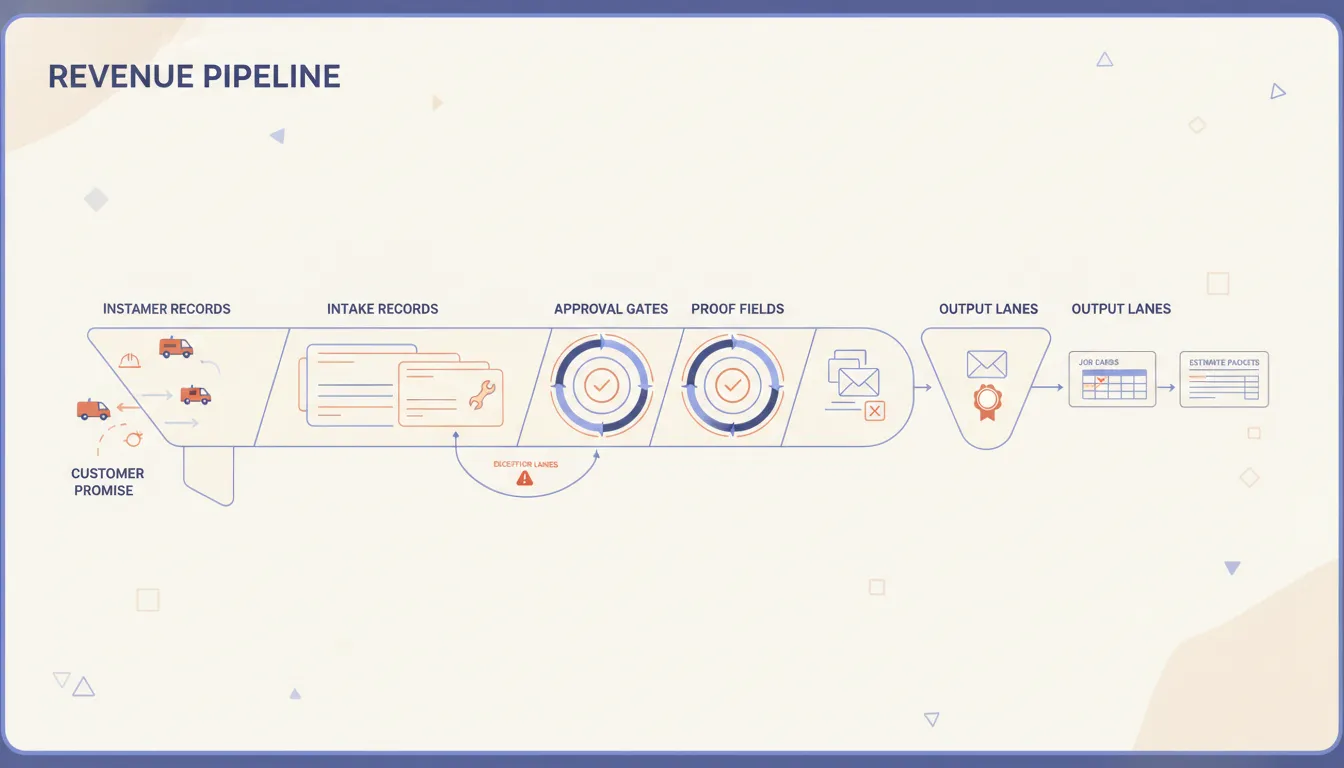
Most AI agent workflow advice starts with the agent.
That is the wrong starting point for an operator.
The first question is not which framework, model, or tool-calling pattern should run the workflow. The first question is what promise the business needs to keep more reliably.
My own builds show the same pattern. On one AI Ops Director handoff, the starting point was not a model choice. It was the operating surface: a Notion API token and a webhook to catch every event coming out of Notion, so the agent had real work to act on.
A sales team may need every qualified lead reviewed before the next morning. A recruiting team may need every screened candidate moved to scheduling without getting lost between inboxes and the ATS. A contractor may need every estimate request routed, owned, and followed up before the prospect calls a competitor. A back-office team may need billing readiness checked before work is marked complete.
Those are operating promises. AI can help with them, but only if the workflow gives the agent a clear job, a clear boundary, and a clear way to prove what happened.
I treat AI agent workflow as a control problem before an automation problem. The AI Operations X-Ray looks for the same pattern: where work enters, which system owns the truth, who owns the next decision, what needs approval, and what proof closes the loop.
If those pieces are vague, the agent will not fix the workflow. It will just move vague work faster.
Start with the promise, not the agent
An AI agent workflow should begin with a sentence a manager already cares about:
- Every qualified lead gets a same-day response or a manager-visible exception.
- Every candidate handoff has a next owner and an aging threshold.
- Every urgent service request reaches the right role before the window closes.
- Every job closeout has proof before billing starts.
- Every risky customer message gets human review before it leaves the company.
That sentence defines the workflow boundary. It also prevents the project from turning into a broad agent platform experiment. Formal process notation such as BPMN can help with detailed maps, but the operator still has to decide what promise the workflow protects.
Without the promise, teams tend to ask the wrong questions. Can the agent use the browser? Can it write into the CRM? Can it send email? Can it call an API? Those capabilities may matter later, but they do not say whether the business is safer, faster, or more reliable.
That is why I keep validation in the workflow design. I say it bluntly to clients: there is no point scraping people who are not in the ICP. The same rule applies to agents. There is no point automating work that is not tied to the right customer, promise, owner, or decision.
A useful first workflow has six operating decisions:
- Intake: What event, record, message, or form starts the work?
- Source of truth: Which system owns the live record?
- Owner: Which person or role owns the next decision?
- Exception trigger: What makes the normal path unsafe or incomplete?
- Approval gate: What can AI prepare, and what requires a human yes?
- Proof: What field, note, timestamp, file, or status confirms completion?
That is why workflow management for operators is a better companion to AI agent planning than a feature checklist. The agent needs an operating model to support. It should not be asked to invent one while work is already moving.
Map the intake and exception lanes
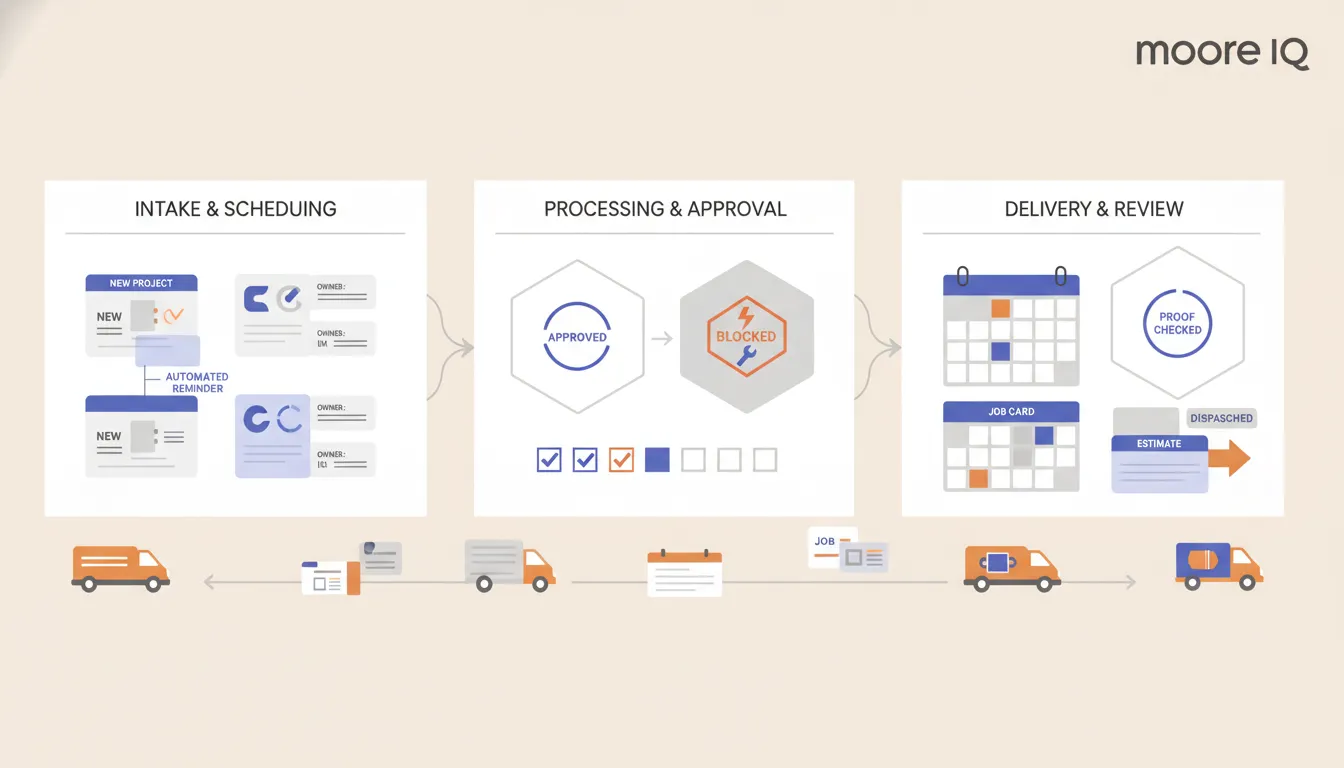
The first useful map is usually not a full process diagram. It is an intake and exception map.
Intake is where work enters. It may be a web form, marketplace message, shared inbox, voicemail transcript, CRM task, project note, applicant record, or payment flag. The agent should know which intake sources matter and which ones are only context.
Exception lanes are where the workflow protects the business. They catch the items that should not follow the routine path:
- A lead has buying language but missing contact details.
- A candidate is qualified but has a scheduling constraint.
- A customer sounds angry or mentions cancellation.
- A job is marked done but has no completion photo or approval.
- Two systems disagree about stage, owner, or amount.
- A message is ready to draft but not safe to send automatically.
This is where many agent demos break in production. They show the happy path. Real operations are mostly about the exception path.
An agent can be very useful in this layer. It can classify incoming work, summarize context, identify missing fields, compare records, draft a next action, and place the item into a manager review queue. But the workflow should still show why the item was routed there and what decision is needed.
For broader operating design, the same source-of-truth thinking shows up in business process architecture for operators. Before an AI agent touches a workflow, the business should know which system wins when records disagree.
Give the agent levels of authority
The safest AI agent workflow does not jump from reading records to taking action.
It moves through levels of authority:
- Observe: read approved records, detect changes, and surface stale work.
- Prepare: summarize context, draft messages, assemble checklists, and gather evidence.
- Recommend: score urgency, suggest next actions, and explain why an item needs review.
- Act: update records, create tasks, send messages, or move work forward.
Most companies should spend more time in levels one through three than they expect. That is not a delay. It is how the team learns which decisions are routine, which need judgment, and which should never be automated.
This is also how I scope ongoing agent work. On one proposal, the plan was a three-month retainer to build at least three agents a month after the first automation, which only makes sense when each agent has a defined business lane instead of a vague mandate.
For example, a lead-response agent might observe new leads, prepare a short account summary, draft a reply, and recommend urgency. It should not automatically send a risky pricing response, change an opportunity stage, or promise a delivery date until the approval rule is proven.
A recruiting workflow might let an agent prepare candidate summaries and flag stale handoffs. It should not reject candidates, invent fit reasons, or move someone out of process without clear human ownership.
A service workflow might let an agent compare job notes against billing requirements. It should not mark work complete when the proof field is missing.
This is the operator version of AI governance. It is not abstract policy language. It is a practical question: what can the agent do without creating business risk? The same control mindset appears in the NIST AI Risk Management Framework, which emphasizes context, governance, measurement, and risk management before wider use.
The AI operating system for operators article uses the same frame at a wider level. The agent workflow is one controlled path inside that larger control layer.
Build the queue before the automation
AI agent workflows need somewhere for uncertain work to land.
That place is the queue.
A queue is not just a task list. It is the operating surface that shows what the agent found, why it matters, who owns the next action, what is blocked, and what proof is missing.
A good queue record should answer:
- What triggered this item?
- Which source record is authoritative?
- What did the agent observe or prepare?
- What decision does a human need to make?
- What action is allowed after approval?
- What proof will show completion?
- When should this item become stale?
Without that queue, agent work disappears into chat logs, browser sessions, or one-off notifications. Managers cannot inspect it. Operators cannot improve it. The business cannot tell whether the workflow is getting safer or just noisier.
This is also where implementation choices matter. Some workflows need durable retries, error handling, API limits, ownership rules, and logs. For those cases, n8n consulting can help turn the operating model into a workflow that is observable and recoverable rather than a fragile demo.
The tool is not the point. The queue is the point. The queue is where the business decides whether AI is helping real work move.
Review proof every week
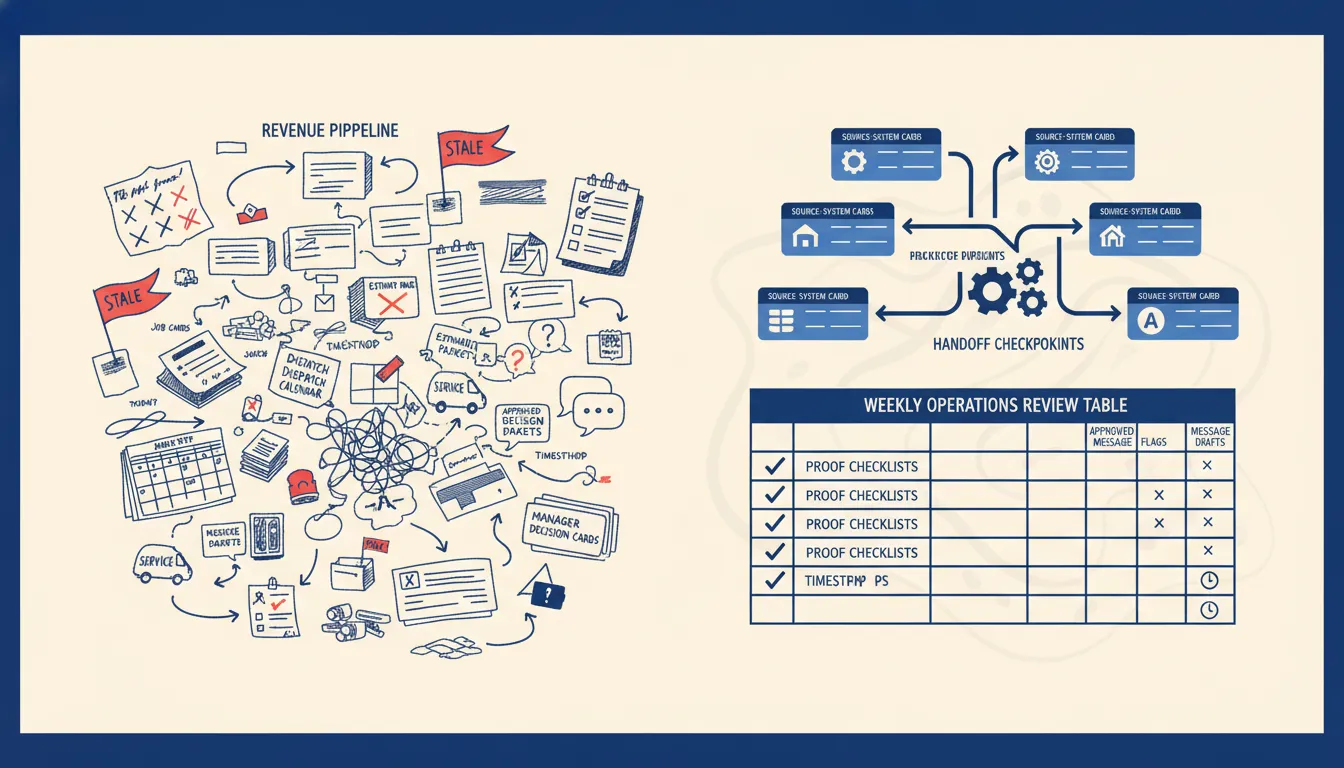
An AI agent workflow should have a weekly review habit before it has broad autonomy.
The review does not need to be long. It needs to expose whether the workflow is protecting the business promise.
Review questions should include:
- Which stale items did the agent catch before a customer, candidate, vendor, or manager complained?
- Which drafts were approved, edited, rejected, or escalated?
- Which records disagreed across systems?
- Which exceptions had no clear owner?
- Which automations failed because source data was missing?
- Which actions are ready to move from prepare to recommend, or from recommend to act?
That review turns AI from a novelty into an operating system habit. It gives leadership a way to improve rules, not just ask for better prompts. It also aligns with the accountability and transparency principles in the OECD AI principles, but in the plain language of owners, managers, and proof.
It also keeps teams honest. If a workflow cannot show proof, it should not claim success. A sent message, a completed task, a status change, or a summary is only useful if it connects back to the promise the business meant to keep.
The workflow optimization scorecard is useful here because it forces teams to score broken handoffs before they automate them. If the issue is unclear ownership, adding an agent will not solve it. If the issue is stale visibility, an observe-and-review workflow may create value quickly.
What to build first
The first AI agent workflow should be narrow enough to inspect every day.
A good starting build might include:
- One intake source, such as form submissions, CRM tasks, inbox replies, or job status changes.
- One source-of-truth rule, so the agent knows which record wins.
- One classification step, such as routine, missing data, approval needed, stale, or blocked.
- One manager review queue.
- One approved action path, such as draft reply, create task, request missing info, or update a non-risk status.
- One proof field that confirms the work was handled.
That is enough to learn. It is also small enough to govern.
The goal is not to prove that AI can touch every system. The goal is to prove that one business promise can move with better visibility, clearer ownership, faster preparation, and stronger proof.
If the first workflow works, expand by promise, not by tool. Add another intake source. Add another exception class. Add another approved action. Add another review metric. Keep the control loop visible.
When this is not worth automating yet
Do not build an AI agent workflow when the business cannot name the current owner of the work.
That is a process problem, not an AI problem.
Do not build one when records disagree and no one knows which system wins. Do not build one when every exception still requires founder memory. Do not build one when the team wants full autonomy but has never reviewed drafts, recommendations, or proof from a safer version.
In those cases, the better first step is operating design. Pick the promise. Name the owner. Decide the source of truth. Define the exception lane. Decide what proof means.
Then the agent has a job worth doing.
My point of view
AI agent workflows are valuable when they make operations more accountable. They are dangerous when they make unclear work look automated.
The operator advantage is not having the most agents. It is knowing which promises matter, which records can be trusted, which decisions need approval, and which proof leadership can inspect.
If your team is considering an AI agent inside sales, recruiting, service, dispatch, or back-office operations, start with the workflow map before the tool decision. If you want help finding the safest first promise to automate, book a consultation and bring the messy handoff. That is where the value usually is.
FAQ
Frequently asked questions
01What is an AI agent workflow for a business?
For operators, an AI agent workflow is the controlled path where an AI assistant reads approved records, prepares or recommends next actions, routes exceptions, respects approval gates, and records proof that work happened. It is not just a prompt chain or tool demo.
02Where should an AI agent workflow start?
Start with one business promise that already matters, such as lead response, candidate follow-up, dispatch escalation, job closeout, or billing readiness. Define the intake source, source of truth, owner, exception trigger, approval rule, and proof field before building.
03Should AI agents act automatically inside business systems?
Only after the workflow has proven its source-of-truth rules, approval gates, and audit trail. Most first versions should observe, summarize, draft, flag, and recommend before they are allowed to update records or send messages.
04What makes an AI agent workflow risky?
Risk rises when the agent can act across systems without knowing which record is authoritative, who owns exceptions, which messages need approval, or what evidence proves completion. The problem is usually unclear control, not weak model intelligence.