Field note
Updated Sep 30, 2026
AI automation agency vs freelancer vs in-house team
AI automation agency vs freelancer vs in-house team: when each one fits, what each one risks, and why every model still needs one owner inside your business.


The AI automation agency vs freelancer choice comes down to the work: use an agency for breadth and parallel capacity, a freelancer for a narrow outcome with direct accountability, and an in-house team when automation is a continuing business capability. Provider headcount is a weak buying signal. So is a slide full of partner logos, although it does give everyone something colorful to stare at while the ownership question goes unanswered.
I cover this as part of my business process automation services work.
The decision is not really about who has the most impressive tool list. It is about matching the delivery model to the work, the risk, and what has to remain after launch. In every case, name an internal owner before the work starts.
On one equipment quoting build, I narrowed the first phase to one stable pricing table with about 40 items. Sales reps were waiting 1 to 3 days for quotes because pricing and deal records lived in separate systems. The tempting scope was everything. The responsible scope was the stable rental workflow first, with the more volatile fabrication process explicitly excluded.
I gave the buyer two infrastructure paths. I could manage the operating layer for the fastest route to production, or deploy it inside their environment for stronger end-to-end ownership and a longer setup. The system was still planned for a 2 to 3 week delivery window, with documentation, testing, and a support period built into the handoff.
That experience reinforced my rule: choose the delivery model after you understand the boundary. An unclear scope does not become safer because an agency has a larger team, a freelancer has a strong profile, or an employee has a company email address.
Start with the capability you are buying
Before comparing providers, decide whether you are buying a project or building a permanent capability.
A project has a defined operating result. Examples include creating complete deals from approved quote requests, reconciling invoices into accounting, or preparing a daily exception brief. It has acceptance tests and a handoff point. An agency or freelancer can usually deliver that shape well.
A capability has no natural finish line. The backlog will keep changing. Teams will add systems, revise policies, manage models, test new workflows, and support users. That is where an in-house owner or team starts to make sense.
This distinction sounds simple, but I see buyers mix the two constantly. They hire a contractor for what is actually a permanent product role, or hire a full-time employee for one integration and then wonder what the role owns after launch.
The AI automation consulting path should help define that boundary before prescribing a staffing model. If the goal is an operating system rather than a single connector, business process automation services should still begin with one named outcome and a clear source of truth.
When an AI automation agency fits
An agency is strongest when the work needs several disciplines at the same time. A serious automation program can involve process design, application engineering, data work, security, user experience, testing, training, and support. One person may know several of those areas, but a team can run them in parallel.
Choose an agency when:
- The scope spans several departments or core systems.
- Security, compliance, or procurement needs formal support.
- Delivery must continue through vacations, illness, or staff changes.
- Several workstreams must move at once.
- The launch includes change management and user adoption.
- You need a support bench after the first release.
The tradeoff is distance. Agencies can insert account managers, handoffs, and rotating specialists between the buyer and the person doing the work. That is not automatically bad. It becomes bad when nobody can explain who owns architecture, testing, and the final operating result.
Ask for the named delivery lead, not just the sales lead. Ask which roles are committed, which are shared across clients, and what happens when the original architect leaves. My guide to comparing AI automation companies goes deeper on those questions.
An agency is also not a substitute for internal judgment. A provider can map permissions and propose controls, but the business still has to decide which records are authoritative and which actions are acceptable.
When an AI automation freelancer fits
A freelancer is often the best choice for a narrow, valuable problem that needs one accountable specialist. Communication is direct. Decisions move quickly. The person scoping the work is often the person building it, testing it, and explaining it at handoff.
Choose a freelancer when:
- One operating workflow has a clear owner and boundary.
- The integration surface is limited and understood.
- Speed matters more than parallel staffing.
- You want direct access to the builder.
- The project can be accepted against concrete tests.
- The business can absorb a documented handoff.
The obvious risk is key-person dependency. If one person holds the credentials, architecture, undocumented exceptions, and deployment knowledge, the business has not bought a system. It has rented access to a person.
I reduce that risk by keeping client-owned accounts where practical, documenting field maps and recovery steps, and defining what happens after launch. A capable freelancer should be comfortable making the system transferable.
There is also a worker-classification issue when a supposed freelancer becomes a permanent, tightly controlled member of the team. The IRS explains that classification depends on behavioral control, financial control, and the relationship of the parties. The Department of Labor also maintains current guidance and rulemaking on employee and independent contractor status. That is a legal and tax question, not a branding choice, so get qualified advice when the relationship is long-term or embedded.
My guide on how to hire an AI automation consultant covers the evidence, authority, and recovery questions I would ask an individual builder.
When an in-house AI automation team fits
Build in-house when automation is part of how the company will operate and compete for years. The strongest case is not secrecy by itself. It is a durable backlog plus the need for institutional knowledge, daily context, and repeated iteration.
Choose in-house when:
- Automation priorities change every month.
- The systems contain sensitive or highly specialized knowledge.
- The team needs ongoing product management, not periodic projects.
- Adoption depends on close relationships across departments.
- The backlog can support the role after the first build.
- Fast internal decisions matter more than outside delivery capacity.
The common mistake is hiring someone who runs tools instead of someone who owns the outcome. A person who can build workflows but cannot decide priorities, document authority, challenge bad requests, or run acceptance tests becomes an internal ticket queue.
An internal automation owner should own outcomes, access, exceptions, cost, evidence, and recovery. That role can coordinate outside builders too. In-house does not mean every line of work must be done by employees.
Hiring also takes time, and one employee rarely covers architecture, security, integrations, product thinking, and adoption equally well. If the need is urgent, an external build paired with an internal owner can be safer than waiting for a perfect hire who may not exist in one person.
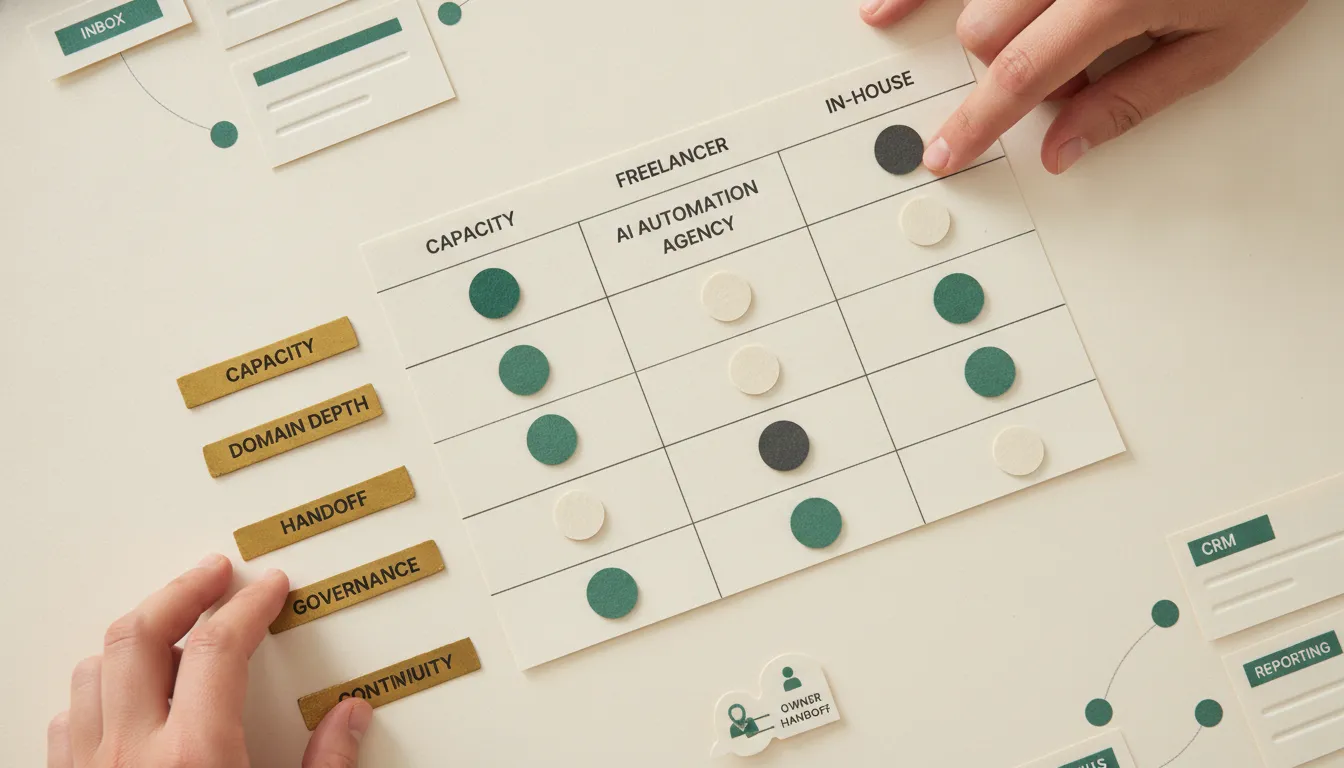
Compare the models on operating risk
I use a scorecard that forces the buyer to evaluate the work rather than the provider's marketing.
| Buying question | Agency | Freelancer | In-house |
|---|---|---|---|
| Parallel capacity | Usually strongest | Usually limited | Depends on team size |
| Direct builder access | Varies | Usually strongest | Strong |
| Key-person risk | Lower if staffing is real | Highest without handoff | Present, but controllable |
| Institutional context | Must be learned | Must be learned | Builds over time |
| Speed to start | Moderate | Often fastest | Usually slowest |
| Long-term continuity | Contract dependent | Person dependent | Employment dependent |
| Cross-functional adoption | Can support formally | Needs internal support | Usually strongest |
| Cost shape | Team and overhead | Concentrated specialist time | Salary, benefits, tools, management |
Do not total the columns and pick a winner. Weight them against the actual project.
For a contained workflow, direct access and speed may matter most. For a regulated multi-department program, governance and staffing depth may dominate. For a company with a continuing backlog, institutional context and daily ownership may outweigh the slower hiring cycle.
My AI automation consulting pricing guide explains why integration depth, data condition, authority, testing, and recovery drive cost more than workflow count.
The hybrid model is often the practical answer
I usually prefer a hybrid for the first meaningful build: one named internal owner paired with an external specialist or agency.
The internal owner controls:
- The business outcome.
- Source-of-truth decisions.
- Access and authority.
- Priority and scope changes.
- Acceptance criteria.
- User adoption.
- The final go-live decision.
The external builder supplies concentrated architecture and implementation capacity. That combination avoids two bad extremes: an outside provider making business decisions it cannot own, or a new internal hire learning the company while also inventing the technical approach under deadline.
A hybrid can later move in either direction. If the backlog grows, hire internally and transfer more ownership. If the work remains periodic, keep a small internal owner and bring in outside capacity for defined releases.
The important point is that “hybrid” must not mean fuzzy responsibility. One person still owns each decision.
Handoff is part of the product
A launch without a handoff is a delayed dependency problem.
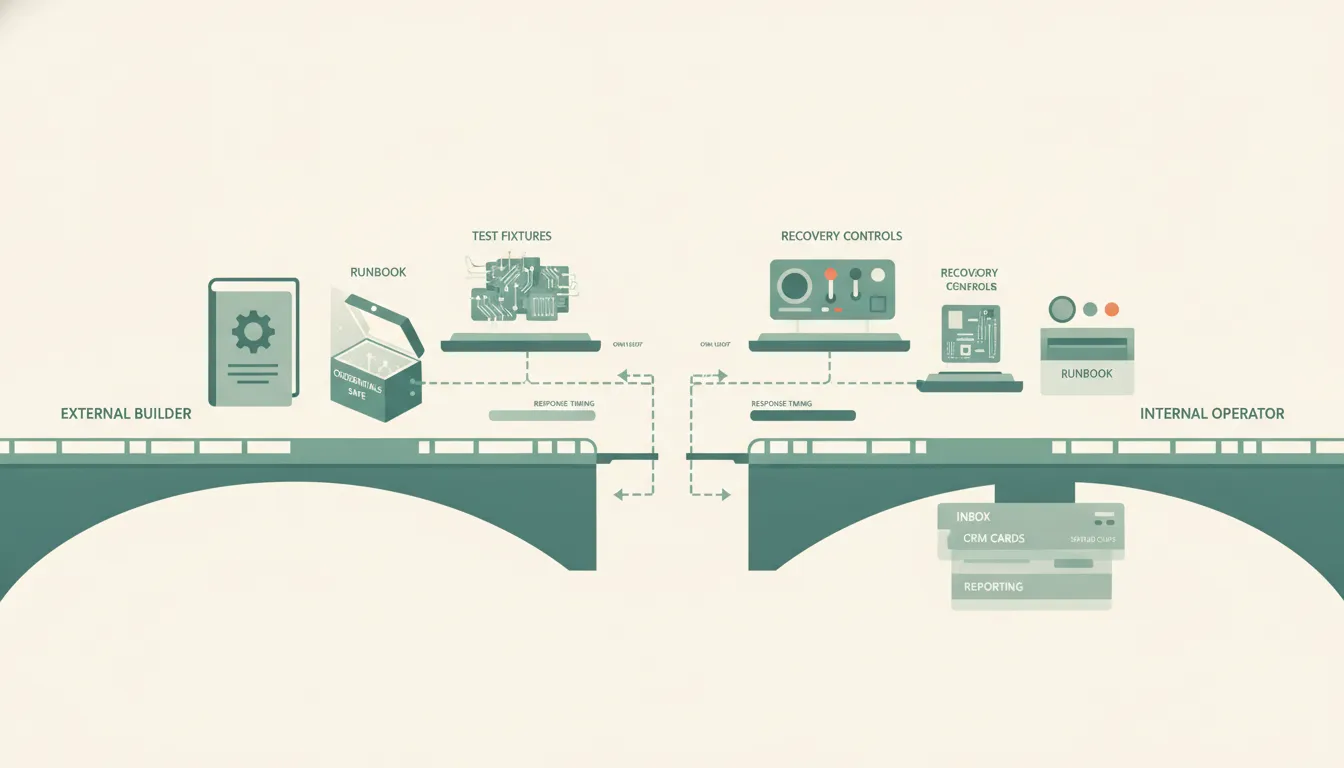
Before signing, define who owns:
- Vendor accounts and billing.
- Source code and workflow definitions.
- Data and database access.
- Credentials and secret storage.
- Hosting and deployment access.
- Architecture and field maps.
- Test fixtures and acceptance results.
- Monitoring and alerts.
- Pause, replay, and recovery instructions.
- The support window and escalation path.
The NIST AI Risk Management Framework is a useful reference for asking how AI risk will be governed, measured, and managed across the system lifecycle. CISA's Secure by Design guidance supports the same operating principle: security responsibilities should be designed into the product rather than added after the happy path works.
I want one recovery drill before handoff. Send a duplicate event, remove a required field, expire a test credential, or make a destination unavailable. Then confirm the workflow fails visibly, preserves the work, and resumes safely. The provider model does not matter if nobody can recover the system.
When not to hire me for this
You do not need me, an agency, a freelancer, or a new employee when a native feature in software you already own solves the problem. You also do not need a custom build when the task is rare, the process changes weekly, nobody owns the result, or the team cannot define a correct outcome.
A configuration change, checklist, report view, or short internal project may be enough. Hiring a delivery model before proving the work deserves automation only gives an unclear problem a payroll line or a contract number.
My final decision rule
Use an AI automation agency when you need breadth, parallel delivery, and a support bench. Use a freelancer when one skilled builder can own a narrow result and make the system transferable. Build in-house when automation has become a continuing capability with a durable backlog and daily operating context.
Whichever model you choose, keep one accountable internal owner. Require a clear boundary, real acceptance tests, client-controlled access, documented recovery, and a handoff that survives the original builder.
The best provider is not the largest team or the cheapest profile. It is the delivery model that matches the work without leaving you dependent on a mystery system after launch.
If a narrow first build with one accountable builder fits your case, the free AI Operations X-Ray is a quick way to find that first lane.
FAQ
Frequently asked questions
01Is an AI automation agency better than a freelancer?
Not by default. An agency is usually a better fit for parallel work across architecture, engineering, security, design, and change management. A freelancer can be better for a narrow system where direct accountability and speed matter more than team breadth.
02When should I hire an in-house AI automation team?
Hire in-house when automation is a continuing capability with a durable backlog, sensitive institutional knowledge, frequent changes, and enough work to keep the role productive after the first launch.
03Can a freelancer build production AI automation?
Yes, if the specialist can define the operating boundary, test failure paths, document the system, and hand over durable control. Production readiness depends on the delivery discipline, not the provider's headcount.
04What should every AI automation contract include?
Define the outcome, systems, authority, exclusions, acceptance tests, security responsibilities, account ownership, documentation, support window, and recovery process. Also state who owns code, data, credentials, and vendor accounts.
05What is the best hybrid model for AI automation?
A strong hybrid is one named internal owner paired with an external specialist or agency for the first build. The external team supplies concentrated delivery capacity while the internal owner controls priorities, access, acceptance, and adoption.
06Is an AI automation freelancer cheaper than an agency?
Often, because a freelancer prices concentrated specialist time while an agency prices a team with overhead. The cheaper quote is only better if it covers the same boundary, acceptance tests, and handoff. Compare the scope line by line before you compare the totals.