Field note
Updated Sep 30, 2026
AI automation consulting pricing: what moves the price
AI automation consulting pricing runs from a few thousand dollars to tens of thousands. Here is what moves the price and what a fair quote should include.

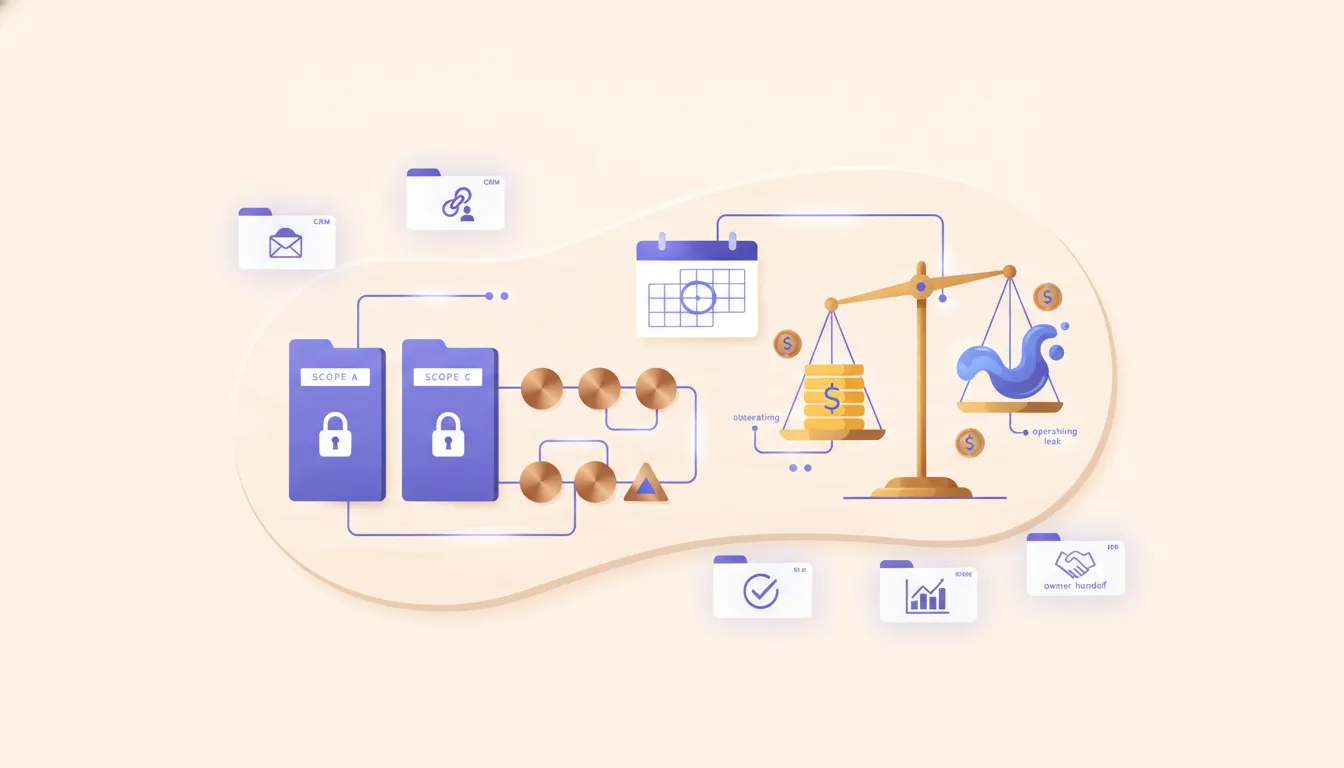
AI automation consulting pricing is not one clean market rate. A narrow workflow may cost a few thousand dollars, and a multi-system operation or custom AI application can move into the tens of thousands. The useful question is not, “What does automation cost?” It is, “What operating boundary am I asking someone to own?”
I cover this as part of my business process automation services work.
Published pricing guides show how wide the category has become. One guide puts many automation builds between $2,500 and $15,000. Another puts consulting at $100 to $300 per hour and projects at $25,000 to $250,000. Those ranges disagree because the label covers everything from one workflow to a custom operating layer.
I have built more than 300 AI and n8n automations. The number of boxes on the workflow canvas has never been the best predictor of cost. The expensive part is usually the business reality around those boxes: messy records, unclear ownership, exceptions, approvals, security, production volume, and recovery.
I saw that clearly on an account-monitoring project. A team was manually logging into 20 accounts and could only check each one once or twice per day. The automation could monitor them four or five times daily and continue outside working hours. The visible task was “log in and check.” The actual build had to manage credentials, account isolation, scheduling, health checks, exceptions, and evidence that each check really happened.
My rule is simple: price the operating promise, not the demo.
A practical cost frame for buyers
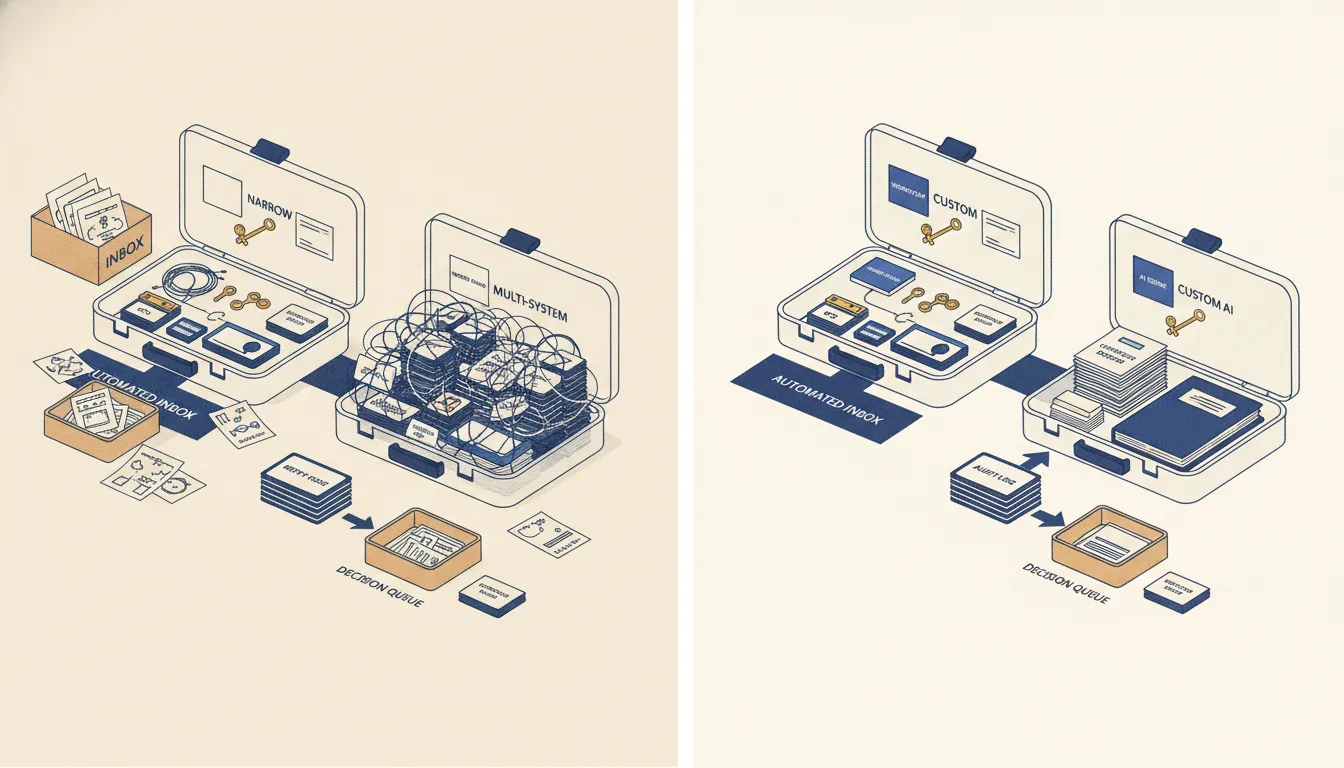
I use three scope bands to help a buyer understand the shape of the engagement. These are market-oriented planning bands, not a quote from me.
Narrow workflow
A narrow workflow handles one defined handoff with stable rules. It may receive a form or email, validate known fields, update one destination, and notify an owner when something is missing.
This is the “few thousand dollars” end of the market when:
- One team owns the process.
- One or two systems are involved.
- The source data is already usable.
- The workflow prepares or routes work rather than making high-risk decisions.
- Exceptions are limited and easy to describe.
- Acceptance criteria can be tested with a small set of known cases.
Multi-system operation
This is not one workflow. It is an operating lane that crosses a CRM, inbox, database, accounting platform, document store, scheduling tool, or line-of-business system.
Cost moves up because the build must decide which record wins, preserve identifiers across systems, prevent duplicates, route exceptions, reconcile destinations, and recover after partial failure. This is where business process architecture matters more than the automation platform.
Custom AI application
A custom application adds a durable interface, user roles, stored data, AI analysis, permissions, usage controls, audit history, and production support around the automation engine.
That can be the right investment when multiple people need to review, correct, approve, or operate the system every day. It should not be confused with adding a chat box to a workflow.
The seven drivers of AI automation consultant cost
A good consultant should be able to explain the price through concrete scope drivers.
1. Source-of-truth uncertainty
If sales says the CRM is correct, finance trusts accounting, operations uses a spreadsheet, and the source document lives in email, the first job is not automation. It is deciding which record has authority at each step.
Uncertainty creates discovery work, reconciliation logic, and exception rules. If nobody can answer which system wins, a cheap build will only move disagreement faster.
2. Integration depth
A native connector that reads a clean record is cheaper than a private API, browser automation, legacy database, file exchange, or undocumented vendor portal.
I also care about write semantics. Can the destination safely accept retries? Does it return a stable identifier? Does it expose webhooks? Can I read the result back? A connector logo does not answer those questions.
3. Data cleanup and migration
Historical data often contains duplicate contacts, inconsistent dates, missing identifiers, stale statuses, and fields that mean different things to different teams.
A workflow built on top of bad data can look successful while producing bad outcomes. Cleanup, mapping, and migration should be visible line items, not surprises discovered halfway through delivery.
4. Authority and approvals
Reading a record is different from changing it. Preparing a draft is different from sending it. Recommending a payment is different from releasing money.
The quote should state what the system may read, prepare, change, send, and spend. I use a simple authority test before expanding any of those permissions.
When AI participates in a consequential decision, I also use the NIST AI Risk Management Framework as a practical governance reference. Model confidence does not replace a named owner or a defined approval boundary.
5. Exception handling
The happy path is usually the cheapest part. Cost rises with the number and seriousness of the uncomfortable cases:
- Required data is missing.
- Two records disagree.
- A person changes a record while the automation is working.
- The destination times out after accepting a write.
- A credential expires.
- An AI result is uncertain.
- An approver is unavailable.
- The same request arrives twice.
If a quote covers only the happy path, it is not cheap. It is incomplete.
6. Production proof
A five-record demo does not prove a system can handle production volume. I want acceptance criteria for accuracy, throughput, cost per unit, duplicate prevention, exception routing, and recovery.
Production proof also means reading the destination back. “The API returned 200” is not the same as “the business outcome is correct.”
7. Ownership and maintenance
The business will change after launch. Fields move. vendors update APIs. Approval rules change. New products appear. A system without an owner drifts.
I prefer builds where the client owns the code, accounts, credentials, data, documentation, and runner. A qualified person on your side should be able to pause the system and understand why it stopped. A named owner, inside your team or outside it, is what keeps the system useful after launch.
The hidden cost below the quote
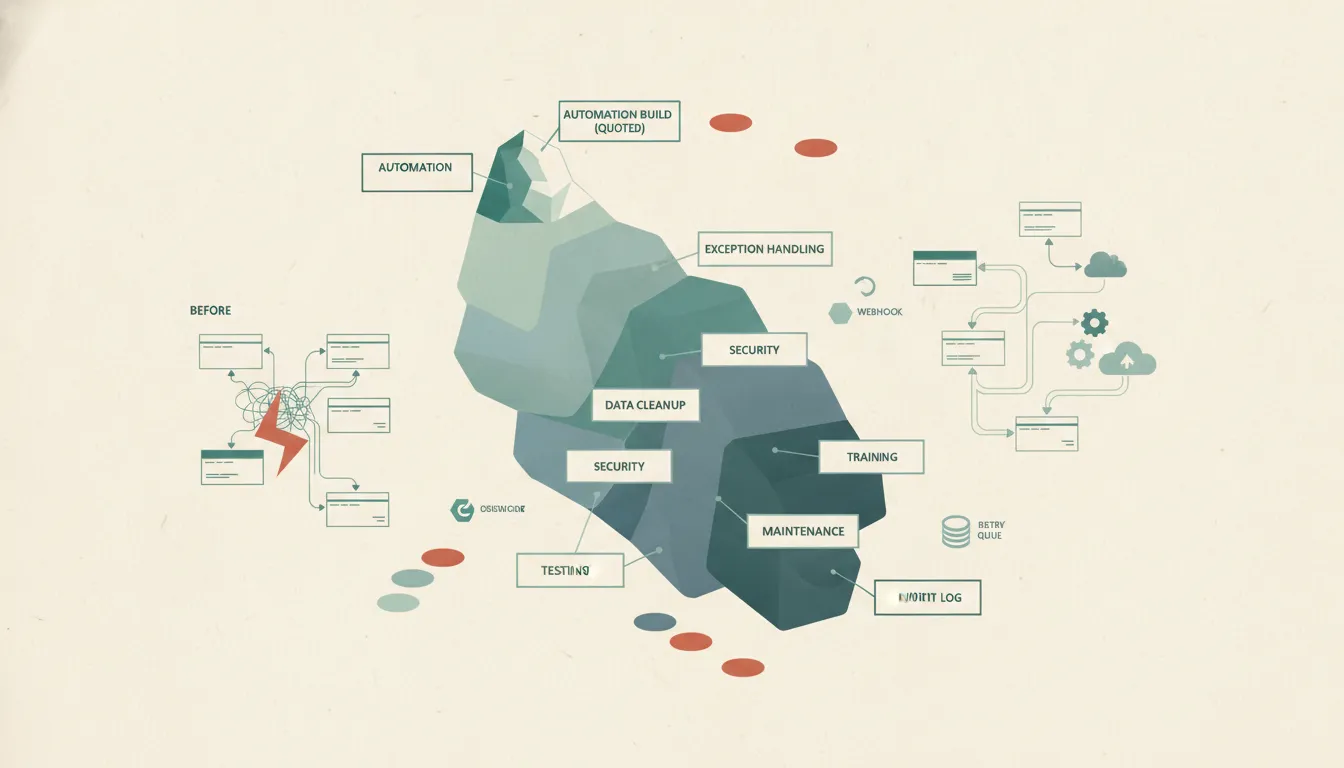
The build fee is only one part of the first-year cost. I ask buyers to separate five buckets:
- Mapping and technical scoping.
- Implementation and integration.
- Production verification and training.
- Software, model, hosting, and data costs.
- Monitoring, maintenance, and improvement.
A proposal can look inexpensive because it leaves out the last three. That does not make those costs disappear. It moves them onto you after launch.
Ask for the expected monthly run cost and the unit behind it. That may be cost per document, account, lead, call, report, work order, or completed case. I would rather expose the cost model before a build than explain a runaway bill after it ships.
How I compare cost with the operating leak
I do not start with “How many hours can AI save?” That question produces inflated spreadsheets.
I map one measurable leak:
- Work waiting between teams.
- Revenue that never reaches billing.
- Leads that miss the response window.
- Quotes delayed by missing information.
- Staff re-entering the same record.
- Exceptions discovered at month-end.
- Managers logging into multiple systems to assemble one decision.
Then I calculate the current annual cost conservatively. I include labor only when the time can actually be recovered or redirected. I include lost revenue only when the handoff can be tied to a real outcome. I include risk only when the business can describe the failure and its consequence.
The build should have a believable path to recovering more value than its first-year cost. If it does not, I recommend a smaller boundary or no build.
The AI Operations X-Ray is the fastest way to map that leaking handoff before asking for a proposal. For a custom build, business process automation services should begin with that operating boundary and end with proof that it works.
What a responsible quote should include
Before comparing providers, whether it is a solo consultant's quote or AI automation agency pricing, I want the quote to answer these questions:
- What business outcome is being protected?
- Which systems and records are in scope?
- Which record owns truth at each step?
- What may the automation read, prepare, change, send, or spend?
- Which exceptions stop the workflow?
- Who owns each exception?
- What are the acceptance criteria?
- What production volume will be tested?
- What monthly software and run costs are expected?
- Who owns the code, credentials, accounts, and documentation?
- How will the system be monitored, paused, corrected, and replayed?
- What maintenance is included and what is separate?
Use my guide to comparing AI automation companies if two proposals look similar. The better partner is usually the one who can explain failure and recovery, not the one with the best demo. My agency vs freelancer vs in-house comparison shows how the cost shape changes with the delivery model.
Red flags in a cheap AI automation quote
I slow down when I see:
- A price before anyone maps the current workflow.
- A tool list instead of a business outcome.
- No source-of-truth decision.
- No exception inventory.
- No production-volume test.
- No duplicate or retry strategy.
- No read-back verification.
- No owner after launch.
- A required monthly platform fee with no export path.
- A promise that AI will replace judgment the business has not defined.
Cheap is useful when the boundary is truly narrow. Cheap is dangerous when the proposal hides the hard parts.
When not to hire me for AI automation
Do not hire one because the team wants to “use AI.” Hire when a specific operating leak is frequent, measurable, stable enough to map, and valuable enough to fix.
I would wait when:
- The process changes every week.
- Nobody owns the outcome.
- The volume is too low to justify a build.
- A checklist, shared inbox, template, or native software rule solves the problem.
- The source data is not trustworthy and nobody is willing to clean it.
- The business has not defined approval authority.
- The core offer or unit economics are broken.
Automation is a multiplier. It will not rescue a process the business does not understand. It can make a bad process run faster and fail at a larger scale.
My buying rule
Do not compare quotes by workflow count, agent count, or promised hours saved. Compare them by operating boundary, authority, production proof, ownership, and recovery.
The honest answer to “How much does an AI automation consultant cost?” is a range. The useful answer is a scoped operating promise.
If the consultant cannot explain what makes the price move, what happens when the system is wrong, and what you own after handoff, the quote is not ready.
If you want a quote built on those terms, my automation services page lists what I build.
More on this: Contract management automation: what to automate first and How to choose a workflow automation consultant.
FAQ
Frequently asked questions
01How much does an AI automation consultant cost?
A narrow workflow may cost a few thousand dollars. A multi-system operation or custom AI application can cost tens of thousands or more. The responsible answer depends on integration depth, data condition, authority, exception handling, production proof, and ownership requirements.
02Why do AI automation quotes vary so much?
Quotes vary because some cover a single rules-based handoff while others include multiple systems, AI judgment, custom interfaces, security, migration, production testing, monitoring, training, and recovery.
03Should I hire an AI automation consultant hourly or fixed fee?
I prefer a fixed fee after the operating boundary and acceptance criteria are clear. Hourly work can fit open-ended discovery or support, but it makes the buyer carry more scope risk.
04What should an AI automation quote include?
It should include the business outcome, systems involved, source of truth, authority boundaries, exceptions, acceptance criteria, delivery phases, software costs, ownership, documentation, monitoring, maintenance, and recovery.
05How does AI automation agency pricing compare with a solo consultant?
An agency prices a team, so the quote carries team overhead along with the build. A solo consultant prices concentrated specialist time. Either way, compare the same scope: operating boundary, exceptions, production proof, ownership, and recovery.