Field note
Updated Sep 30, 2026
How to hire an AI automation consultant: questions to ask
How to hire an AI automation consultant: the questions to ask about scope, proof, ownership, and recovery before a polished demo wins the room.


To hire an AI automation consultant well, start with the operating problem, not the AI vocabulary. A good consultant turns a messy handoff into a clear boundary, explains what can fail, and defines how the business will know the result is correct. A polished demo is nice, and so is a tidy cable drawer, but neither proves the system will survive Monday morning.
I cover this as part of my business process automation services work.
I learned this in proposal work long before every software company added an agent to its homepage. On one build, I reviewed the prospect's specification before recommending the system. I turned the specification into three milestones and said plainly where discovery was still required. The timing was ten days for the first milestone, ten days for the second, and two to three weeks for the third.
That candid gap mattered. I knew the first two parts of the system. One framework in the final phase was new territory, so I named it as discovery instead of hiding it under confident language. My rule is simple: uncertainty belongs in the scope. It should not arrive as an invoice surprise halfway through delivery.
Start with the operating outcome
The first hiring question is not, “Which models do you use?” It is, “What business outcome will this system own?”
A useful answer sounds like this:
- Route complete sales requests to the right owner within the required window.
- Reconcile approved invoices into the accounting record without duplicates.
- Prepare a daily exception list from several operational systems.
- Draft a response from verified records and hold it for approval.
- Detect a failed handoff before a customer has to report it.
A weak answer is “build an AI agent for operations.” That describes a category, not a promise.
Before I quote, I want to know whether a perfect build would materially change your team's day. If it saves a few occasional clicks, a custom system may be the wrong answer. If it prevents revenue leakage, removes a repeated queue, or makes a decision possible without logging into several systems, it may deserve a proper build.
The AI Operations X-Ray helps map that first boundary. When the problem is already clear enough for a custom engagement, business process automation services should begin with the same outcome and end with evidence that it happened.
Ask for a boundary before a tool list
A consultant should map five things before prescribing a stack:
- The trigger that starts the work.
- The records the system may trust.
- The decisions it may prepare or make.
- The destination that proves completion.
- The exceptions that require a person.
This is where many projects expose a deeper issue. Sales trusts the CRM, finance trusts accounting, operations trusts a spreadsheet, and the original request lives in email. No automation tool can decide which record wins unless the business makes that decision first.
That is why business process architecture matters during hiring. The consultant is not there only to connect software. The consultant has to expose record ownership, handoffs, and contradictions before those contradictions become automated.
Ask the candidate to sketch the boundary in plain language. If the explanation requires twenty product logos but cannot name the source of truth, keep looking.
Use paid discovery for real uncertainty
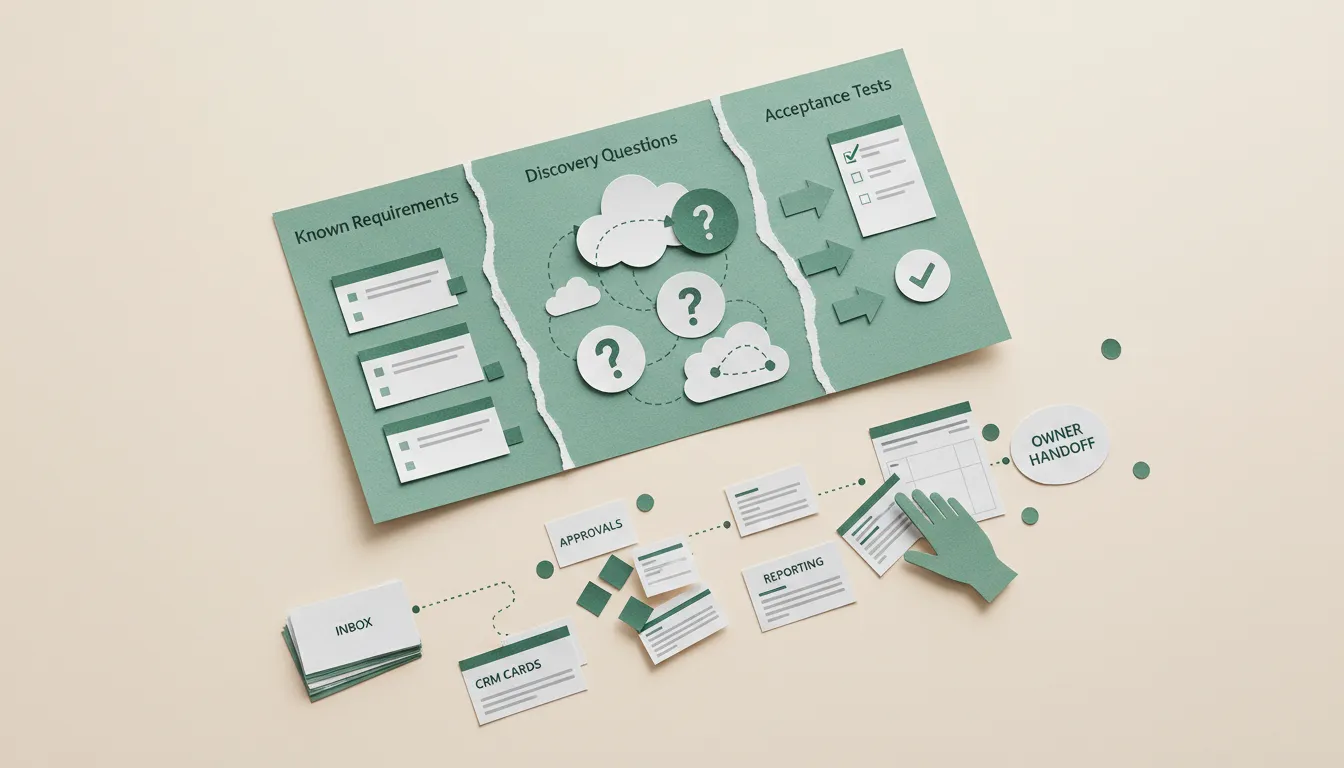
Discovery is useful when it reduces build risk. It is waste when it restates the sales call in a larger document.
A responsible discovery phase should produce decisions such as:
- The source-of-truth record at each step.
- Confirmed API, webhook, file, or browser access.
- Data fields and identifiers required for matching.
- Authority boundaries for reads, writes, sends, and spend.
- An exception inventory.
- Acceptance tests and production volume.
- Security and credential requirements.
- A phased implementation plan.
- A run-cost model.
- Ownership and support responsibilities.
I prefer fixed-fee implementation after those decisions are clear. If the system boundary is still moving, pretending it is fixed only moves the uncertainty into change requests.
A good consultant will also tell you when discovery is unnecessary. One stable form, one destination, known fields, and simple rules may be scoped directly. Ceremony is not the product.
Questions to ask an AI automation consultant about failure
Technical fluency makes someone an AI automation expert, but operating judgment is what protects the buyer. I use scenario questions because they are harder to bluff than a stack discussion.
Ask what happens when:
- The same event arrives twice.
- A destination times out after accepting a write.
- Required data is missing.
- Two records disagree.
- A credential expires overnight.
- An AI result is uncertain.
- An approver does not respond.
- A person edits the record while the workflow is running.
- The vendor changes an API field.
- The workflow is paused for a week and then restarted.
The answer should include idempotency, stable identifiers, retry limits, exception routing, alerts, read-back verification, and a recovery path. It should also identify the person who owns each exception.
The NIST AI Risk Management Framework gives buyers a useful way to ask how AI risks will be governed and measured. CISA's Secure by Design guidance supports the same basic buying principle: security should be part of the design, not an add-on after the happy path works.
For systems that use language models, the OWASP Top 10 for Large Language Model Applications is a practical prompt for questions about prompt injection, sensitive information, unsafe outputs, and excessive agency. You do not need to become the security engineer. You do need a consultant who can explain which risks apply and what controls will be tested.
Define authority before autonomy
“Autonomous” is not a complete requirement. A workflow might be safe to read records and prepare a draft but unsafe to send a message, change a deal stage, release a payment, or delete data.
I separate authority into five verbs:
- Read.
- Prepare.
- Change.
- Send.
- Spend.
The consultant should define where human approval is required for each one. That authority split is the frame I use before expanding a system's permissions.
This also reveals whether the buyer and consultant share the same risk tolerance. A candidate who treats every approval as friction may build something fast and dangerous. A candidate who requires approval for every harmless lookup may build an expensive notification machine. The right boundary depends on consequence, reversibility, confidence, and evidence.
Demand proof beyond the demo
A demo proves that one path worked once. Production proof asks whether the system works at real volume, with real exceptions, and with a recoverable failure.
I want acceptance criteria for:
- Accuracy on a representative test set.
- Duplicate prevention.
- Required-field handling.
- Correct routing.
- Maximum acceptable processing time.
- Cost per completed unit.
- Approval enforcement.
- Destination read-back.
- Alert delivery.
- Pause, replay, and recovery.
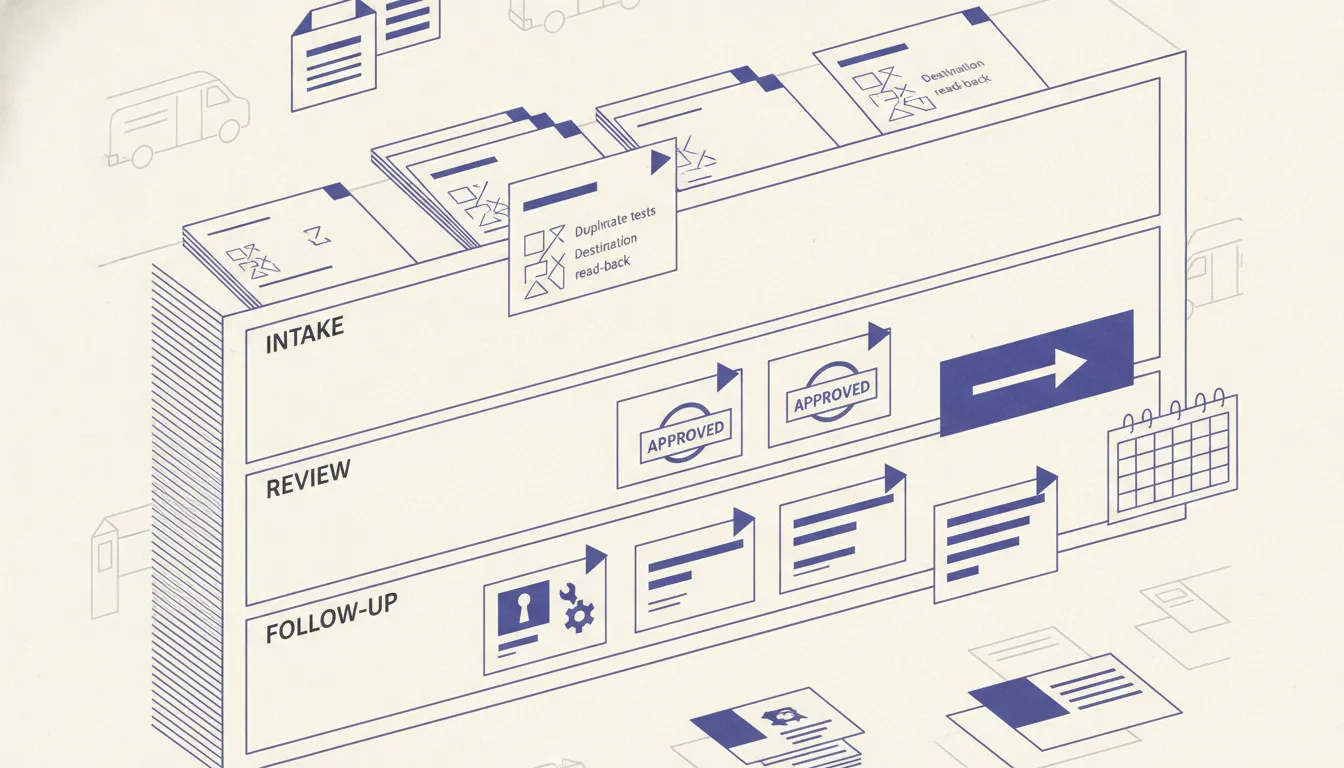
The destination read-back is important. An API response can say the request was accepted while the business record is still wrong. The consultant should verify the actual outcome, not stop at a green workflow node.
Ask for one recovery drill before handoff. Expire a test credential, send a duplicate event, or make a destination unavailable. Then watch whether the system fails visibly, preserves the work, and resumes safely. That tells you more than another perfect demo.
Protect ownership at handoff
You should know what you own before the contract starts.
My preferred handoff, the same one I use on my n8n builds, gives the client ownership of:
- Vendor accounts and billing relationships.
- Code and workflow definitions.
- Data and database access.
- Credentials and secret storage.
- Hosting or runner access.
- Architecture and field maps.
- Operating instructions.
- Test fixtures and acceptance results.
- Monitoring and recovery instructions.
The consultant may continue to maintain the system, but maintenance should not depend on holding the business hostage. A qualified person on your side should be able to pause the workflow, inspect its state, and move the system to another maintainer.
My guide to comparing AI automation companies covers the same issue for larger providers. Company size does not replace clear ownership. If you are unsure whether you need one consultant or a whole agency, my agency vs freelancer vs in-house comparison covers that choice.
Compare proposals on scope, not spectacle
When two proposals look similar, compare them across these questions:
| Buying question | Strong proposal | Weak proposal |
|---|---|---|
| Outcome | Names the business result | Names the AI tools |
| Boundary | Defines records and systems | Lists connectors |
| Authority | Separates read, change, send, and spend | Promises autonomy |
| Exceptions | Names failure paths and owners | Covers the happy path |
| Proof | Defines acceptance and read-back | Promises a demo |
| Ownership | Gives the client durable control | Hides key accounts |
| Recovery | Includes pause, replay, and support | Says monitoring is included |
Price matters, but compare like with like. My AI automation consulting pricing guide explains why integration depth, data condition, authority, proof, and recovery make quotes move.
I would rather receive a narrower proposal that explains its exclusions than a broad proposal built from assumptions. Exclusions can be planned. Hidden assumptions become delays.
When not to hire me for this
You do not need me, or another AI automation consultant, when:
- A native rule in software you already own solves the problem.
- The task happens too rarely to justify a custom build.
- The process changes every week.
- Nobody owns the outcome.
- The source data is unreliable and nobody will fix it.
- The team wants AI mainly because other firms mention it.
- The business cannot define what a correct result looks like.
A checklist, shared view, template, or small configuration change can be the better decision. I would rather recommend that than install a custom system your team resents maintaining six months later.
My final hiring test
Hire an AI automation consultant who makes the problem clearer before making the technology sound impressive.
The right consultant should be able to state the operating outcome, map the trusted records, define authority, expose uncertainty, price discovery honestly, test exceptions, prove the destination, and hand over durable control.
If a candidate cannot explain what happens when the system is wrong, what you own after delivery, and how the workflow recovers, the proposal is not ready. If they can answer those questions in plain language, you are evaluating someone who understands operations, not just a tool builder.
If you want to see what I build before you ask me these questions, my automation services page lists it.
More on this: Contract management automation: what to automate first.
FAQ
Frequently asked questions
01When should I hire an AI automation consultant?
Hire when a repeated operating problem has a named owner, measurable consequence, stable enough rules, and enough value to justify a custom build. If the process changes weekly or a native software rule solves it, wait.
02What should I ask an AI automation consultant?
Ask what record owns truth, what the system may read or change, how exceptions are handled, how production proof works, what you own after handoff, and how the workflow is paused and recovered.
03Should an AI automation consultant offer paid discovery?
Yes, when systems, data, rules, or security constraints are not clear enough for a responsible fixed scope. Discovery should produce decisions and a buildable plan, not a longer sales document.
04How do I compare AI automation proposals?
Compare the operating boundary, acceptance criteria, exception coverage, ownership, security, run costs, and recovery plan. Workflow counts and agent counts are weak substitutes for those answers.
05When should I not hire an AI automation consultant?
Do not hire one to rescue a process nobody owns, automate very low volume work, replace a checklist that already works, or add AI because the team feels behind. Fix the operating decision first.
06Is an AI automation expert the same as an AI automation consultant?
Often it is the same person, but the titles hide a real difference. An AI automation expert may only build what you ask for, while a consultant should also challenge the scope, name the source of truth, and say when not to build. When you hire, test for both: can they map the problem, and can they ship a tested system?