Field note
Updated Sep 30, 2026
AI automation for small business: what to buy first
AI automation for small business works best as one narrow build: a repeated handoff, one owner, one measurable result. Here is how to pick what to buy.


AI automation for small business should remove a costly operating gap without giving the owner a new system to babysit. The best first service is usually narrow: one repeated handoff, one named owner, one measurable result, and one recovery path. Buying “AI transformation” before defining that lane is a reliable way to purchase a very expensive vocabulary lesson.
I cover this as part of my business process automation services work.
On one recruiting build, I repaired a personalization failure and backfilled 351 of 352 lead records with zero script errors. A second pass found and repaired 95 orphan records. The important service was not “add AI to outreach.” It was diagnose the production fault, correct the rule, repair existing records, and return proof that the live data was usable again.
I have also mapped operations where people logged into 20 accounts once or twice a day because that was all the schedule allowed. A controlled system could check the work four or five times a day and continue outside working hours. My opinion is simple: buy automation where better coverage changes a business result, not where AI merely makes a task look more modern.
Start with the operating problem, not the service menu
Small businesses rarely need an abstract AI strategy first. They need a leaking handoff fixed.
A useful starting problem sounds like this:
- Qualified leads wait too long for an owned response.
- Approved quotes require the same details to be typed into several systems.
- Completed work reaches billing without the required evidence.
- Customer replies sit in an inbox while a sequence keeps running.
- Managers log into several tools to discover the same daily exceptions.
- Records disagree and nobody knows which system owns the truth.
These are operating problems. They can be measured, observed, and accepted against real examples.
A weak starting problem sounds like “we need an AI agent.” That statement does not identify the trigger, trusted record, allowed action, exception owner, or proof of completion. It tells the provider which category page the buyer has been reading.
I use the AI Operations X-Ray to rank the gaps before recommending a build. If the problem is already clear and crosses several systems, business process automation services should still begin with one promise the owner can verify.
The SBA Office of Advocacy reports that small firms have been closing the AI adoption gap. That makes the buying decision more immediate, but it does not make every process a good automation candidate.
Know which AI automation services you are actually buying
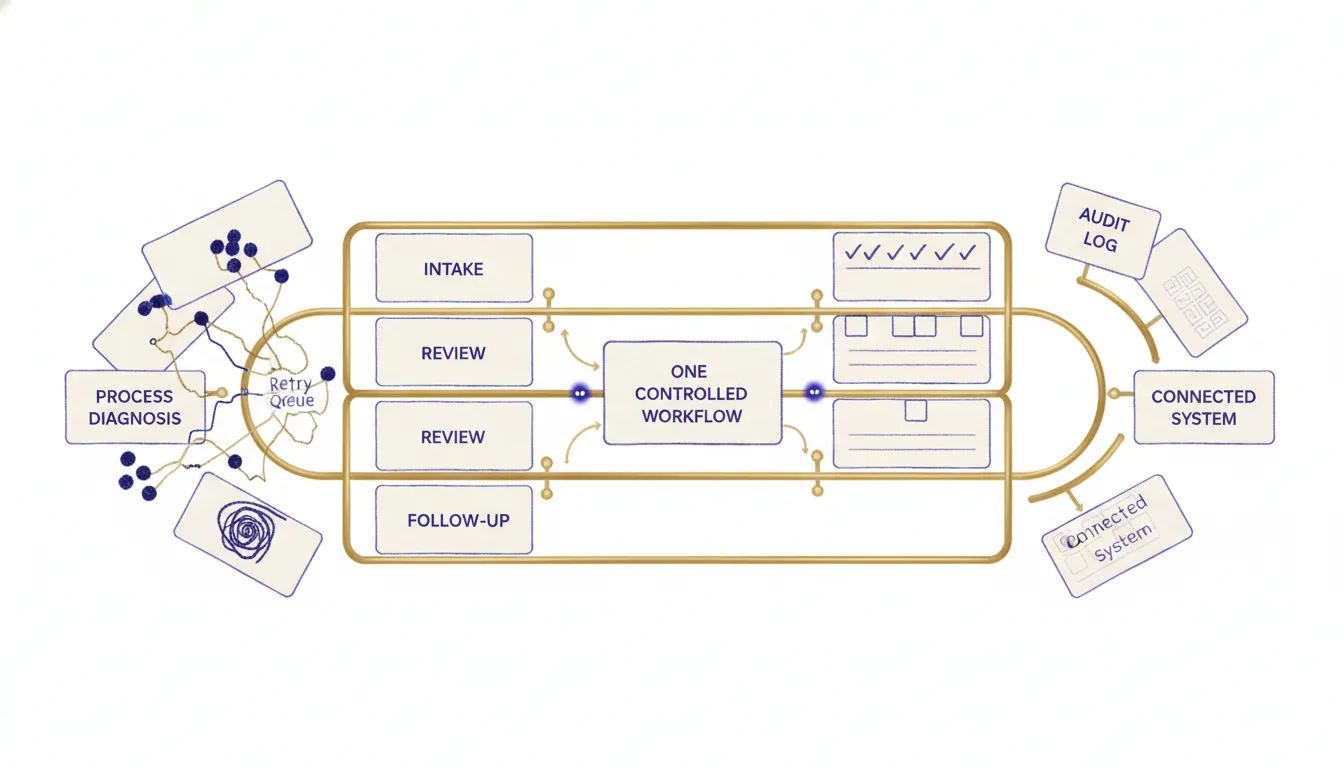
“AI automation services” can describe several different products. They should not be priced, scoped, or judged the same way.
Opportunity diagnosis
This is a short engagement to identify the highest-value lane, map the current process, find source-of-truth conflicts, estimate operating consequences, and decide whether automation is justified.
Buy this when several departments describe the problem differently, the process is mostly tribal knowledge, or the first build is not obvious. The output should be decisions and a buildable boundary, not a larger collection of ideas.
Workflow implementation
This service owns one defined result across known systems. It may include intake, validation, enrichment, AI preparation, approval, destination updates, alerts, and reconciliation.
Buy this when the process has a stable owner and clear acceptance tests. This is usually the best first custom engagement for a small business because the value and risk can be contained.
AI-assisted decision support
This service prepares a decision rather than making it. Examples include drafting replies, classifying requests, summarizing account changes, extracting fields, or producing an exception brief.
Buy this when judgment is useful but the final action affects money, customer trust, employment, safety, or an irreversible record. Preparation is easier to test and reverse than unattended action.
Operating system build
This connects several workflows, records, queues, dashboards, and permissions into one operating layer. It may support sales, delivery, finance, or recruiting across the day.
Buy this after one or two lanes have proved their value. A broad system built before the business understands its first controlled workflow tends to automate contradictory rules.
Maintenance and improvement
This covers monitoring, vendor changes, rule updates, failure recovery, model evaluation, cost review, and new releases.
Buy this when the system owns meaningful work and the business changes often enough that drift is inevitable. Maintenance should be planned, but it should not become lock-in. The company should keep the accounts, data, code, documentation, and ability to move to another qualified maintainer.
A five-part fit test for small business AI automation
I use five questions to decide whether a small-business process deserves custom automation.
Is the work repeated enough?
A task that happens twice a month may not justify software. A checklist, template, or saved view can be the better answer. Frequency is not everything, but it matters when the goal is reducing recurring handling.
Are the rules stable enough?
If the team changes the definition of a qualified lead, approved quote, complete job, or payable invoice every week, the automation will become a fast-moving argument. Stabilize the decision first.
Is the consequence meaningful?
The lane should affect response time, revenue, delivery capacity, billing readiness, customer experience, compliance, or management visibility. Saving clicks is not the same as changing the business. My AI automation consulting pricing guide shows how to weigh a build against the leak it fixes.
Does one person own the result?
Every active item and exception needs an owner. A workflow cannot create accountability where management has avoided assigning it.
Can the result be proved?
The provider and buyer should be able to agree on a representative test set and a visible destination. If nobody can define a correct outcome, nobody can accept the build responsibly.
This is where AI automation consulting should earn its fee. The provider should make the operating decision clearer before making the technology sound impressive.
Compare providers on control and proof
A provider should explain the system in plain business language. I want to hear which record starts the work, what the system may read or change, where it stops, who handles exceptions, and how the destination is verified.
Use this scorecard:
| Buying question | Strong answer | Weak answer |
|---|---|---|
| Outcome | Names one measurable business result | Promises efficiency |
| Source of truth | Names the authoritative record | Lists integrations |
| Authority | Separates read, prepare, change, send, and spend | Promises autonomy |
| Exceptions | Names owners, deadlines, and recovery | Says errors are logged |
| Proof | Defines acceptance tests and destination read-back | Offers a demo |
| Ownership | Uses client-controlled accounts and exports | Hides key infrastructure |
| Support | Defines monitoring, maintenance, and response boundaries | Says support is included |
| Economics | Separates build, software, usage, and maintenance | Gives one vague total |
My guide on how to hire an AI automation consultant goes deeper on discovery and recovery. My guide to comparing AI automation companies is useful when comparing larger delivery teams.
Do not give extra credit for the number of agents, workflows, or product logos in a proposal. Those counts can describe complexity without describing value.
Require client ownership from the first day
Small businesses are especially exposed when one outside builder controls the hosting, credentials, billing accounts, or only copy of the workflow.
My preferred ownership model gives the client control of:
- Vendor and infrastructure accounts.
- Source code and workflow definitions.
- Data and database access.
- Credentials and secret storage.
- Field maps and business rules.
- Test fixtures and acceptance results.
- Monitoring and alert destinations.
- Pause, replay, and recovery instructions.
- Export and shutdown procedures.
The provider can manage those assets during delivery and continue under a support agreement. The relationship should survive because the service is useful, not because the business cannot leave.
Security belongs in this conversation too. CISA places cyber readiness responsibility with business leadership, not only with a vendor. The owner does not need to become a security engineer, but someone inside the business must approve access, understand where data moves, and know how credentials are revoked.
For AI-assisted work, the NIST AI Risk Management Framework provides a practical structure for governance, mapping, measurement, and management. The scale of the controls should match the consequence of the workflow.
Acceptance testing is part of the service
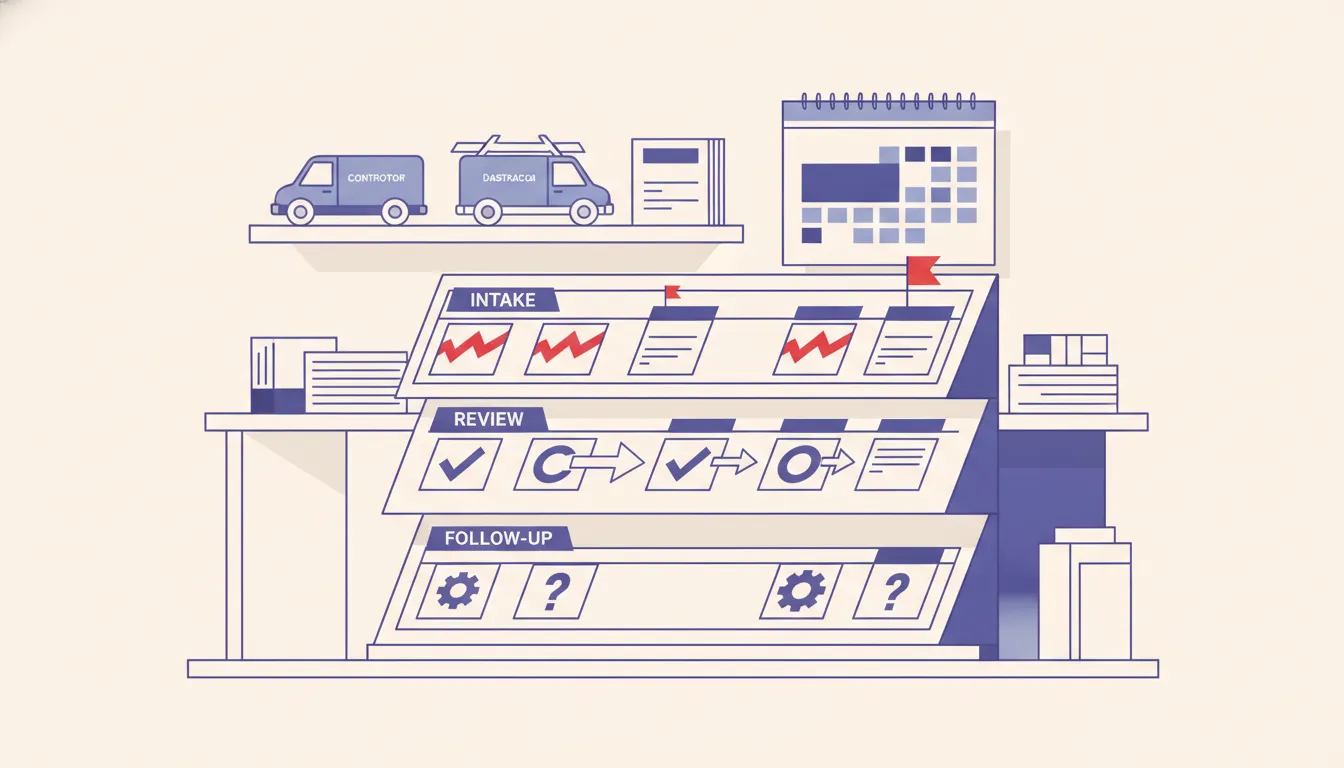
A green workflow run is not proof that the business result happened.
Before launch, I want the provider to test:
- A normal item from start to finish.
- The same item arriving twice.
- A required identifier being missing.
- Two records disagreeing.
- A destination timing out after accepting a write.
- A model returning an uncertain or malformed result.
- An approver not responding.
- A credential expiring.
- A paused workflow being restarted safely.
- The final destination being read back and compared with the source.
The result should state what passed, what failed, which records were affected, and what was done to recover. This is the same reason I test accounting automations for failure: quiet errors can leave every technical service online while the business record is still wrong.
The provider should also test the stop control. The owner must be able to pause one dangerous lane without shutting down every useful automation around it.
When not to hire me for small-business automation
Do not start with the process that has the most visible AI potential. Start with the process that has a stable boundary and a consequence worth controlling.
I would defer a build when:
- Nobody owns the result.
- Inputs are unreliable and nobody will correct them.
- The decision changes every week.
- Volume is low enough for one person to handle safely.
- A native software feature already solves the problem.
- The proposed result is more generated content without a business event.
- The business cannot explain what happens when the system is wrong.
- The provider requires broad access before proving a narrow use case.
You do not need me for a configuration change, a reliable checklist, or a process one person can already see end to end. Custom software is not a prize for finding a repetitive task.
The FTC's AI business guidance is another reason to stay specific. Claims about AI capability and results should match what the system actually does. A measured operating promise is easier to test and defend than a broad claim about an intelligent business.
My recommendation for the first engagement
Buy one workflow implementation with a short discovery boundary, client-owned accounts, explicit approval rules, a representative test set, destination read-back, and written recovery instructions.
Choose a lane tied to revenue, customer response, delivery, billing, or management visibility. Keep the first release narrow enough that the current manual process and automated result can be compared side by side.
Then decide whether the evidence supports expansion. If the workflow reduces real handling, catches exceptions earlier, and remains understandable to the owner, build the next lane. If it does not, fix the process or stop.
That is what useful AI automation services for small business look like. They do not begin with a transformation slogan. They begin with one piece of work the business can control, prove, and own.
If you want to see what a first lane looked like for other businesses, my case studies show real builds.
FAQ
Frequently asked questions
01What are AI automation services for small business?
They are scoped services that use integrations, rules, software, and sometimes AI to complete or prepare recurring business work across the systems a company already uses. A good service includes discovery, implementation, testing, ownership, and recovery, not just a workflow demo.
02What should a small business automate first?
Start with a repeated, rules-based handoff tied to revenue, customer response, delivery, billing, or management visibility. The process should have a named owner, stable inputs, enough volume, and a clear definition of done.
03How do I compare AI automation providers?
Compare the operating outcome, source of truth, authority boundaries, exception handling, acceptance tests, account ownership, recurring costs, support, and recovery plan. Tool lists and agent counts are weak buying signals.
04Do small businesses need custom AI automation?
Not always. Native rules, templates, saved views, and documented checklists are often enough for low-volume or simple work. Custom automation earns its place when several systems, repeated judgment, or costly exceptions make the manual lane unreliable.
05How long does small-business automation take?
It depends on the number of systems, data condition, approval rules, exception paths, and proof required. A narrow first workflow can move quickly, while a multi-department operating system needs phased discovery, testing, and handoff.
06Is small business AI automation worth the cost?
It is when the lane is repeated, stable, owned, and tied to revenue, response time, delivery, or billing. Compare the build against what the leak costs you today, not against the cheapest demo. If a native software feature or a checklist fixes it, that is the better buy.