Field note
Sep 20, 2026
Back office automation: prove who owns the next handoff
Back office automation needs proof of ownership, not just completed tasks. I explain how to test acceptance, exceptions, and recovery before a wider rollout.


Back office automation should move administrative work to a verified outcome, with a named owner when the normal path stops. I start with the handoff, not the software list. Sending a request is useful. Proving that the right person accepted responsibility is the part I want to buy. Otherwise I have built a very efficient way to move the problem to somebody else's inbox. An achievement, technically.
That distinction showed up clearly in a recent controlled voice-intake pilot. I tested a transfer where the receiving endpoint answered but never performed the required acceptance step. The phone connection ended normally after 16 seconds. I recorded the transfer as declined, not connected, and preserved a callback request.
That was a synthetic acceptance test, not a customer outcome or a claim that a live office had adopted the system. But it exposed the buying question I care about: what does this system call success when nobody has actually taken the work?
The same question belongs in the gap between operations and finance. An invoice can arrive in an approval queue without an approver accepting it. A purchase request can reach a manager without permission to commit funds. A service team can mark work complete while billing still lacks the evidence it needs.
I do not want automation to make those gaps disappear from the report. I want it to make them harder to ignore.
What back office automation should actually cover
I use back office automation to describe the internal work around a business promise: collecting records, checking required information, preparing decisions, routing approvals, and reconciling the result. The tools may sit in finance, HR, procurement, or operations. The process often crosses all of them.
I separate that internal work from the customer-facing interaction. My voice test happened at an intake boundary, but its lesson applies to the administrative handoff after the conversation: a transport event does not prove that a person owns the follow-up.
For a first project, I would scope one complete handoff. For example, operations submits a billing-ready job packet, finance accepts or rejects that packet, and an unresolved exception remains visible until somebody resolves it. That is an illustrative design, not a claim about the pilot.
I would not begin with “automate the back office.” That phrase can hide several different projects and several people who believe somebody else is responsible.
Our business process automation work starts by defining that boundary. I want a clear starting event, an authorized next action, and evidence that the intended result reached its destination.
A completed software step is not an accepted handoff
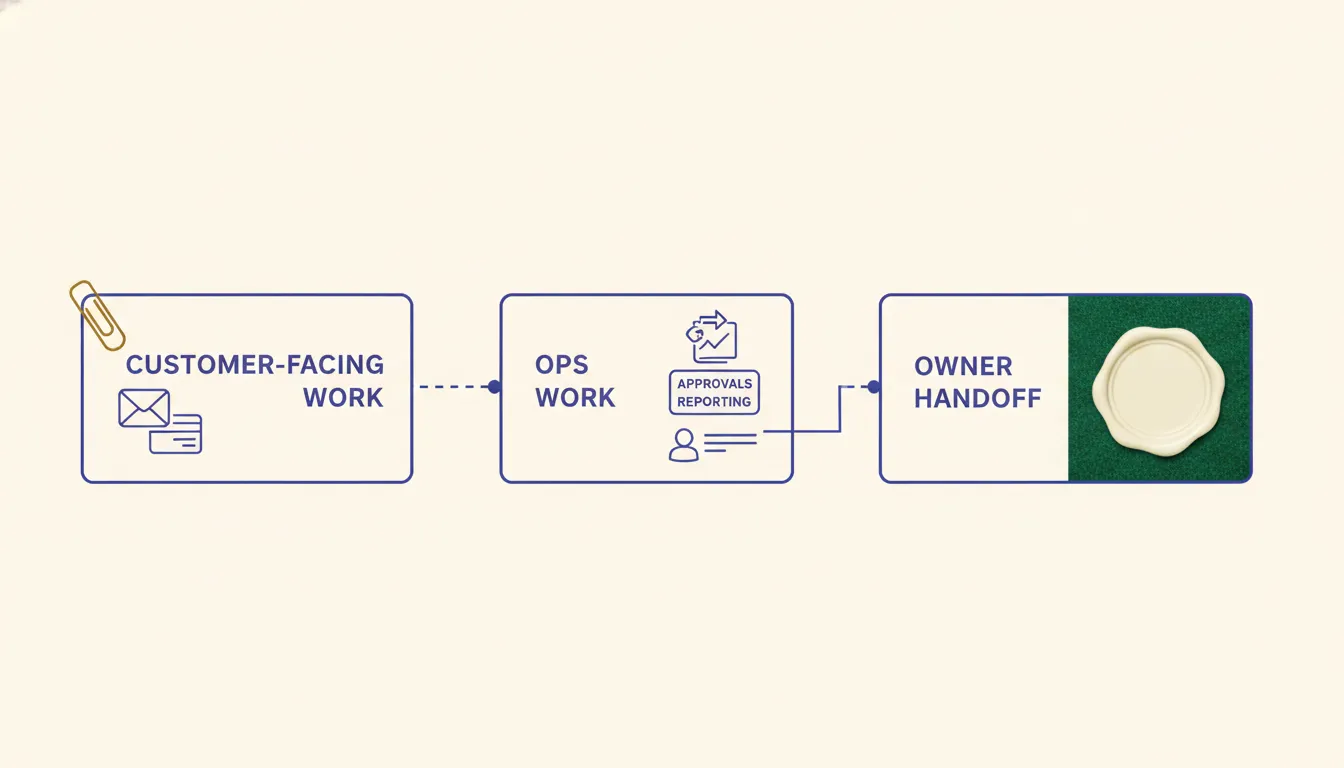
The provider's status was not wrong in my test. I would have been wrong to interpret it as a business outcome.
Twilio explains that a completed call can have been answered by a person, a phone menu, or voicemail. That is a useful connection status. It cannot tell me whether the intended person accepted responsibility for the caller.
I apply the same skepticism to ordinary office systems. “Sent” tells me an attempt happened. “Created” tells me a record exists. “Approved” is only useful if I know who approved what, using which version of the request.
I want the operating record to distinguish these states:
- Received: the source request exists and has an identity.
- Prepared: the required information is ready for a decision.
- Routed: the request reached the designated destination.
- Accepted: the next owner explicitly took responsibility.
- Completed: the authorized business action happened and its evidence was checked.
- Exception: progress stopped and a named owner owes a decision.
These are design choices, not a demand for another platform. A small team can express them in an existing system. What matters is that routing cannot silently stand in for acceptance.
I use this workflow management operating model to separate responsibility from activity. A board full of moved cards can still contain a queue of unattended promises.
Decide where the automation must stop
I prefer systems that the operating team can inspect and troubleshoot. A black box that performs impressive work but hides the reason it stopped is a poor handoff to the people who have to run it.
I have described an email-to-spreadsheet design in four steps: receive the email, analyze it, parse the result, and send the data to the sheet. That is a useful way to explain a small workflow. It is not four steps of business authority. The analysis step does not grant permission to approve an expense, alter a commitment, or tell a customer something is settled.
Before I connect finance and operations, I want the owners to answer a narrower question: which facts permit the next action, and which missing facts force a stop?
For a billing packet, I would ask who can confirm delivery, who can resolve a disputed amount, and who can authorize an adjustment. For a purchase request, I would ask who owns the budget and whether an amended request invalidates the earlier approval.
I do not assign those rights to the automation because it can technically update the record. I encode the rights the business has already decided.
The NIST AI Risk Management Framework offers a voluntary framework for managing AI risk across design, use, and evaluation. My practical application is modest: identify the consequence, name the authorized decision-maker, and test the limit before expanding access. I do not treat the framework as a certification or a substitute for industry-specific obligations.
Make the exception survive the failure
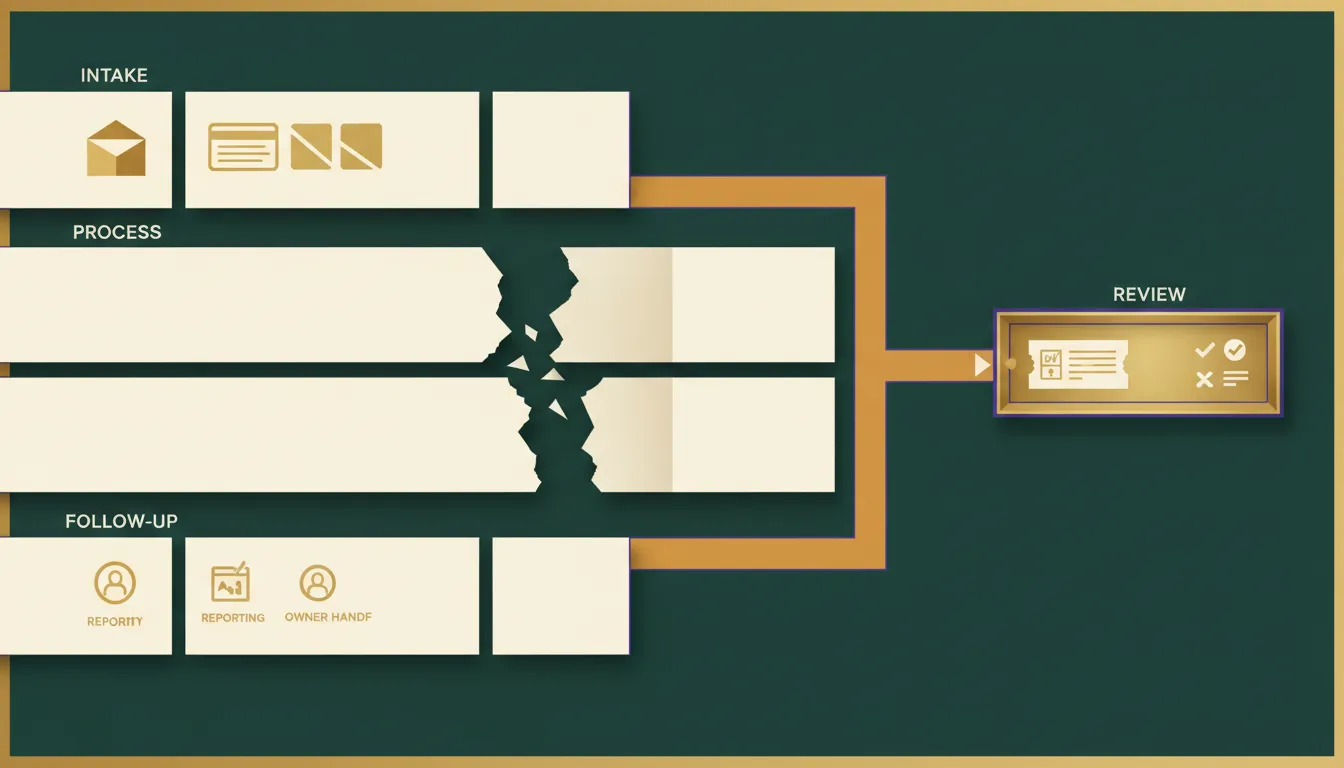
In the same controlled pilot, I tested what happened when the application was unavailable. The fallback was hosted separately from the failed application. It could still play an unavailable message instead of leaving the caller dependent on the component that had just stopped working.
I deliberately kept that message limited. It was not a booking confirmation or a promise that somebody would call back at a particular time.
That is the pattern I would carry into an administrative process. If the integration service is down, an alert that depends entirely on that service may not help. If the approver is unavailable, routing the request back to the same unattended queue is not escalation.
I want the exception path to preserve the original request, explain what has and has not happened, and leave a next action with someone who can take it. The fallback should not silently broaden authority. A failed approval process is not permission to approve by default.
I also want an honest recovery rule. Once the dependency returns, should the request resume automatically, wait for a review, or be compared against the destination first? Those are business decisions with technical consequences.
For finance-related work, I use the silent failure test for accounting automation to ask whether the operation can expose a missing or inconsistent record before it reaches reconciliation. A clean error log does not answer that question by itself.
Test the handoff before buying a wider rollout
I ask for a demonstration of the awkward cases, not just a clean request moving through the happy path.
First, send a valid request and verify that the intended owner accepts it. Then leave a request unaccepted. The system should show the difference without somebody reading every message manually.
Next, change the request after approval. I want to see whether the existing approval still applies or whether the system requests a new decision. That protects against approving one amount and acting on another.
Then submit the same request again. I want evidence that recovery will not create a second commitment. Stripe's idempotent-request documentation shows one concrete mechanism for retrying an operation without accidentally performing it twice. I would not assume every connected system offers that protection or that it lasts indefinitely. The delivery team must prove the actual retry behavior of the systems involved.
Finally, interrupt the dependency and recover it. Check the destination before replaying consequential work. A timeout does not necessarily mean nothing happened.
I would ask the builder to leave the results in a form an operator can understand:
| Test situation | Evidence I want | What must not happen |
|---|---|---|
| Nobody accepts the request | Open exception, named owner, next action | Routed becomes completed |
| Approved details change | Revised request and renewed authority where needed | Old approval silently covers new work |
| Duplicate or uncertain request | Destination comparison and controlled retry | Duplicate commitment |
| Service becomes unavailable | Independent failure path and preserved request | Work vanishes or approval is bypassed |
This is the sort of proof I expect when hiring a workflow automation consultant. A working demonstration is necessary. It is not the whole acceptance test.
Measure less chasing, not more software activity
I would baseline how long work waits between teams, how often someone must chase an owner, and how many exceptions remain unresolved past the team's agreed deadline. Then I would compare the same measures after the pilot.
I keep routed, accepted, and completed counts separate. If routing rises while acceptance stays flat, I have made delivery faster without proving that the operation improved.
I also separate controlled test evidence from production evidence. My synthetic pilot proved specific failure behavior under specific conditions. It did not establish customer adoption, labor savings, or a revenue increase. Those require observation after authorized rollout.
The decision to expand should rest on verified outcomes and manageable exception work. I would rather run a smaller process that the team trusts than connect every department to an ambiguous success label.
When not to hire us for this
You do not need us for this if a clear owner, an existing approval feature, and a shared queue solve the problem. I would try that before commissioning a custom integration.
I would also pause when nobody can define acceptance or agree on decision authority. Software can enforce a rule. It cannot settle an unresolved ownership dispute just by moving the request faster.
If the existing systems work and the gap is between them, I would consider improving the handoffs around legacy systems rather than replacing the applications. The scope should reflect the integration depth and the decisions involved, not the number of screens in the demo.
For a broader operation, the AI Operations X-Ray can help identify the first handoff worth examining. My starting question stays the same: when this system says the work moved forward, who actually has it now?
FAQ
Frequently asked questions
01What is back office automation?
I use the term for software that moves internal administrative work through defined steps, such as validating records, preparing approvals, and reconciling outcomes. I keep consequential decisions with the authorized owner rather than treating automation as permission to act.
02Is the back office a CRM?
No. I treat the CRM as one possible system in the process. Finance, HR, procurement, and operations may own different records, so the handoff must define which system and person control each decision.
03What are some examples of back office tasks?
Invoice intake, purchase-request routing, employee onboarding, record reconciliation, and exception follow-up are common examples. I select the first task by the cost of a missed handoff and the availability of reliable evidence, not by how impressive the demo looks.
04What should remain under human approval?
I keep payment release, material changes to commitments, and sensitive exceptions behind explicit authority rules. A system may prepare the evidence and route the request without gaining permission to approve it.
05How do I know whether an automated handoff worked?
I look for destination evidence that the next owner accepted the work, then separate that from proof the business action was completed. A sent message, updated task, or successful software run alone does not establish either outcome.