Field note
Updated Sep 30, 2026
How to choose a workflow automation consultant
How to choose a workflow automation consultant: look for one clear outcome, owned records, production proof, and a handoff your team can actually use.


To choose a workflow automation consultant, look for the one who can turn one expensive operating problem into a controlled, measurable system your team can own. The job is not to leave you with a colorful workflow canvas and a cheerful promise that it ran once. Apparently, “it ran” is not a business outcome, which has ruined many tidy demos for me.
I cover this as part of my business process automation services work.
I learned this again on a recent delivery. The underlying system worked, but the client still needed a 190-row self-test tracker before the work felt complete. The missing piece was not another integration. It was a shared way to see every requirement, result, exception, and acceptance decision.
My rule now is direct: proof is part of the product. If a consultant treats visibility for your team as a later dashboard request, the build is not fully scoped.
Start with the operating outcome
The first useful question is not, “Which automation tool do you use?” It is, “What must happen reliably after this engagement?”
A clear outcome might be:
- Every qualified lead reaches the correct owner within the response window.
- Every approved invoice creates one accounting record or one visible exception.
- Every recruiting intake produces a complete candidate brief before review.
- Every service request is assigned, acknowledged, and tracked to closeout.
- Every failed handoff has a named owner and a safe replay path.
That outcome gives the engagement a boundary. It also exposes whether the problem belongs in business process automation services, a native software configuration, or a simpler operating change.
I want a buyer to name the current cost of the failure without inventing a heroic hours-saved spreadsheet. Delayed revenue, duplicate work, missed response windows, unreconciled records, and manager review time are useful measures when they can be observed. “Use more AI” is not one.
Require a boundary before a proposal
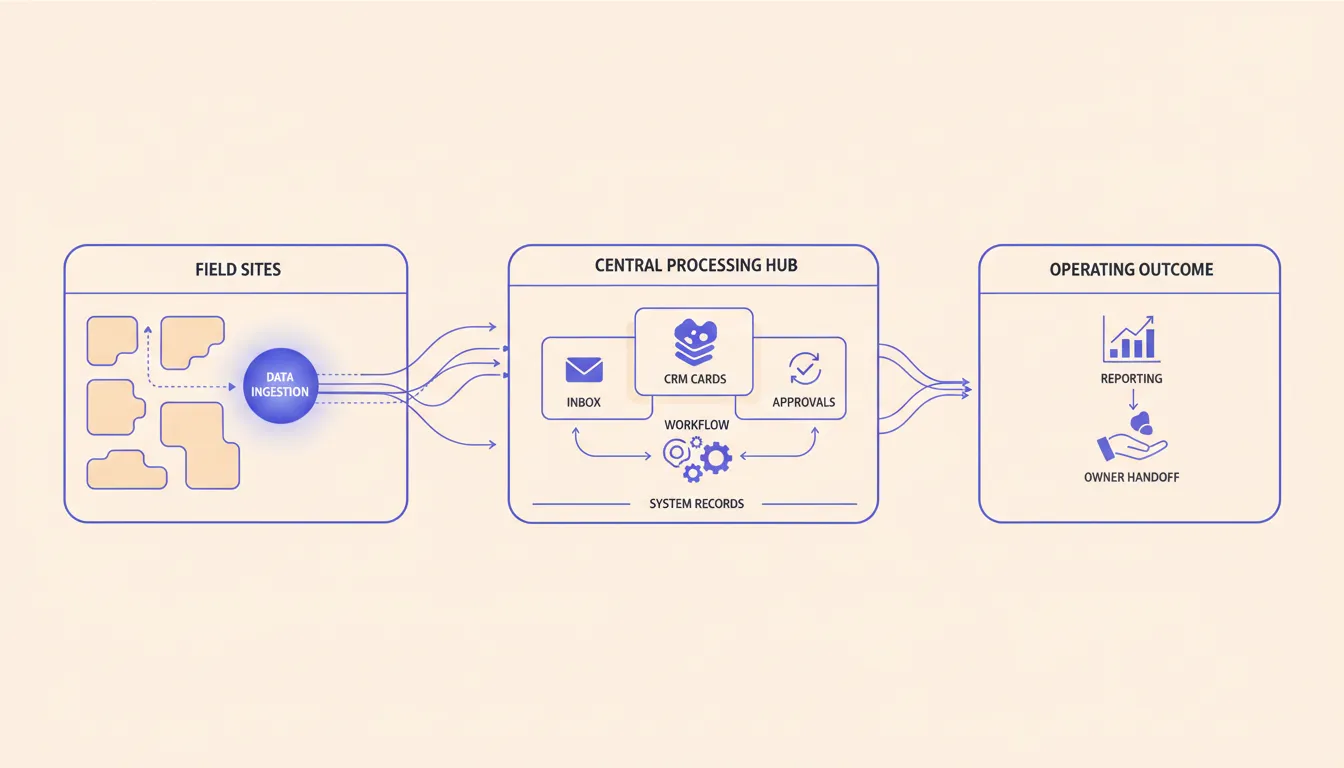
A responsible consultant should map the lane before pricing the build. The map does not need to become a six-week ceremony. It needs to answer the decisions that make the workflow safe to operate.
I use six boundary questions:
- Trigger: What event starts the work?
- Source of truth: Which system owns each consequential fact?
- Authority: What may the system read, prepare, change, send, or spend?
- Exception: What conditions stop the happy path, and who owns them?
- Proof: What record demonstrates that the business result happened?
- Recovery: How does someone on your team pause, correct, replay, or complete the work manually?
This is the practical core of business process architecture. A connector diagram shows where data moves. A process boundary shows which record wins when two systems disagree and what happens when a destination accepts a write but never returns a useful confirmation.
The proposal should reflect that boundary. If it lists applications, workflow counts, and AI models but never names the authoritative record or exception owner, it is describing activity instead of delivery.
Judge workflow automation consulting by the decisions it produces
Discovery is useful when it removes uncertainty from the build. It is waste when it produces a large document that avoids every hard decision.
By the end of discovery, I expect:
- A current-state lane from trigger to business outcome.
- A target-state lane with the manual and automated steps separated.
- A system-of-record decision for each important field or status.
- An authority table for reads, drafts, writes, sends, approvals, and spend.
- An exception inventory based on cases the team actually sees.
- Acceptance criteria using representative records and real operating volume.
- A delivery sequence that proves the narrowest valuable path first.
For AI-assisted decisions, the NIST AI Risk Management Framework is a useful reference because it puts governance, context, measurement, and management around the system. Its companion AI RMF Playbook also makes roles, monitoring, documentation, and human oversight explicit.
I do not expect every small business to adopt a federal framework line by line. I do expect the consultant to answer the same operating questions in plain language.
Ask how the system fails
The happy path is easy to demonstrate. Buyers should spend more time on the uncomfortable paths:
- The incoming record is missing a stable identifier.
- The same request arrives twice.
- Two systems disagree about status.
- A credential expires during a scheduled run.
- The destination times out after accepting a write.
- An AI result is uncertain or malformed.
- An approver is unavailable.
- A person edits the record while the automation is working.
- A retry creates a duplicate customer action.
A real workflow automation expert can describe the detection rule, owner, response window, and recovery step for each material exception. My guide on how to hire an AI automation consultant has more scenario questions like these.
That is also why I use a simple authority test before allowing a system to take consequential action. Preparing a message is different from sending it. Drafting a payment record is different from releasing funds. Confidence is not permission.
NIST SP 800-53 provides a broad security and privacy control catalog that includes accountability, monitoring, configuration, incident response, and recovery concerns. A buyer does not need to turn a sales automation into a federal compliance program. The consultant still needs a credible answer for access, logs, change control, failure response, and recovery.
Make production proof contractual
A demo proves that the consultant can make the expected example work. Production proof shows whether the system keeps the operating promise with real records, volume, timing, permissions, and exceptions.
I want acceptance tests to cover:
- Count reconciliation: Did every accepted input create exactly one expected result?
- State reconciliation: Did the result reach the authoritative record?
- Duplicate prevention: Did retries avoid repeated customer or financial actions?
- Exception visibility: Can your team see what stopped and why?
- Permission limits: Can each component perform only its required actions?
- Age checks: Can the team find work that stopped moving?
- Read-back verification: Does the destination confirm the business record, not merely an API response?
- Recovery: Can the team correct and replay a failed case safely?
This is where many cheap proposals become expensive. Testing is absent from the quote, so the buyer either accepts a demonstration as delivery or funds the production work later.
My guide to comparing AI automation companies uses the same distinction. The better provider is usually the one who can explain how a system proves itself and recovers, not the one who shows the longest workflow.
Demand a proof layer your team can read
The people operating the business should not need developer access to know whether the automation is healthy.
A useful proof layer shows:
- Current status and last successful result.
- The business outcome, not only execution activity.
- Expected, completed, skipped, failed, and stale totals.
- Stable timestamps and record identifiers.
- The owner and next action for each open exception.
- Evidence for representative completed cases.
- A safe replay, reassignment, or manual fallback path.
That can be a focused dashboard, report, tracker, or existing system view. It does not need to become a second software product. It does need to answer your team's next question without forcing the consultant to inspect logs.
I would put this requirement in the acceptance criteria at the start. Building it during closeout makes finished work feel unfinished and turns visibility into surprise scope.
Know what ownership means
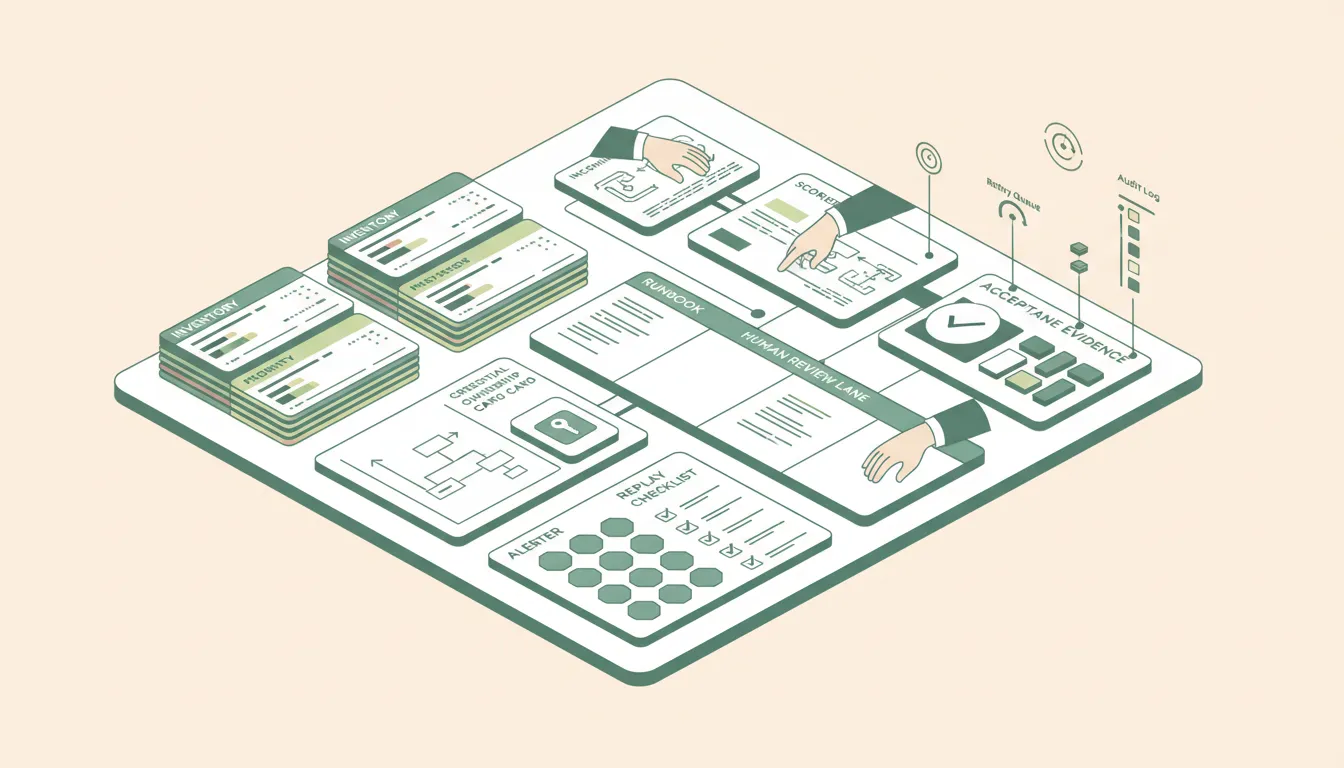
Ownership is not satisfied by a contract sentence saying the client owns the work. The team needs practical control.
Before launch, I want these items named:
- Who owns each account, subscription, domain, server, and data store?
- Where do credentials live, and who can rotate them?
- Who receives alerts and owns exceptions?
- Who can pause the system without calling the original builder?
- What documentation explains the lane, fields, decisions, and recovery?
- What source files, exports, and deployment access transfer at closeout?
- What support is included, and what changes require new scope?
- What happens if the consultant disappears?
Self-hosting can improve control, but it also transfers real operating responsibility. The n8n self-hosting documentation says it requires server, container, security, resource, and application management knowledge, and warns that mistakes can cause data loss, security problems, and downtime. “You own the server” is not the same as “your team can operate the system.”
The right ownership model depends on internal capability. The requirement is an honest handoff, not a particular hosting slogan.
Compare proposals by missing risk
Workflow proposals often look difficult to compare because they use different tools and package names. I normalize them around the operating boundary.
| Buying question | Strong proposal | Weak proposal |
|---|---|---|
| Outcome | Names one measurable business result | Promises general efficiency |
| Scope | Lists records, systems, roles, and exclusions | Lists tools and workflow counts |
| Authority | Separates reads, drafts, writes, sends, and approvals | Says the system is autonomous |
| Exceptions | Names stop conditions and owners | Covers the happy path only |
| Proof | Defines production acceptance tests | Offers a demo |
| Recovery | Includes pause, correction, replay, and fallback | Says errors will be monitored |
| Ownership | Transfers practical control and documentation | Leaves accounts or knowledge with the builder |
| Support | Defines maintenance and change boundaries | Uses a vague ongoing retainer |
Cost still matters. My guide to AI automation consultant cost explains why integration depth, data condition, authority, exceptions, and recovery move the price. The cheaper proposal is better only when it preserves the same operating promise.
When not to hire me for this
You do not need me for every repeated task.
Do not hire a workflow automation consultant when:
- A native rule in software you already own solves the problem.
- A checklist or template removes the actual failure.
- The volume is too low to justify a custom system.
- The process changes every week and has no stable owner.
- Nobody agrees on the authoritative record.
- The team will not maintain the source data.
- The desired automation would hide a broken offer or policy.
- The business cannot define what success looks like.
I would rather narrow the boundary or recommend no build than automate confusion. A small, owned rule that works is more useful than an impressive system nobody trusts.
Use this buyer checklist
Before selecting a workflow consultant or automation builder, ask for clear answers to these questions:
- What business outcome will this engagement protect or improve?
- Which system owns truth at each step?
- What may the automation do without approval?
- Which exceptions stop the workflow?
- Who owns each exception and response window?
- How will production acceptance be tested?
- What can your team see without developer access?
- How will the team pause, correct, replay, or work manually?
- Who owns the code, data, accounts, credentials, and documentation?
- What support is included after launch?
- Which future changes are outside the current scope?
- What evidence will prove the operating result after 30 days?
You can review the broader automation services boundary after the outcome and risks are clear. The consultant's tool choice matters, but it comes after ownership, proof, and recovery.
A useful consultant leaves behind more than a working automation. The team gets a defined operating lane, visible exceptions, tested recovery, and practical control. That is the standard I would use to buy the work, and it is the standard I use when I deliver it.
If you want to see where your own process leaks before you talk to anyone, the free AI Operations X-Ray maps it first.
More on this: Contract management automation: what to automate first.
FAQ
Frequently asked questions
01What does a workflow automation consultant do?
A workflow automation consultant maps a business process, defines the source of truth and authority boundaries, connects the required systems, tests exceptions, proves the result in production, and hands the operating lane to a named owner.
02How do I choose a workflow automation consultant?
Choose one who can explain the business outcome, system boundary, exception model, acceptance tests, recovery path, and ownership terms before discussing a long tool list.
03What should a workflow automation proposal include?
It should include the current process, target outcome, systems and records in scope, authority limits, exception owners, acceptance criteria, delivery phases, run costs, security responsibilities, documentation, and post-launch support.
04When should I not hire a workflow automation consultant?
Do not hire one when a native software rule, checklist, template, or clearer team ownership solves the problem, or when the process changes too often to define a stable operating promise.
05Who should own an automated workflow after launch?
A named business owner should own the outcome and exception decisions, while a named technical owner maintains credentials, integrations, alerts, and changes. One person may fill both roles in a small company, but the responsibilities should still be explicit.
06Is workflow automation consulting worth it for a small business?
It is when one repeated handoff costs real money or time and the rules are stable enough to write down. Workflow automation consulting should start with that one lane and prove it before anything bigger. If a checklist or a native software rule fixes the problem, you do not need a consultant.