Field note
Aug 15, 2026
Accounting automation: the silent failure test
Accounting automation should expose missing revenue, bad handoffs, and unreconciled records before a quiet logic error reaches month-end.

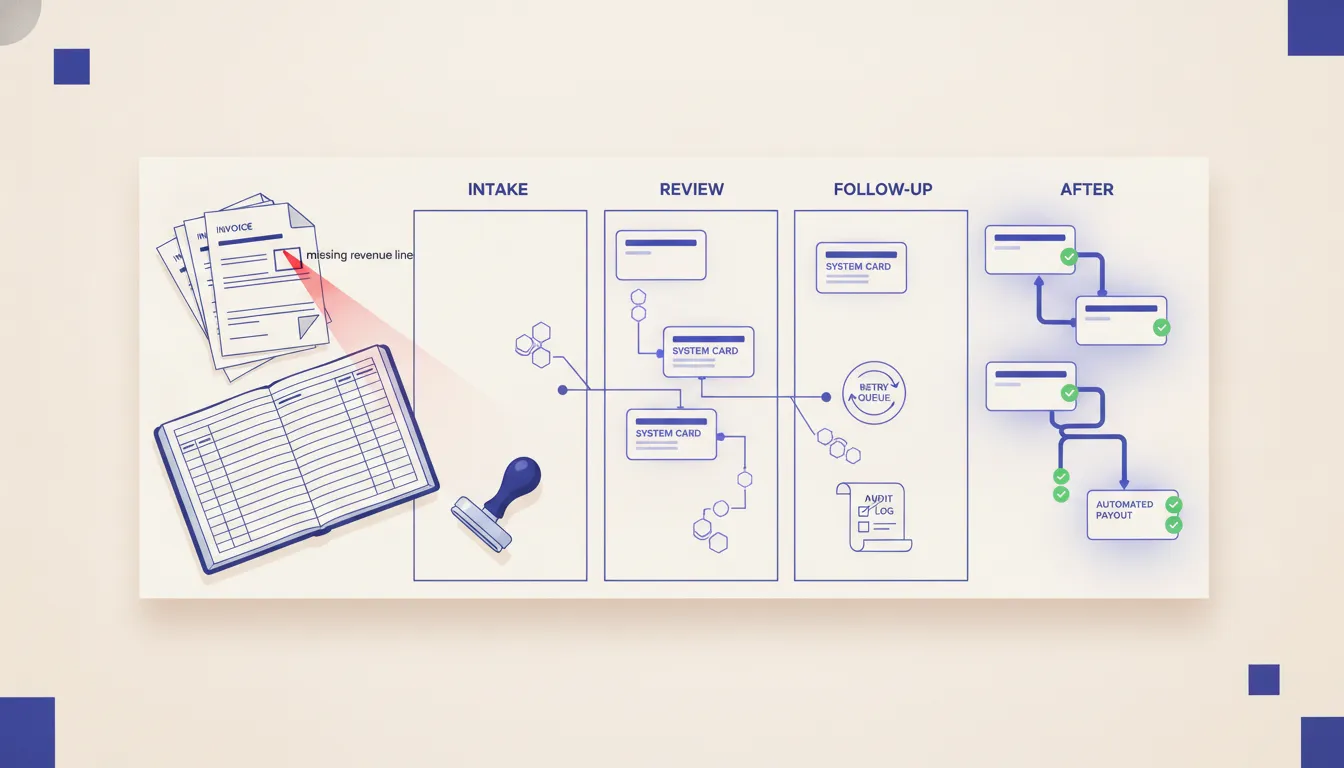
Accounting automation should make financial records easier to trust. It should not merely move data faster while quiet errors survive until month-end.
I learned this from a workflow that never technically failed. It tracked data usage so a business could bill each client correctly. The runs stayed green, but a logic change stopped assigning usage to one client. Nobody saw an error. At month-end, that client's usage was missing, the amount could not be reconstructed responsibly, and the business had to absorb a full month of cost.
That is the failure mode I care about most. A loud error creates a ticket. A silent error creates false confidence.
I have also built invoice-processing work that begins with email and moves structured data toward QuickBooks. On one finance lane, the first useful spine had four steps: receive the email, analyze it, parse the result into structured fields, and send the record onward. Those four stages reduced handling, but they did not prove the accounting outcome by themselves.
My rule is simple: accounting automation is not finished until the operator can trace the source, approval, posting, exception, and reconciliation.
Start with the financial promise
I start with one promise the business needs to keep, not a list of integrations.
Useful promises sound like this:
- Every completed job reaches billing with the required customer, scope, amount, and completion evidence.
- Every supplier invoice reaches an approved, posted, and reconcilable state exactly once.
- Every payment-status change reaches the people responsible for customer follow-up.
- Every automated entry can be tied back to its source document and approval.
- Every exception has one owner, one reason, and one next action.
That boundary turns accounting automation into business process automation. Finance work crosses sales, delivery, purchasing, customer records, banking, and management reporting. Moving one field between two tools is not the same as controlling the outcome.
The IRS recordkeeping guidance is practical here. Business records support financial statements, tax returns, and the items reported on them. If an automated entry loses its supporting document or approval history, the workflow is moving in the wrong direction.
Before I build, I write down three things:
- The exact financial outcome the lane must produce.
- The records and people with authority over each decision.
- The evidence that proves the outcome happened correctly.
If those answers are vague, adding OCR, AI, or another connector only makes the uncertainty travel faster.
Design for silent failure before the happy path
Most demos show a clean invoice moving into an accounting system. I want to see the uncomfortable version.
A workflow can stay online while it:
- Assigns revenue to the wrong customer or job.
- Skips a completed job that should be billed.
- Creates a duplicate after an API timeout and retry.
- Accepts a changed supplier bank detail.
- Posts to the wrong entity, account, project, period, or tax code.
- Updates the CRM but fails to update accounting.
- Records an approval without preserving who made it.
- Creates an entry but loses the supporting attachment.
These failures are dangerous because activity still looks normal. Emails are processed. Runs are green. Records exist. The gap appears only when someone reconciles the business result.
The broader accounting automation operator test covers authority, source records, and failure drills. I use the silent failure test as the next layer: what can be wrong even when every service says it is healthy?
For each step, I define an invariant. Every invoice must have one stable source reference. Every billable job must reach one billing state. Every write must return a destination identifier. Every approval must preserve identity and time. Every posted amount must later match the record that proves it.
Health checks tell me whether the machinery is running. Invariants tell me whether the business promise is still true.
Separate prepare, approve, post, and reconcile
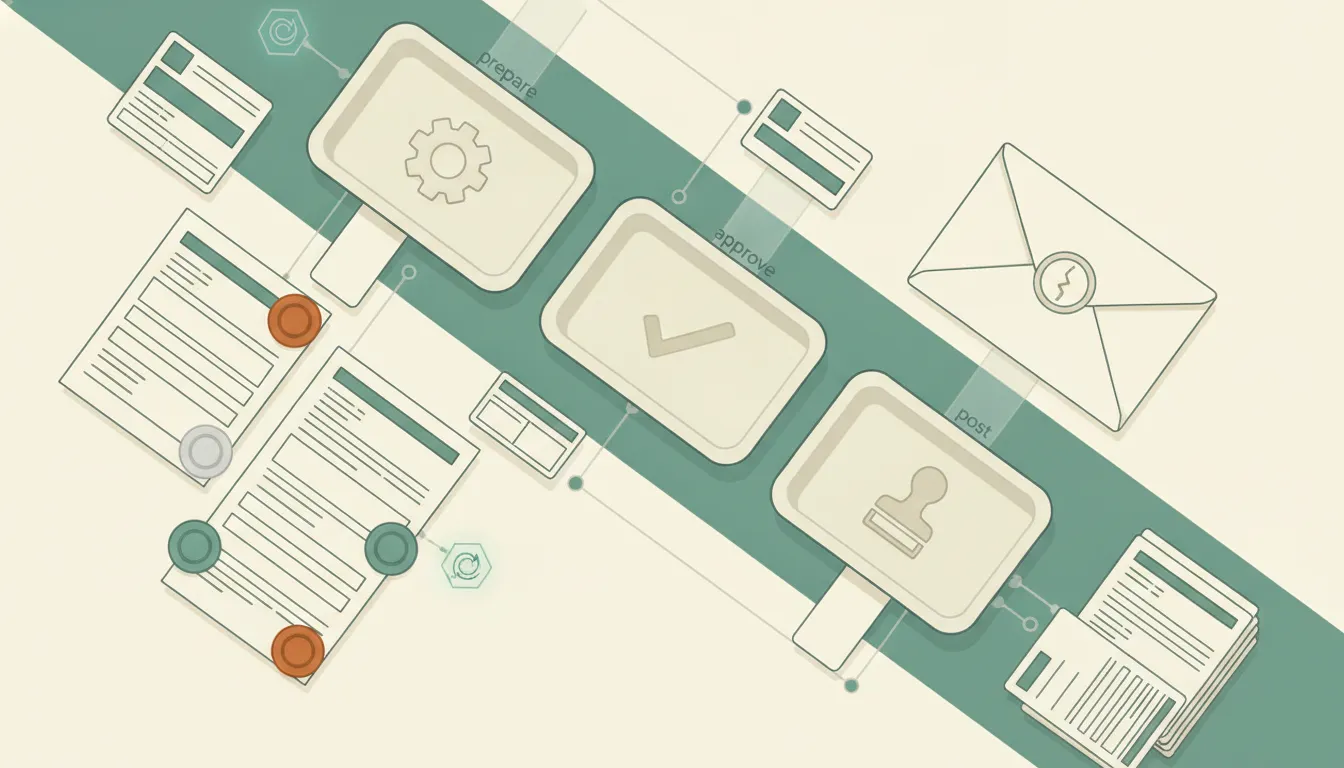
I do not build accounting automation as one unattended action. I separate it into four control stages.
Prepare
The workflow receives the source, preserves the original, extracts fields, matches known records, collects operational context, and assembles a proposed update.
AI can help read an invoice, classify a transaction, summarize a variance, or suggest coding. It is useful here because preparation is reversible.
Approve
A named person reviews the action when money, policy, unusual spend, changed details, missing evidence, or judgment is involved. The review packet should show the source, amount, matching records, exception, proposed action, and exact authority being granted.
An approval button without context is not a control.
Post
The workflow writes only after the rule allows it. It uses stable references and duplicate protection so a retry cannot create a second financial record.
The AP automation process is a useful example because extraction is only the front door. Supplier validation, matching, approval authority, posting, payment control, and reconciliation all belong in the lane.
Reconcile
The workflow reads back the destination and compares the result with the source and approval. A successful API response is not the finish line.
I reconcile at three levels:
- Technical: Does the expected destination record exist?
- Record: Do customer, vendor, amount, entity, account, project, date, and status match?
- Financial: Does the result agree with the ledger, bank, subledger, or close review that proves it?
The SBA guide to managing business finances ties bookkeeping and financial statements to understanding the business. Faster entries are not useful if they make that understanding less dependable.
Give every exception an operating owner
An exception queue is not enough. I want each stopped item to contain:
- The source record and current destination state.
- The rule or invariant that failed.
- The conflicting or missing field.
- The financial impact if known.
- The allowed next actions.
- One current owner.
- A due time and escalation path.
- Proof of correction and safe replay.
I also separate business exceptions from technical failures. A missing purchase order needs an operating decision. An expired credential needs a system fix. A destination timeout may need a safe replay. Those should not land in one vague error bucket.
This is a business process architecture problem. Architecture decides which record wins, who owns disagreement, where automation must stop, and how recovery works.
My opinion is direct: the business should own the accounts, credentials, rules, logs, and documentation. I prefer visible systems that a qualified operator can pause and troubleshoot. No outside builder should become the only person who can explain why money moved or why revenue disappeared.
Make reconciliation visible every day
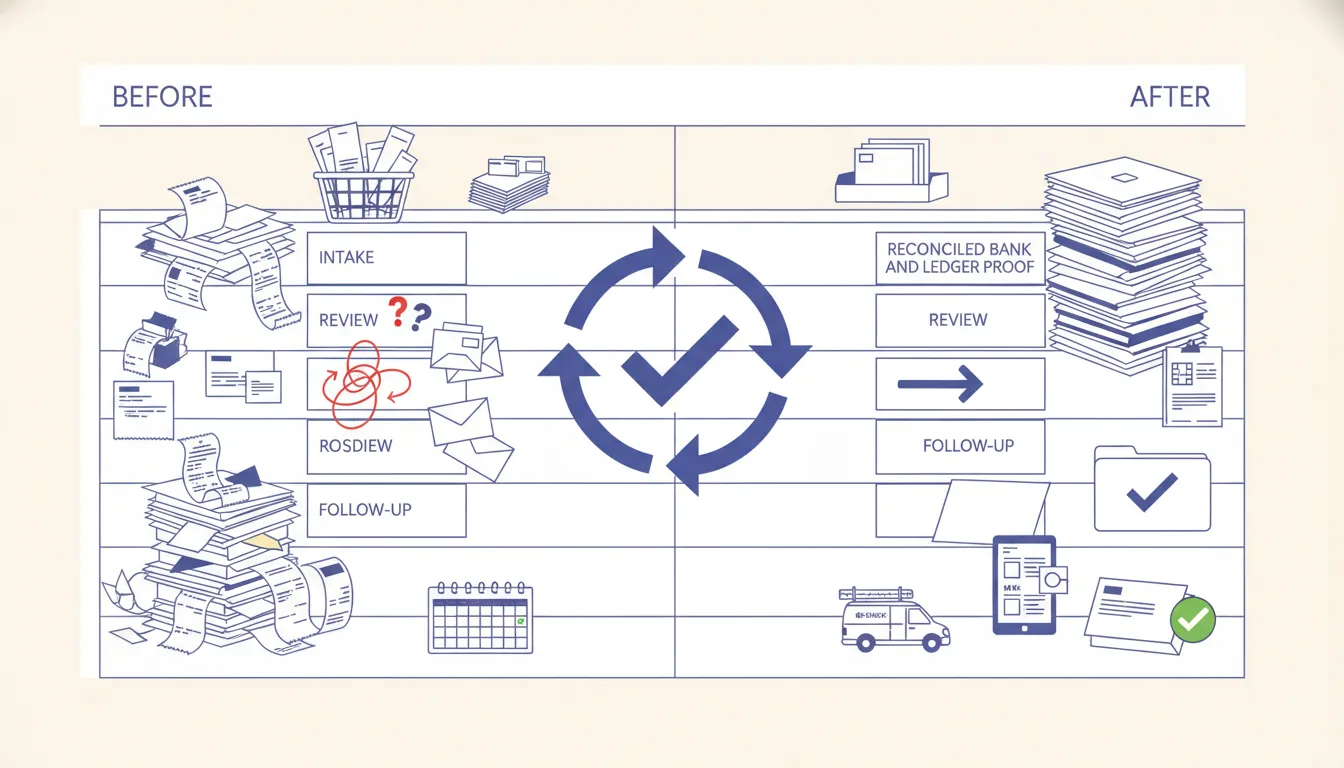
Accounting automation needs a recurring proof pack, not another vanity dashboard.
A useful daily or weekly review shows:
- Billable work that has not reached an invoice-ready state.
- Invoices waiting on evidence or approval.
- Duplicate risks and changed supplier details.
- Posted records that do not match their sources.
- Payments that cannot be reconciled.
- Customer or vendor status conflicts across systems.
- Exceptions past their owner deadline.
- Automations paused, replayed, or changed.
The report should lead to decisions. That is the same standard I use for a report automation scorecard: show what changed, what is blocked, who owns it, and what proof closes the item.
I do not measure success by documents scanned or workflow runs completed. I measure completed, reconciled outcomes.
My first scorecard includes:
- Percentage of valid records completed and reconciled on time.
- Number and age of open exceptions.
- Duplicate records prevented.
- Approval turnaround and override rate.
- Destination mismatches and unreconciled amounts.
- Time to detect, stop, correct, and recover from failure.
- Financial records that cannot be traced to source evidence.
A system can process more work and still make the business less reliable. These measures expose that tradeoff.
Run failure drills before expanding authority
Before I widen the lane, I test the cases most likely to create false confidence:
- The same invoice arrives through two channels.
- A source record changes after preparation but before approval.
- The destination times out after accepting the write.
- A retry runs after the first request succeeded.
- A required attachment fails while the entry succeeds.
- A user changes the destination record after automation.
- An approver loses authority while work is waiting.
- A closed period or locked account rejects the post.
- A completed job never enters the billing queue.
- A payment appears released but does not reconcile.
For each drill, I ask whether the workflow stopped safely, preserved evidence, explained the problem in operator language, assigned one owner, and proved the corrected result.
The NIST AI Risk Management Framework is useful when AI participates because governance, measurement, and ongoing risk management belong in the operating system. Model confidence does not replace financial authority or reconciliation.
When not to hire us for accounting automation
Do not hire us when the business has not decided who approves spend, which accounting system owns the record, what evidence is required, or who closes exceptions.
I would also hold off when transaction volume is low enough for one owner to review the lane without delay. A shared intake address, clean folders, a written approval matrix, and a disciplined close checklist may solve the problem without custom automation.
Automation is early when the chart of accounts, entity structure, vendor list, job coding, or approval rules change every week. The workflow will turn that instability into rework.
A narrower first move may be better:
- Centralize intake.
- Preserve source files and metadata.
- Define the record owners.
- Route approvals without posting automatically.
- Produce a daily exception and reconciliation review.
That creates proof before write authority expands. I use the AI Operations X-Ray to map the leaking handoff, record authority, approval boundary, and safest first build.
Accounting automation earns trust when normal work becomes quieter and missing financial truth becomes easier to see. The operator should be able to trace every source, approval, posting, exception, and reconciliation without guessing.
If the workflow can fail silently for a month, it is not finished.
FAQ
Frequently asked questions
- 01What is accounting automation?
- Accounting automation uses rules, integrations, and sometimes AI to collect finance inputs, validate records, route approvals, prepare entries, reconcile outcomes, and surface exceptions with less manual handling.
- 02What should a business automate first in accounting?
- Start with one frequent and rules-based handoff such as invoice intake, billing readiness, approval routing, payment-status updates, or a close checklist. Keep the first lane narrow enough to compare with the current manual process.
- 03What is the biggest risk in accounting automation?
- The biggest risk is silent failure: the workflow keeps running while a logic error, bad match, missing record, or failed write produces incomplete financial truth.
- 04How should accounting automation be measured?
- Measure completed and reconciled outcomes, exception age, duplicate prevention, approval time, destination mismatches, recovery time, and financial records that cannot be tied back to source evidence.