Field note
Jun 4, 2026
Business process architecture for operators
Business process architecture helps operators decide which system owns the truth, which manager owns the exception, and which handoffs deserve automation.


Business process architecture sounds like something a large company buys before a transformation program. That framing is why many operators ignore it until the business is already running on tribal knowledge, inbox promises, spreadsheet reconciliations, and customer callbacks.
The practical version is much smaller and more useful. It answers four questions every growing business eventually has to face:
- Which promise does this process protect?
- Which system owns the truth?
- Which person owns the next decision?
- What happens when the normal path breaks?
If those answers are unclear, automation does not fix the process. It moves unclear work faster, creates more alerts, and gives managers a cleaner dashboard for a mess nobody owns.
Moore IQ treats business process architecture as an operating guardrail. Before choosing a tool, workflow, integration, or AI agent, we want to know how the work should move and who is accountable when it does not. The AI Operations X-Ray is built to find those handoff and ownership gaps before a team spends money automating the wrong layer.
Start with the promise, not the process diagram
A business process is not valuable because it has boxes and arrows. It is valuable because it protects a promise the business made. Formal standards like BPMN from the Object Management Group are useful when teams need notation, but operators should not confuse notation with ownership.
A contractor promises that a new lead will be contacted quickly and moved toward an estimate. A facilities team promises that urgent requests will reach the right vendor before the SLA is missed. A recruiting firm promises that qualified candidates will not sit untouched. A dealer promises that a trade-in customer will get a fast, credible answer.
The architecture starts there.
For each promise, define the operating path:
- Trigger: What starts the process?
- Source of truth: Where does the record live?
- Owner: Who owns the next decision?
- Handoff: What must be true before the work moves?
- Exception: What breaks the normal path?
- Proof: What field, status, timestamp, or note proves the promise was handled?
This is the difference between a useful operating map and a generic process document. The generic version says sales hands off to operations. The operator version says the CRM owns the lead, the estimator owns first response within one business hour, the project board owns scoped work, finance owns deposit status, and stale records escalate every morning.
That level of clarity is not bureaucracy. It is how managers stop rebuilding the business from memory. It is also consistent with the operating intent behind ISO 9001 quality management, where repeatable processes matter because they help organizations meet customer requirements and improve them over time.
Architecture tells you whether you have a tool problem

Many software searches begin with the wrong sentence: we need a better tool.
Sometimes that is true. Often, the real problem is that the current process has no architecture. Nobody has decided whether the CRM, inbox, project tool, accounting system, or spreadsheet owns the truth. Nobody has named the exception owner. Nobody has defined what done means.
That is why the tool problem versus architecture problem matters. If a handoff fails because the system is missing a required capability, a tool change may help. If it fails because three teams believe three different records are authoritative, a new tool usually adds a fourth version of the truth.
Before replacing anything, ask:
- Is the source system clear?
- Is the handoff rule clear?
- Is one manager accountable for exceptions?
- Can leadership see stale work without asking for a manual report?
- Can the team measure the workflow without exporting a spreadsheet?
If the answer is no, the first project is architecture cleanup. That might mean a better status model, an exception queue, an integration rule, a weekly review, or a narrower automation pilot. It does not always mean a platform replacement.
Separate routine work from exception work
Business process architecture becomes especially useful when it separates routine work from exception work.
Routine work follows known rules. The lead is complete. The work order has a location and priority. The candidate has the right fields. The invoice matches the job. The vendor response is on time. This is where automation can route, notify, draft, update, summarize, and close low-risk steps.
Exception work is different. A customer is angry. A request is missing fields. A candidate needs human judgment. A vendor missed the window. The estimate does not match the job scope. A payment status conflicts with the project status.
Those items should not disappear into the same task list as routine work. They need a visible lane, an owner, context, a decision threshold, and a response window.
The architecture should say:
- Which cases qualify as routine?
- Which cases become exceptions?
- Who owns each exception type?
- What context must be shown before the owner acts?
- Which decisions can AI recommend but not make?
- What evidence is captured after the decision?
This is where automated workflow benefits become measurable. The win is not that software touched the task. The win is that fewer customers chase status, fewer records go stale, fewer managers rescue invisible work, and fewer employees guess what happens next.
Design the exception lane before adding AI
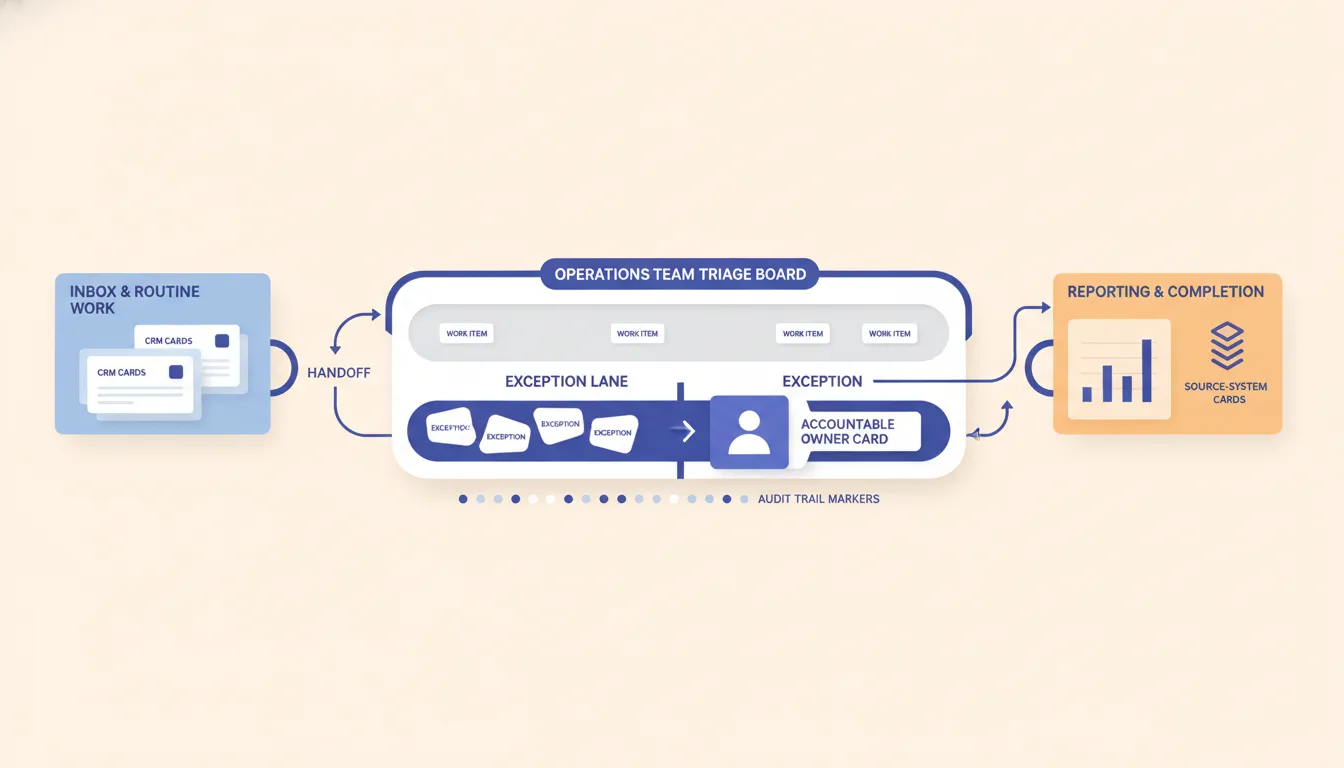
AI is useful in business processes when it has a clear role. It can classify requests, read messy notes, summarize history, recommend next actions, flag stale items, draft replies, and compare records across systems.
But AI is not a substitute for ownership.
If the architecture does not define who owns a risky decision, AI will either stop too often or act too freely. If the source of truth is unclear, AI will summarize conflicting data without resolving which record matters. If the exception lane is hidden, AI will make the queue look more organized while the manager still discovers problems too late.
A safer pattern looks like this:
- Define the normal path.
- Define exception triggers.
- Name the human owner for each exception.
- Let AI prepare context and recommended actions.
- Record the human decision.
- Review patterns weekly.
That is also how operators keep automation governance simple. High-volume, low-risk routine work can move quickly. Ambiguous, high-risk, customer-sensitive, or financial decisions stay visible until the operating rule is proven.
Use architecture to pick the first automation project
Business process architecture should make the next project easier to choose.
A good first project has a painful promise, a clear owner, a manageable system boundary, and proof that can be measured before and after. A poor first project has too many departments, unclear authority, fake consensus, and no way to prove whether the change helped. The measurement discipline is the useful part of formal improvement cycles like NIST's process improvement guidance, even when a small business keeps the ceremony lightweight.
Use a simple decision frame:
- Revenue impact: Does the process affect leads, proposals, renewals, collections, or booked work?
- Service impact: Does the process affect response time, SLA risk, customer trust, or delivery quality?
- Labor impact: Does the process create manual chasing, duplicate entry, or status meetings?
- Risk impact: Would a wrong decision create compliance, financial, safety, or reputation risk?
- Ownership clarity: Can one manager own the exception lane?
- System clarity: Is there one source of truth or a realistic path to one?
- Proof: Can the team measure improvement without adding more manual work?
This is close to the scorecard approach in workflow optimization for messy handoffs. The difference is that process architecture comes one level earlier. It decides what the process is supposed to protect, which records matter, and which decisions belong to people before the team optimizes or automates the flow.
What a useful process architecture map includes
A lightweight map is enough for most small and mid-sized operators. It should fit on one page per promise and be clear enough for managers to run.
Include these fields:
- Business promise: The outcome this process protects.
- Trigger event: The signal that starts the work.
- Source system: The authoritative record.
- Supporting systems: Tools that may inform the work but do not own the truth.
- Stage model: The statuses that matter.
- Decision owner: The person or role accountable for the next action.
- Exception triggers: Conditions that pull work out of the routine path.
- Escalation rule: What happens when time, risk, or ambiguity crosses a threshold.
- Evidence field: The proof captured before the step is complete.
- Weekly review: The metric a manager checks to see whether the process is improving.
This is not a replacement for quality systems, SOPs, or management review. It is the operating layer that makes those systems usable. The same logic shows up in quality management system operations: leadership needs shared definitions before it can trust reports across teams.
A simple operator exercise
Pick one process that creates recurring pain. Do not start with the biggest transformation idea. Start with a promise that gets missed often enough to matter.
Write one sentence for each answer:
- The promise this process protects is...
- The record of truth is...
- The normal owner is...
- The exception owner is...
- The step that goes stale most often is...
- The proof that work is complete is...
- The first automation should only help with...
If those sentences are hard to finish, the next step is not a software demo. The next step is architecture clarification.
Once the rules are visible, automation becomes safer. An AI assistant can watch stale records. An integration can sync only the right fields. A workflow can route routine work. A manager can review the exceptions that actually matter. If the first project lives in routing, approvals, and system handoffs, n8n consulting can help turn that architecture into a controlled automation layer instead of another disconnected workflow.
That is the operator value of business process architecture. It turns vague process pain into a managed system of promises, owners, records, exceptions, and proof.
FAQ
Frequently asked questions
- 01What does business process architecture mean for operators?
- For operators, business process architecture means the practical map of how work moves from a business promise to a completed outcome. It names the source of truth, the decision owner, the handoff rule, the exception path, and the proof that the work finished.
- 02How is business process architecture different from process mapping?
- Process mapping usually shows the steps. Business process architecture decides which steps matter, which systems own the record, who can make decisions, where exceptions go, and how the workflow connects to revenue, service quality, staffing, or risk.
- 03Do small businesses need business process architecture?
- Yes, but they do not need a heavy documentation program. A small business needs enough architecture to prevent customers, jobs, candidates, invoices, and exceptions from living in different tools with no clear owner.
- 04Where should a business process architecture project start?
- Start with one painful promise, such as lead response, work order intake, candidate follow-up, billing closeout, or vendor dispatch. Trace the handoffs, name the source of truth, and define the exception owner before adding automation.
- 05Can AI help with business process architecture?
- AI can help classify requests, summarize context, watch stale records, draft next actions, and surface exceptions. It should support a clear process architecture, not replace decisions about ownership, risk, and source of truth.