Field note
Aug 1, 2026
CRM system features independent dealers should test
The CRM system features that matter most are ownership, vehicle context, handoff control, approval boundaries, exception visibility, and safe recovery.

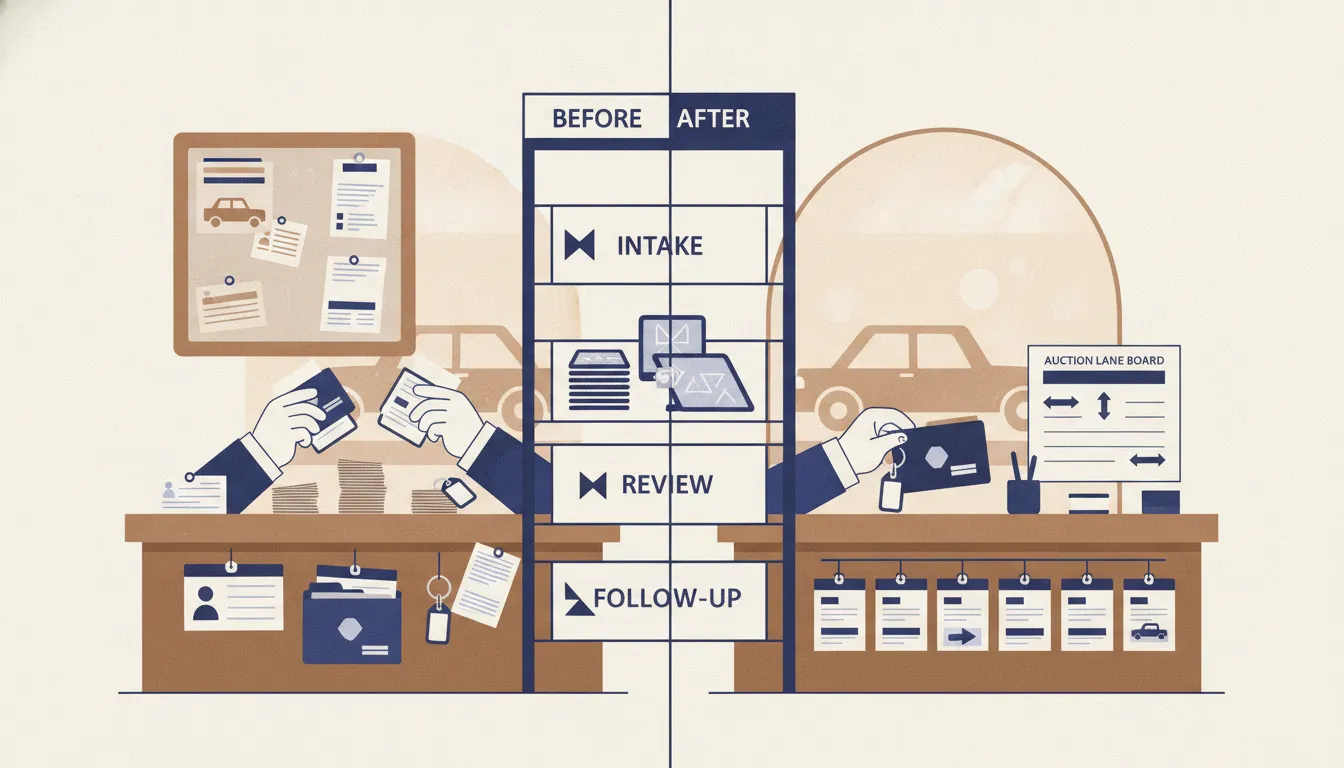
The CRM system features that matter are not the ones that make the longest comparison table. They are the ones that help an independent dealer answer five questions without opening six systems:
- What happened?
- Which customer and vehicle does it involve?
- Who owns the next action?
- What decision is blocked?
- What proves the customer received the right follow-up?
I use those questions because dealer CRM projects rarely fail from a missing button. They fail when a lead arrives without a real owner, the vehicle record is stale, recon status never reaches sales, a finance handoff disappears, or an automated message makes a commitment the store cannot support.
On one dealership operations review, I mapped a 21-step vehicle lifecycle against a seven-day frontline-ready target. The store already had systems for the DMS, shop, customer conversations, finance, accounting, and listings. The real problem was not a lack of software. The real problem was that the work crossed every tool and the handoffs were still difficult to see.
I have built over 500 production-grade workflows. My rule after that volume is direct: choose one source of truth for each operating decision, then make every CRM feature respect that boundary.
Start with one operating promise
Before I compare CRM system features, I write the promise the system has to keep:
Every valid customer inquiry reaches a named owner with current vehicle context, a clear next step, and visible proof of follow-up.
That promise is more useful than a vendor category. It forces the buyer to define what a valid inquiry contains, where vehicle status comes from, how ownership is assigned, which actions require a person, and what happens when a destination system rejects the update.
For independent used-car dealers, the promise usually crosses marketplace leads, website forms, phone calls, texts, the DMS, recon status, appointment scheduling, trade-in requests, finance documents, and manager review.
That is why I treat CRM buying as business process automation. A CRM can hold customer records and conversations, but the operating result depends on what happens between the records.
Test unified lead capture and named ownership
The first CRM system feature I test is not an AI writer. It is whether every approved lead source lands in one visible queue with its original context intact.
A useful intake record should preserve:
- Lead source and original timestamp.
- Customer identity and consent context.
- Vehicle of interest and stock identifier when available.
- Original message, attachments, and conversation history.
- Assigned salesperson or BDC owner.
- First-response due time.
- Missing information and current exception reason.
- Last human or automated action.
The system should also distinguish assignment from ownership. Round-robin routing can put a name on a record. That does not prove the person saw it, accepted it, or knows the next action.
I want an acceptance state, a due time, an escalation owner, and a visible reason when the assignment cannot proceed. My field note on used-car lead response covers the speed side. The CRM feature test goes one step further: can the store prove that fast response used the right customer and vehicle context?
A generic acknowledgment may be safe. A message that promises availability, price, financing, or a trade value is a different class of action. The CRM needs separate permissions for each one.
Keep vehicle context attached to the conversation
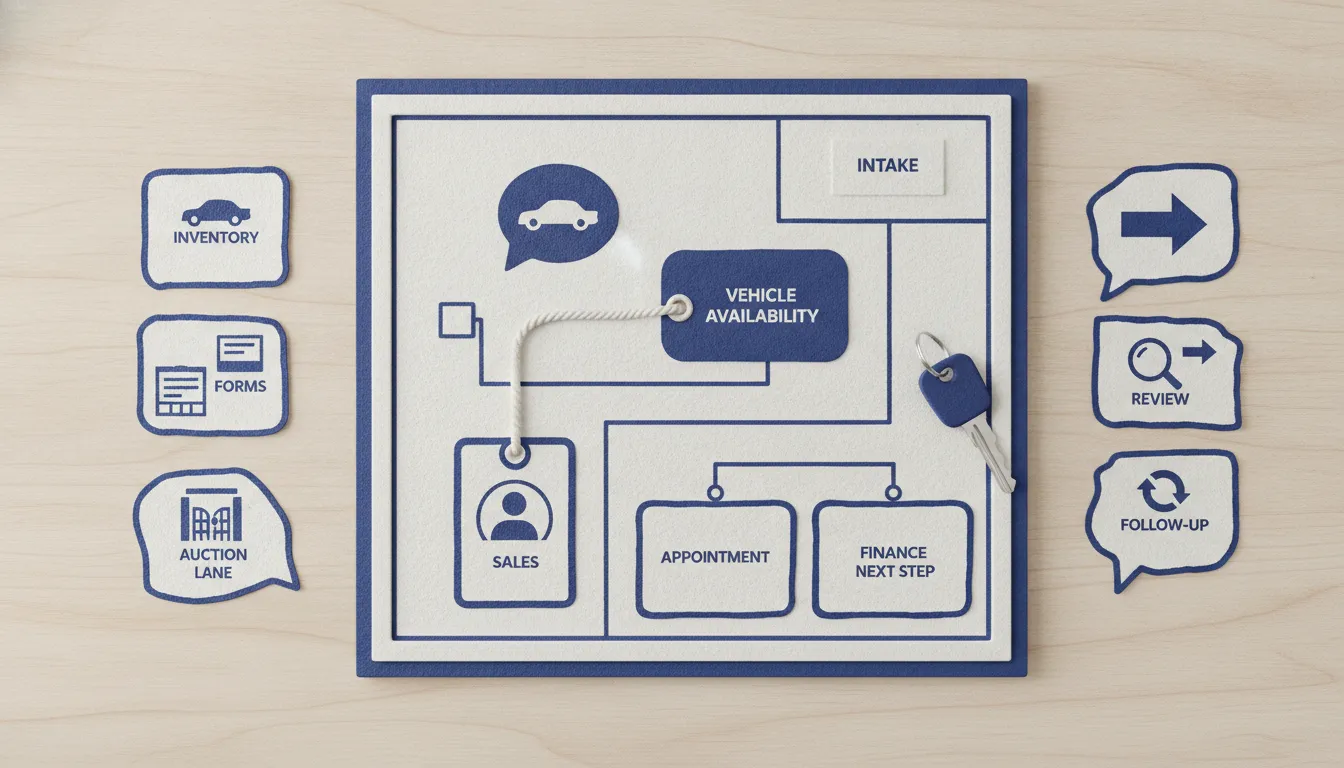
A dealer CRM is not useful when it knows the customer but loses the car.
The CRM should show whether the vehicle is available, held, sold, inbound, in recon, awaiting title work, or not ready for a customer promise. It should also show the age of that status and where it came from.
I do not want the CRM to become a second inventory system. I want it to read the authoritative vehicle record, expose the status needed for the conversation, and stop when the record is missing or stale.
That is the practical connection between a CRM and a DMS. The DMS may own the vehicle, deal, and accounting record. The CRM may own the customer conversation and next action. The operating layer has to preserve the handoff between them.
My dealer CRM and order-management handoff test goes deeper on this boundary. The short version is that the same customer intent should survive from inquiry to appointment, appraisal, finance, funded deal, and admin handoff without being rebuilt from private inboxes.
The FTC Used Car Rule is also a useful reminder that customer-facing vehicle information and disclosures need disciplined handling. Speed does not excuse a stale record or an unsupported promise.
Make the next action specific
Many CRMs have tasks. A task called "follow up" is not an operating control.
I want the next action to include:
- The exact customer question or missing item.
- The person who owns the decision.
- The due time and escalation rule.
- The source records needed to act.
- The allowed action.
- The evidence required to close it.
For example, "follow up on trade" is too vague. "Appraisal owner reviews the submitted VIN, mileage, photos, payoff status, and requested appointment window by 2:00 p.m." is an owned action.
The same rule applies to finance. "Check financing" hides whether the customer needs a document, a lender decision, consent confirmation, or a manager review. The CRM should expose the blocked state without pretending it owns the credit decision.
This is where sales automation needs dealer controls. The CRM can draft, remind, summarize, and route. A named person should still own pricing, credit, compliance, vehicle-condition uncertainty, and final customer commitments.
Give exceptions their own queue
A CRM demo usually follows a clean lead from form to appointment. Real dealership work is full of exceptions:
- Duplicate customer records from two lead sources.
- One customer asking about multiple vehicles.
- Vehicle sold after the lead arrived.
- Recon status missing or older than the response window.
- Trade-in request missing the VIN, mileage, or photos.
- Finance step waiting on a document or human decision.
- Customer opt-out or consent uncertainty.
- Destination API rejecting an update.
- Salesperson unavailable after assignment.
- Automated message prepared but not approved.
Each exception needs a plain-language reason, one current owner, a due time, allowed decisions, and closure proof.
A shared task list is not enough. A red badge is not enough. If the manager cannot identify the person responsible for the next decision, the CRM has only made the delay easier to count.
I also want the CRM to suppress duplicate customer actions. If the marketplace, website form, and phone system all create the same intent, the customer should not receive three automated acknowledgments from three records.
Require permissions, audit history, and data ownership
CRM system features affect customer data, conversations, finance context, employee access, and integrations. The buying test has to include control over who can see, change, export, and automate each class of information.
The FTC Safeguards Rule guidance explains the need for covered financial institutions to maintain safeguards that protect customer information. I am not giving legal advice, but I use that risk as an operating requirement. The CRM should support role-based access, durable audit history, secure credentials, incident handling, and clean offboarding.
My ownership rule is simple. The business should own the accounts, code, data, credentials, rules, logs, and documentation. A vendor or builder should not be the only person who can explain why a customer received a message or why a finance handoff moved.
When the current system can hold valid records but cannot support those controls around daily work, I consider legacy system modernization before replacement. Modernization may mean keeping the core system and adding controlled intake, orchestration, exception review, and reporting around it.
Test the CRM with failure, not just a demo
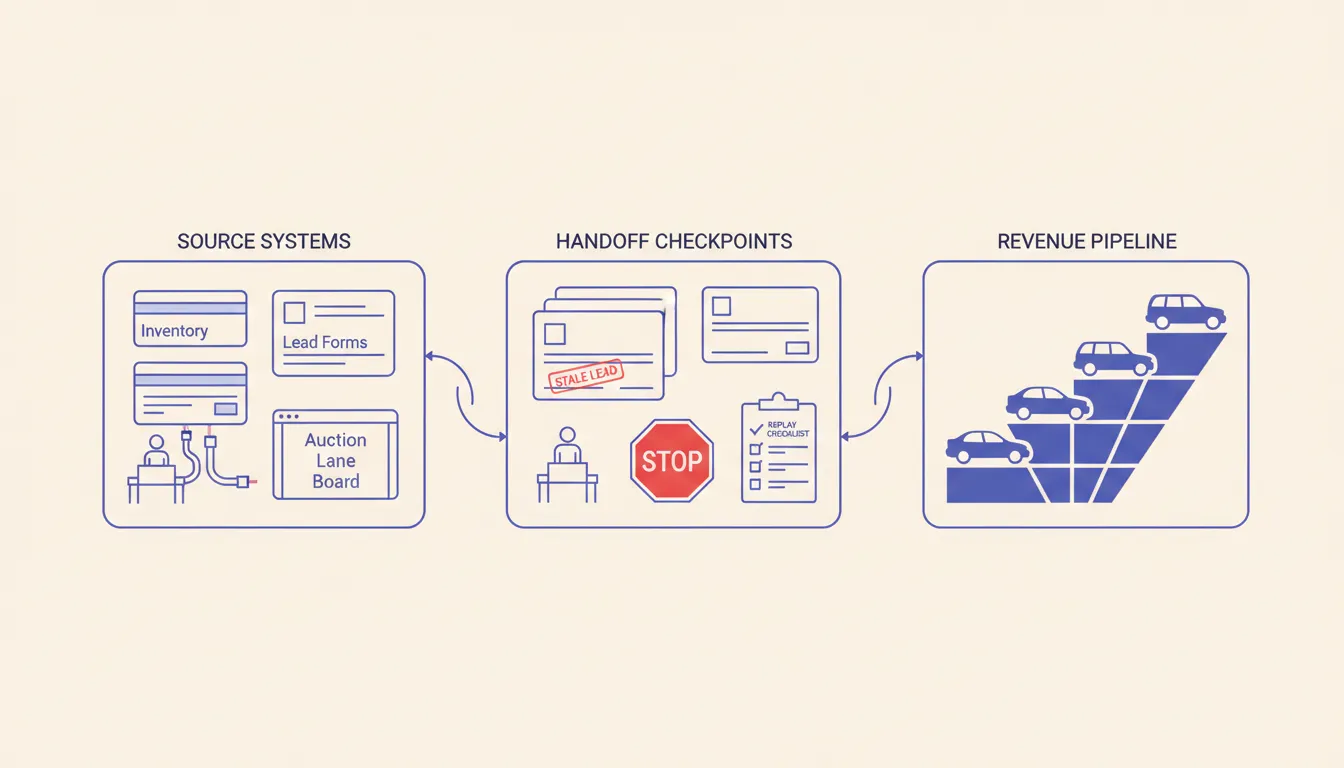
I do not accept a CRM because the happy path works in a demonstration account.
I run a small operating test:
- A normal web lead arrives and receives a named owner.
- A duplicate lead arrives through another source.
- The requested vehicle is sold after the first inquiry.
- The inventory source returns a stale status.
- A trade-in request is missing required information.
- The finance handoff requires a human decision.
- The CRM or destination API rejects an update.
- The assigned salesperson becomes unavailable.
- The manager pauses the workflow, corrects the record, and replays it safely.
- The team confirms that no duplicate message or task was created.
The NIST AI Risk Management Framework is useful for AI-assisted CRM features because it treats trustworthiness as something that has to be governed, mapped, measured, and managed. I apply the same idea to the operating workflow. The store should know what the system used, what it proposed, where uncertainty was high, who approved the action, and how to stop it.
The manager should perform the recovery drill. Watching the vendor recover its own demo does not prove the store owns the process.
Measure the operating outcome
A CRM makes activity easy to count. Leads created, tasks assigned, texts sent, emails opened, and appointments scheduled can all move up while deals still leak between systems.
My first scorecard includes:
- Percentage of approved lead sources captured successfully.
- Percentage of leads with a named owner and accepted assignment.
- Time from lead receipt to first qualified response.
- Percentage of responses using current vehicle context.
- Number and age of unowned or blocked exceptions.
- Duplicate record and duplicate message rate.
- Appointment show rate by source and owner.
- Trade-in requests reaching a named appraisal owner.
- Finance handoffs missing a next action or required document.
- Time to detect, stop, and recover from an integration failure.
I review the exceptions weekly. Which source loses context? Which vehicle statuses are repeatedly stale? Which owners reject assignments? Which finance steps remain blocked? Which automated drafts require heavy correction?
Those answers tell me whether to change the process, the integration, the permissions, or the software.
When not to hire us for dealer CRM automation
Do not hire us for dealer CRM automation when the store cannot agree on the source of truth for customer, vehicle, deal, recon, and finance status.
I would also pause when:
- Lead ownership changes by whoever notices the inbox first.
- Inventory availability cannot be trusted.
- Pricing and finance approval boundaries are informal.
- The team wants automatic messages without exception review.
- Shared credentials hide who changed a record.
- No one owns stale leads or rejected updates.
- The manager cannot stop or replay the workflow.
- The buyer is copying a large dealer group instead of fitting the system to the lot.
My field note on why big dealership AI tools do not fit independent lots covers that last point. More modules can create more maintenance, more hidden handoffs, and more places for the truth to drift.
The best CRM system features make the store easier to operate and easier to recover. They preserve customer context, vehicle truth, named ownership, approval boundaries, and proof.
Start with one lead lane. Connect the minimum records. Run the failure drill. Measure completed outcomes. If the CRM can support that operating promise, expand it. If it cannot, the replacement case will be clear for the right reasons.
FAQ
Frequently asked questions
01Which CRM system features matter most for an independent dealer?
Start with unified lead capture, named ownership, vehicle context, conversation history, task and appointment handoffs, finance status, exception queues, reporting, integrations, permissions, audit history, and safe recovery.
02Should a dealer replace its DMS when buying a CRM?
Not automatically. Keep the DMS as the authoritative vehicle and deal record when it is reliable, then make the CRM and automation layer respect that boundary. Replace the DMS only when its records, controls, or integration limits block the operating promise.
03Can a dealer CRM respond to leads automatically?
It can acknowledge, classify, gather missing information, and prepare a response, but pricing, credit, compliance, availability uncertainty, and customer commitments should stay inside explicit human approval boundaries.
04How should a dealer test CRM integrations?
Run normal, duplicate, missing-data, stale-record, rejected-update, and source-outage scenarios. Confirm which record wins, who receives the exception, how the workflow stops, and whether the team can replay it safely without creating duplicate customer actions.