Field note
Updated Sep 30, 2026
Dealership automation for sales: what to automate first
Dealership automation should answer leads fast, route them to the right person and check consent before any text goes out. Here is what to automate first.

Dealership automation should protect speed, ownership, consent and follow-up quality before it touches a customer. Good dealership automation software answers the lead fast, checks the car is still there and hands the buyer to a named salesperson.
It can make a dealer faster, or it can make the wrong follow-up happen with more confidence.
That is why I do not start with the automotive sales automation category.
I start with the lane. A lead comes in from the website, Cars.com, Autotrader, Facebook, a missed call, a trade-in form, or a finance question. Somebody needs to know which vehicle it belongs to, whether the customer gave SMS consent, whether the car is still available, who owns the reply, and what should happen if the customer does not respond.
If that lane is already unclear, a bigger sales platform will not fix it. It will just create more places where the same deal can disappear.
For independent used-car dealers, I think sales automation software should be treated as an operating control layer around the sales process, not a generic CRM upgrade. The goal is not to replace judgment. The goal is to make the first move faster and make the human handoff impossible to miss.
I have seen this pattern on dealer-adjacent and CRM workflow builds. The hard part is rarely sending a message. The hard part is keeping source of truth, consent, routing, stale follow-up, and exception review straight when the team is busy. On one workflow, a sync ran every six hours and took about three hours, so the operating question was not "can we automate this?" It was "what can safely move on a schedule, what needs a human, and how do we know when the sync is wrong?"
My rule is simple: automate the first move, but keep the sales owner visible.
Start with the deal lane that leaks first
Most dealers look at sales automation software because the team is overloaded.
Too many leads. Too many duplicate notifications. Too many calls to return. Too many stale CRM tasks. Too many trade-in questions that need a real answer. Too many customers who ask about financing and then vanish before anyone follows up.
That pressure is real, but overload by itself is not a buying strategy.
The useful question is narrower: where does the store lose control first?
For a dealer sales lane, I usually look at:
- New lead to first response.
- First response to human owner.
- Vehicle inquiry to inventory confirmation.
- Trade-in request to valuation owner.
- Finance question to compliant next step.
- Missed call to callback task.
- Appointment set to show confirmation.
- No reply to follow-up sequence.
That is why lead response in 60 seconds is still the cleanest first build. The buyer is warm when the form is submitted. Wait too long and the lead is not the same lead anymore.
The Harvard Business Review lead response study found that companies contacting leads within one hour were far more likely to have a meaningful qualifying conversation than companies that waited longer. I do not treat that as a perfect dealer-specific benchmark. I treat it as a directionally obvious operator warning. Speed matters most when intent is fresh.
A good first automation does not need to be fancy. It needs to answer four questions every time:
- What did the customer ask about?
- What source of truth confirms the answer?
- Who owns the next human action?
- What happens if nobody touches it?
If the current CRM cannot answer those questions cleanly, I would not start by replacing it. I would start with business process automation around one leaking lane.
Do not let the CRM become the only source of work
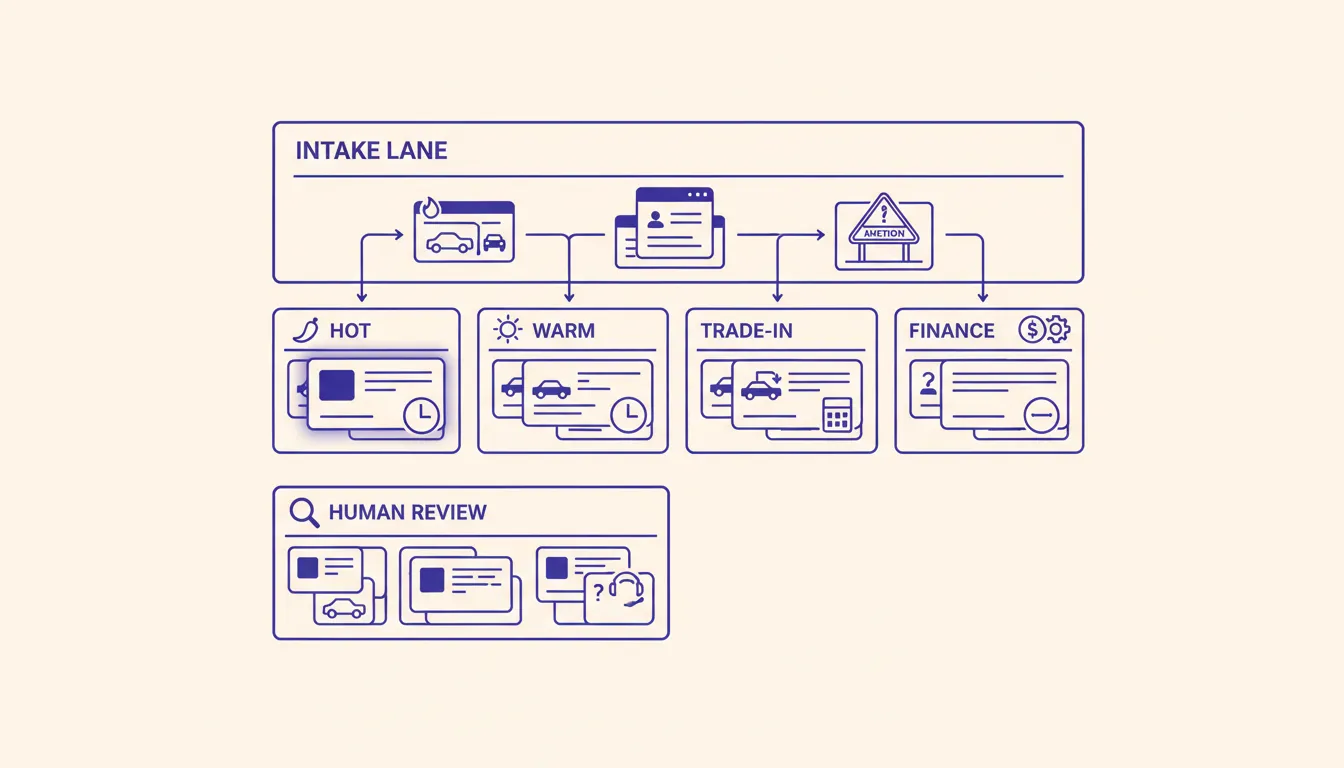
A CRM is usually the system of record. That does not mean it is the best system of action.
The record says a lead exists. The work is deciding what to do with it right now.
That gap is where sales automation software earns its keep. It should watch the incoming lead, enrich it with the vehicle and inventory context, classify intent, send a safe first response when allowed, and assign a human owner before the customer moves on.
The architecture is simple:
- Lead source fires a webhook or structured email.
- Workflow runner receives the payload.
- Inventory and CRM records are checked.
- AI classifies the lead and drafts or sends the first response based on rules.
- The result is logged back to the CRM.
- A human owner gets the hot, risky, or stale exceptions.
That is one reason I like n8n consulting for this class of build. The n8n webhook node gives the dealer a visible workflow surface. If something goes wrong, the operator can see the run, payload, branch, and failure instead of guessing what a black box did.
I would rather have a visible workflow that routes five lead types correctly than a giant platform nobody trusts.
The practical lead types are not complicated:
- Hot vehicle inquiry: confirm availability, name the vehicle, alert the salesperson.
- Trade-in lead: ask for the missing valuation inputs and route to the valuation owner.
- Finance question: acknowledge the question, avoid unsupported promises, route to the finance owner.
- Appointment request: offer specific time windows and set a callback owner.
- Browse lead: send a short helpful reply and enter a lighter nurture lane.
- Spam or junk: suppress external sends and log the reason.
This is also where the BDC replacement pattern has to stay honest. AI should not pretend to be a closer. It should remove the first-response bottleneck, keep the record clean, and make sure the right human shows up with context.
Consent is a workflow field, not a legal footnote
Sales automation software gets risky when it treats every channel the same.
Email, SMS, phone calls, CRM notes, and internal alerts are different actions. They need different rules.
For SMS, the workflow needs to know whether the customer gave permission. The Twilio messaging policy is a useful public reference because it makes opt-in, sender identity, and opt-out expectations explicit. In operator terms, consent needs to be a field the workflow checks before it sends, not a note somebody hopes the team remembers.
That means the lead record should carry:
- Lead source.
- Consent flag.
- Consent timestamp.
- Channel allowed.
- Vehicle of interest.
- Message sent.
- Human owner.
- Next action due.
- Exception reason when blocked.
I do not like sales automation that sends first and explains later. If SMS consent is missing, send email or route to manual review. If inventory freshness is unknown, do not promise availability. If the customer asks a financing question, do not invent an approval path. Route it to the right owner with the customer's actual question attached.
The CFPB's public auto loan consumer tools are a reminder that financing language has real consumer expectations behind it. A workflow does not need to become a lawyer, but it does need to avoid sloppy claims about approval, payment, or terms.
This is the same reason I push against generic "set it and forget it" dealer automation. The first response can be automatic. The rules cannot be vague.
Build an exception queue before a sales command center
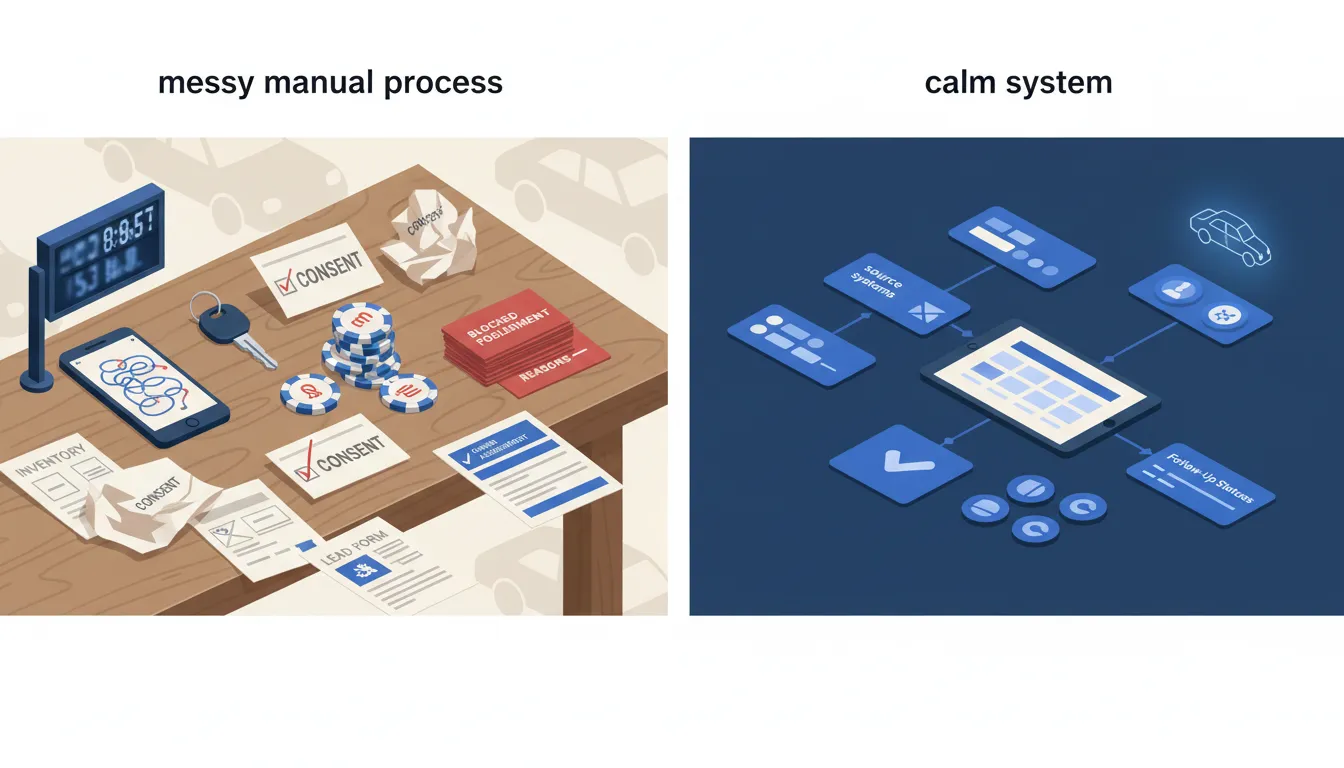
The first useful dashboard is usually not a giant sales command center.
It is an exception queue.
An exception queue is the list of deals that need a human today. It is not every lead. It is the work that will leak if nobody owns it.
For a dealer, that queue might include:
- Hot lead received after hours, first response sent, human callback due.
- Lead asked about a vehicle that is no longer available.
- Trade-in lead has VIN but no photos.
- Finance question includes sensitive credit language.
- SMS consent missing, email sent only.
- Appointment was set but not confirmed.
- Customer replied to automation and no human has answered.
- Lead is stale after two unanswered touches.
That is where a work queue is more useful than a generic report. A report tells you how many leads came in. A workflow queue tells you who has to act now.
I like this approach because it keeps the build small. You do not need every system replaced. You need the first leak made visible.
On one lead pipeline build, the system found raw candidates first and then filtered them down hard before outreach. That same thinking applies here. Do not treat every inbound lead as equal. Classify it, suppress the junk, route the high-intent work, and show the human owner the exact reason it was flagged.
What car dealership automation to build first
If I were choosing sales automation software for a dealer, I would not start with the vendor grid.
I would start with a 30-day operating test.
The test would measure:
- Median time from lead received to first response.
- Percent of leads with a named human owner in the first five minutes.
- Percent of first responses that reference the actual vehicle or question.
- Percent of SMS sends with captured consent.
- Number of stale hot leads caught by the exception queue.
- Number of trade-in leads routed to a valuation owner the same day.
That gives the store a real decision frame. If the current CRM can support those metrics with a workflow layer, keep it. If it cannot expose the data or accept writebacks, then replacement becomes a grounded conversation.
This is where independent dealers need a different playbook than large groups. The lesson from big dealer AI tools is that enterprise software often assumes a level of process maturity, data cleanliness, and headcount that a smaller lot does not have. A 40-car lot does not need a bloated platform that takes months to tune. It needs the few lanes that protect speed and accountability.
I would build in this order:
- Lead intake normalization.
- Inventory lookup and availability guard.
- Consent-aware first response.
- Hot lead alert to a named owner.
- Trade-in and finance exception routing.
- Stale follow-up queue.
- Weekly proof report.
The weekly report matters because automation should prove itself. It should show how many leads came in, how many got an automatic first response, how many were blocked by consent or inventory issues, how many needed human review, and how many were still stale.
That is the point of sales automation software. Not more activity. Better control.
When this is not worth automating yet
There are dealer sales lanes that are not worth automating yet.
If the inventory feed is wrong every day, fix the inventory feed first. If the team cannot agree who owns a lead after first response, fix ownership first. If SMS consent is not captured cleanly, do not let software send texts. If the store wants automation because nobody wants to call customers back, that is not a software problem yet. That is a management problem with a tool attached.
I would also pause if the dealer is looking for a magic closer. Sales automation software can help the team respond faster, route work better, and catch stale follow-up. It cannot make a bad offer good, make unavailable inventory available, or replace the trust a real salesperson builds when the buyer is ready to talk.
That is my line. Automate the repeatable lane. Do not automate around a broken operating decision.
Questions to ask before you buy
Before I buy or build anything, I would ask the vendor or builder these questions:
- Can it receive every lead source without copy-paste?
- Can it check live inventory before writing a response?
- Can it branch by SMS consent?
- Can it classify trade-in, finance, appointment, and vehicle-specific leads differently?
- Can it log the message, timestamp, channel, and owner back to the CRM?
- Can a manager see the exceptions without opening ten tools?
- Can the team turn off automatic sends without turning off the whole workflow?
- Can the system prove what happened when a deal complains or stalls?
If the answer is no, then the software is not ready to own the lane. It might still be useful, but it should not be trusted with customer-facing automation yet.
That is especially true around trade-ins. A fast lead response and a fast valuation workflow are related but not the same job. The AI trade-in valuation pattern works because it separates early estimate, human appraisal, and final offer. Sales automation should do the same thing. It should move the conversation forward without pretending the final decision has already been made.
The best dealer sales automation system is not the one with the most features. It is the one that makes the next action obvious, keeps the source of truth clean, and gives the human owner enough context to close the deal.
That is what I would build first.
Want this mapped against your current CRM, lead sources, and follow-up lane? Run the AI Operations X-Ray and I will show you where the first control layer should go. My used car dealer page, linked just below, covers what I build for independent lots.
FAQ
Frequently asked questions
01What is sales automation software for dealers?
Sales automation software for dealers is the workflow layer that receives leads, classifies intent, sends approved first responses, routes hot opportunities, logs activity, and keeps follow-up from falling through the cracks.
02Should a dealer replace its CRM with sales automation software?
Usually no. Start by making the current CRM, lead sources, inbox, phone system, and inventory feed work together before replacing the system of record.
03What should an independent dealer automate first?
Start with the first-response lane, because new vehicle leads, trade-in leads, finance questions, and after-hours inquiries lose value quickly when nobody owns the next action.
04Can AI send sales messages automatically?
It can, but I only like automatic sending when the message is factual, consent is captured, the inventory source is current, and the handoff to a named human is logged.
05What should dealership automation software check before it sends a text?
It should check that the customer gave SMS consent, that the inventory record is current and that a named person owns the follow-up. If consent is missing, send email or route the lead to manual review. If inventory freshness is unknown, do not promise availability.