Field note
Updated Sep 30, 2026
Dealer deal tracking: one deal state from lead to delivery
Dealer deal tracking should show where every deal stands, who owns the next step and which record to trust, from the first inquiry to delivery day.

Dealer deal tracking should show where every active deal stands, who owns the next move and which record you can trust. Some vendors sell this as a CRM order management system. For the independent used-car dealers I work with, it runs from first inquiry to delivery.
That sounds like one software category. In practice, it is one lane across several systems.
The CRM knows the customer and conversation. The DMS knows the vehicle and official deal. A shop system may know whether the car is ready. A finance platform knows which approval or document is missing. Text messages may live somewhere else. The manager still needs one answer when a buyer calls: what is true right now, and what happens next?
I have seen the before state on a rental-car dealership build. Work moved through spreadsheets, whiteboards, word-of-mouth, and the memory of whoever touched the item last. I built an operating layer that surfaced priorities at 5:45 a.m. and rescored leads at 8:00 a.m. The useful part was not that an AI agent existed. The useful part was that the team could see the next action without reconstructing the day from five places.
My opinion has stayed the same across these builds: the control point is the handoff, not the software logo.
For an independent lot, I would not buy a CRM order management system until the store can define the customer-to-delivery lane clearly enough to test it.
Dealership deal management needs one deal state
Most stores already have several versions of the same deal.
The CRM says the opportunity is open. The DMS says the vehicle is held. The appraisal note is in a text thread. Finance is waiting on proof of income. The salesperson believes the appointment is tomorrow. The customer believes the vehicle is ready today.
A CRM order management system should not create one more status. It should create one visible deal state from the authoritative fields already in the operation.
I start by defining the order record. For a dealer, that record usually needs:
- Customer and contact channel.
- Vehicle of interest and VIN.
- Current availability and readiness.
- Lead source and consent state.
- Trade-in and appraisal owner.
- Appointment state.
- Finance stage and missing items.
- Required approvals.
- Current human owner.
- Next action and due time.
- Final delivery or loss reason.
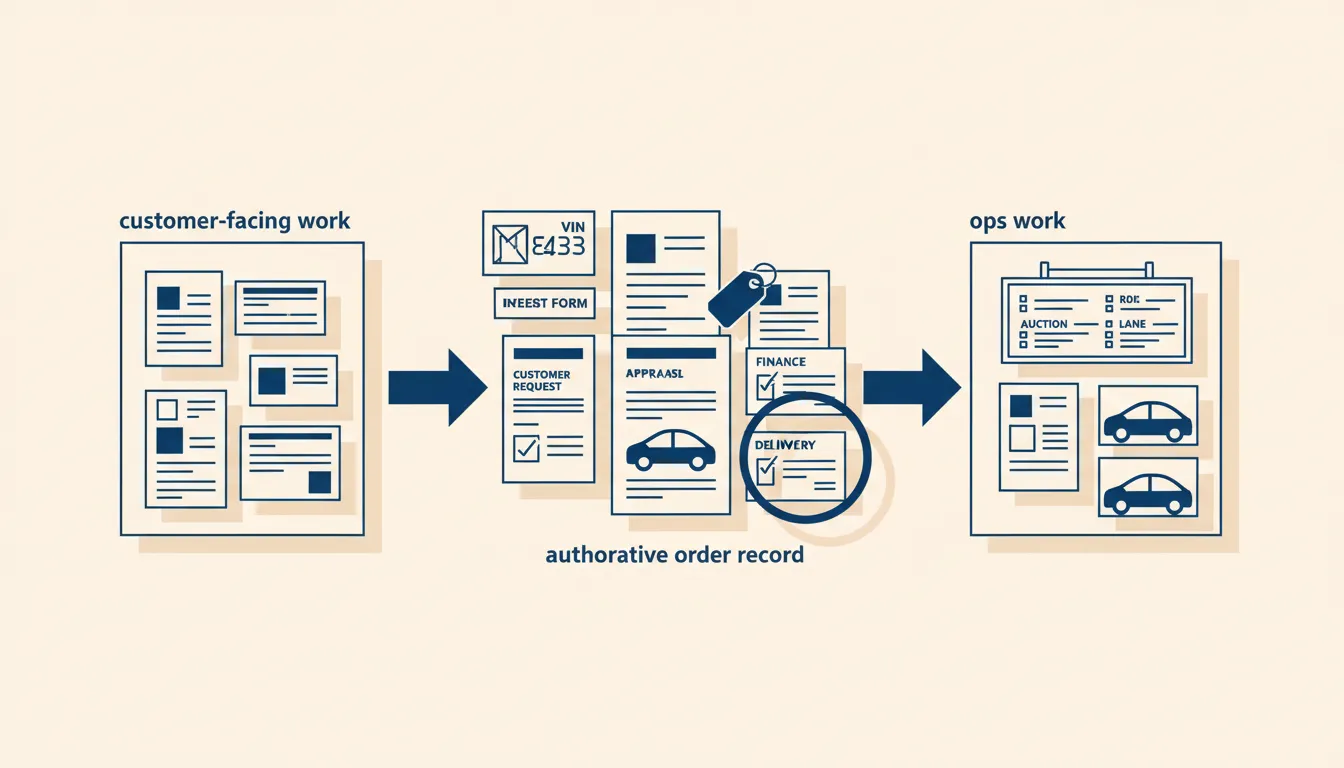
The important decision is not which screen displays those fields. The important decision is which system has authority over each field.
The CRM may own conversation history, consent, and next follow-up. The DMS may own inventory, official deal status, and delivery. The shop system may own recon readiness. Finance may own approval state and missing documents. The operating layer should read those records, show their age, and route the next action without pretending it owns facts that belong elsewhere.
That is the same test I use for dealership management system controls. Keep the official record stable where it is strong. Make the work around it visible.
Define authority field by field
A vendor will often ask whether the CRM or DMS is the source of truth.
I think that question is too broad.
Authority needs to be defined field by field. The CRM can be correct about the last customer reply while the DMS is correct about whether the vehicle sold. The shop system can be correct about readiness while the finance system is correct about a pending stipulation.
A useful authority map looks like this:
| Field | Authoritative system | Freshness requirement | Exception owner |
|---|---|---|---|
| Customer conversation | CRM or messaging platform | Immediate | Sales owner |
| SMS consent | CRM consent record | Before every send | Sales manager |
| Vehicle availability | DMS inventory record | Before every promise | Inventory manager |
| Recon readiness | Shop system | Before appointment confirmation | Service owner |
| Appraisal status | Appraisal lane | Before trade-in follow-up | Buyer or manager |
| Finance status | Finance platform | Before customer commitment | F&I owner |
| Delivery complete | DMS deal record | Same business day | Sales manager |
This is business process design applied to a dealer. The architecture is not a diagram of integrations. It is a set of decisions about truth, timing, ownership, and exceptions.
I also like using a public VIN check as a validation step when appropriate. The NHTSA Vehicle API can decode and validate VIN information. It does not replace the dealer's inventory record, but it can help catch malformed or mismatched vehicle data before the wrong record moves deeper into the lane.
The rule is straightforward: validate externally when useful, but commit operational truth only through the system that owns it.
For equipment transactions, I apply that boundary to quote review inside the dealer's existing CRM, where the request, line items, and approval status need to stay connected.
Customer-facing vehicle records also need a controlled path. The FTC Used Car Rule requires dealers to display a Buyers Guide on used vehicles and give it to the buyer after the sale. I treat that as another reason not to let informal CRM notes silently become official vehicle facts.
Connect the order lane before replacing software
A dealer usually begins shopping because the current stack feels fragmented.
Fragmentation is real, but replacement is not always the first fix. I prefer a 30-day connection test around one deal lane.
Pick one path, such as:
- Vehicle inquiry arrives.
- CRM creates or matches the customer.
- DMS confirms the vehicle and current availability.
- Workflow assigns a salesperson.
- Customer response is logged.
- Trade-in request routes to an appraisal owner.
- Finance request routes to F&I with the exact missing items.
- Appointment reflects vehicle readiness.
- Manager sees blocked or stale deals.
- Delivery writes final proof back to the official record.
That is where business process automation earns its value. The automation is not trying to become a new DMS. It is connecting events, records, decisions, and owners across the systems already in use.
The test should answer four questions:
- Can the current systems expose the fields the lane needs?
- Can the workflow show how old each critical fact is?
- Can the operator stop or reroute an unsafe action?
- Can the final business event be verified in the official record?
If the answer is yes, the dealer may not need a replacement. If the answer is no because a system cannot export, integrate, or accept required updates, the store now has a specific buying requirement instead of a general complaint.
Some DMS products will not offer the clean API path a buyer expects. In that case, a scheduled report or CSV can still work if age, retries, rejected rows, and failure alerts are visible. The DMS integration with a controlled CSV export is useful when the limitation is admitted instead of hidden.
A batch file is not real time. That is fine when the lane shows the timestamp and blocks actions that require fresher data.
Build the exception lane before the dashboard
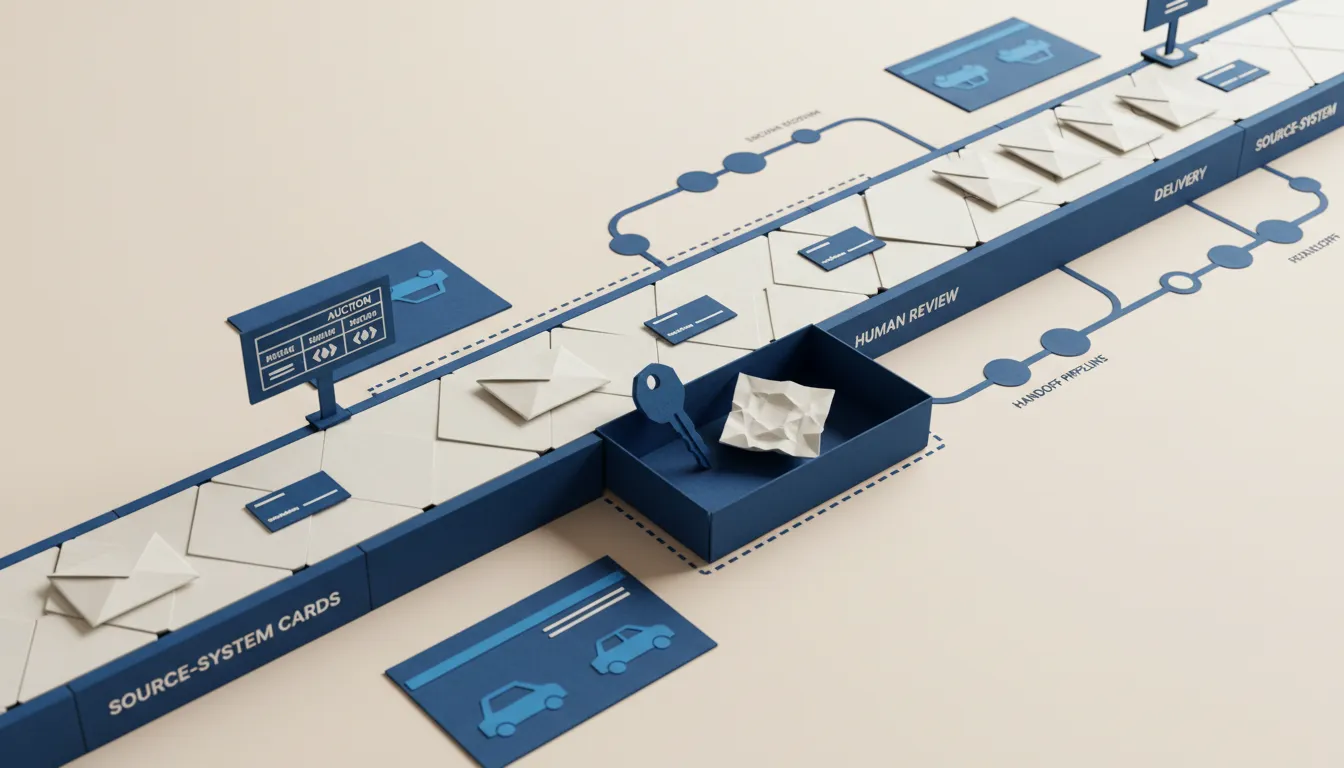
A CRM order management system should make ordinary work quiet and exceptional work obvious.
I would build the exception lane before a large management dashboard. The manager does not need another set of charts if the real problem is that nobody can see the five deals that need action today.
Dealer exceptions include:
- Customer asks about a vehicle that appears sold, held, or in recon.
- CRM and DMS disagree on the vehicle attached to the customer.
- Trade-in request has no appraisal owner.
- Finance stage is active but required documents are missing.
- Appointment is set before the vehicle is ready.
- Automated message is blocked because consent is missing.
- Customer replied but the human owner has not responded.
- Deal status has not changed inside the expected window.
- Delivery appears complete in one system but not in the official deal record.
Each exception needs five pieces of information: the affected deal, what is uncertain, which source was checked, who owns the decision, and when the next action is due.
That is also the standard behind sales automation controls for dealers. Speed only helps when consent, inventory context, and human ownership remain intact.
Financial information needs a stricter lane. The FTC Safeguards Rule guidance explains the need for covered financial institutions to maintain safeguards for customer information. For an operator, that means finance data, credentials, vendors, access, and incident response cannot be treated as details added after the workflow works.
I keep finance documents out of broad sales alerts. I show the salesperson the next safe action, not every sensitive field. F&I gets the controlled detail. The manager gets the exception and owner. Access follows the job.
Score the software on proof, not features
I would score a CRM order management system on operating evidence, not the number of modules in the demo.
One deal state. Can the system show the current state without creating another competing record?
Field authority. Can the vendor explain which application wins for customer, vehicle, recon, appraisal, finance, and delivery fields?
Freshness. Does every critical fact show when it was checked or updated?
Ownership. Does every active deal and exception have one current human owner?
Approval boundaries. Can the workflow stop before pricing, finance, compliance, or customer commitments move without the right person?
Failure visibility. Can a manager understand a failed sync or rejected update without reading technical logs?
Manual control. Can the store pause automated sends or move one lane to review without shutting down everything?
Proof. Can delivery, loss, and follow-up outcomes be verified in the official record?
Portability. Can the dealer export records, rules, configurations, and runbooks if the vendor relationship ends?
Cost clarity. Are implementation, software, usage, maintenance, and integration costs separated?
I use a zero-to-two score for each category. Zero means the vendor does not address it. One means it appears in the proposal. Two means the vendor demonstrates it with one real dealer scenario. A score below 16 out of 20 tells me the operating lane is still relying on assumptions.
The score does not choose software by itself. It forces the buyer to see where the store will still depend on memory, manual cleanup, or vendor support.
When not to hire me
Do not hire me to build deal tracking or a CRM order management system when the team cannot agree on ownership.
If nobody owns vehicle availability, appraisal, finance exceptions, or customer follow-up, software will move the disagreement faster. I would spend one week naming owners and expected response windows first.
I would also pause when inventory data is routinely wrong, consent is not captured, finance access is too broad, or delivery status is not updated in the official record. Those are operating defects that automation can amplify.
The right first move may be a daily checklist and one exception review. Software becomes useful after the store can state what good looks like.
My rule is simple: connect the order lane first, then decide whether any system actually needs replacement.
A good CRM order management system gives the dealer one visible deal state without stealing authority from the systems that already own the facts. It makes stale data obvious, routes exceptions to real people, protects sensitive steps, and proves the final outcome.
That is what I would buy. Not another all-in-one promise. A controlled customer-to-delivery lane the operator can see and own.
If you want to find the first handoff worth fixing, run the AI Operations X-Ray. I will map the leak, the record owners, and the safest first control layer before you commit to a replacement project. My used car dealer page, linked just below, covers what I build for independent lots.
FAQ
Frequently asked questions
01What is a CRM order management system for a dealer?
It is the operating layer that connects a customer record in the CRM to the vehicle, appraisal, finance, documents, appointment, and delivery state required to complete the deal.
02Should the CRM or DMS own the deal?
The DMS should usually own the official vehicle and deal records while the CRM owns conversation and follow-up. The workflow should define authority field by field instead of declaring one application the winner.
03What should a dealer automate first?
Start with one leaking handoff such as vehicle inquiry to availability check, trade-in request to appraisal owner, or finance request to missing-document review.
04When should a dealer replace its CRM or DMS?
Replace a system only after a controlled workflow test proves that the current platform cannot expose, export, or accept the records needed to run the lane safely.
05Do I need deal jacket software?
Not as a first step. A digital deal jacket only helps when the store has already decided which system owns the vehicle, finance and delivery records. Start by connecting one deal lane and making stale items visible, then decide whether a new tool is still needed.