Field note
Aug 11, 2026
HR process automation: protect the human handoff
HR process automation should move records, reminders, and routine routing faster without hiding who owns judgment, exceptions, or the next human decision.


HR process automation should protect the human handoff, not erase it.
I want the system to collect the right record, put it in front of the right person, show how long it has been waiting, and prove what happened next. I do not want a workflow quietly turning an incomplete signal into a hiring decision, an employee promise, or a sensitive record change.
I learned this on a recruiting system where one live run scraped 2,494 potential records and pushed only 33 into outreach after the business rules were applied. The small output was not automatically good or bad. It was a reason to inspect every gate, make the filtering visible, and confirm that the workflow was excluding the right work for the right reasons.
My rule is simple: add an ICP or policy validator between a signal and an action. Then give a human a clean exception lane when the validator cannot make a safe determination.
That rule applies beyond recruiting. Candidate screening, interview feedback, onboarding documents, time-off approvals, policy acknowledgments, access requests, and offboarding all have the same operating problem. Work moves through several people and systems, but responsibility can disappear between them.
Start with one HR promise
The wrong starting point is, "We want to automate HR."
That scope is too broad to own, test, or recover. I start with one promise that a manager can recognize as complete.
Examples include:
- Every interview receives documented feedback from a named owner within one business day.
- Every new hire has the required documents, equipment owner, access status, and first-day confirmation before the start date.
- Every policy exception reaches the correct approver with the evidence needed to decide.
- Every departing employee has access removed, assets reconciled, and the final record confirmed by the accountable role.
- Every candidate who stops moving has a reason, next action, and aging clock.
One promise creates the boundary for the first release. It also exposes whether the problem is really automation, unclear policy, missing ownership, or disagreement about the source of truth.
This is why I separate HR automation tools and their operator controls. A tool can send reminders and update fields. It cannot decide which manager owns a delayed interview, which record wins when two systems disagree, or when an exception is serious enough to stop the workflow.
For the first promise, I want six answers:
- What starts the work? Name the form, event, message, or status change.
- Which record is authoritative? Pick the HRIS, ATS, payroll system, service desk, or controlled document.
- Who owns the next action? Use a role, not a vague team inbox.
- What may the automation do? Separate reading, preparing, routing, changing, and committing.
- What proves completion? Define the field, approval, timestamp, file, or downstream confirmation.
- What stops the workflow? Name the missing data, conflict, threshold, or sensitive decision that requires review.
If the team cannot answer those questions, I map the handoff before I build the workflow.
Separate movement from judgment
HR process automation is strongest when it handles movement and weakest when it hides judgment.
I divide the work into five levels:
- Collect. Capture a form, email, document, event, or status change.
- Prepare. Extract fields, normalize names, find missing data, summarize history, or draft a response.
- Route. Assign the item, start an aging clock, create a task, and notify the correct owner.
- Recommend. Suggest a classification, priority, next step, or policy path with a reason.
- Commit. Reject a candidate, send an offer, change compensation, approve leave, remove access, or make another external promise.
I am comfortable automating the first three when the rules and records are stable. Recommendations need evidence and an explicit reviewer. Commit actions need a higher bar because they affect a person, create a business obligation, or change access and money.
The Department of Justice guidance on AI and disability discrimination in hiring makes the operator responsibility concrete. Employers need to examine hiring technology before and during use, account for how it may screen out qualified people with disabilities, and preserve a reasonable accommodation path. Buying the tool does not transfer that responsibility to the vendor.
This is also where recruiting automation should earn trust. The first win is not an autonomous hiring decision. It is a process where qualified work stops disappearing, feedback reaches the right record, owners see delays, and operators can recover a bad handoff without rebuilding the case from inboxes.
My opinion is direct. If the automation cannot show why it routed, held, or excluded an item, it is not ready to influence a sensitive decision.
Build three decision lanes
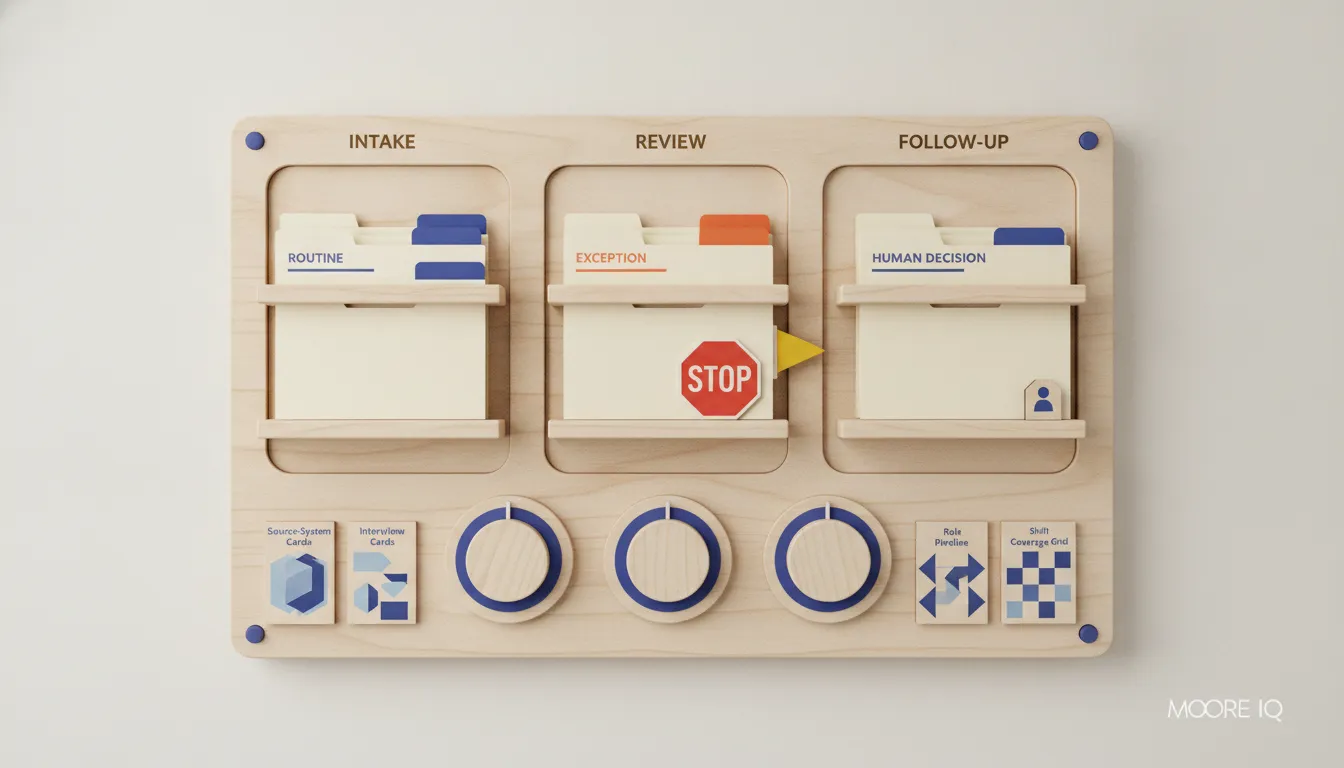
Every automated HR process needs three visible lanes.
Routine lane
The record is complete, the rule is stable, the owner is known, and the allowed action is low risk. The workflow can move the item and record its proof.
Exception lane
The item is missing data, conflicts with another record, falls outside the normal policy, has no owner, or has waited too long. The workflow stops and creates a decision packet instead of guessing.
Human decision lane
The workflow has prepared the evidence, but a named person must decide. The reviewer should see the original record, relevant history, recommendation if one exists, reason for the recommendation, and the exact action approval will allow.
I do not treat a notification as an approval. "A candidate needs review" is only an alert. A real approval records who reviewed which version, what they decided, when they decided, and what became allowed afterward.
The operating model in my field note on recruitment workflow handoffs is the same. A candidate should never sit between recruiter, hiring manager, client, and system with no visible next owner. The automation should make the baton clearer every time it changes hands.
For small teams, one person may own both the routine lane and the exceptions. That is fine. The system still needs to show which responsibility that person is carrying.
Design the exception packet
A useful exception packet prevents the reviewer from reopening five tools just to understand what happened.
I include:
- The person or case identity from the authoritative record.
- The current stage and the last confirmed action.
- The exact reason the workflow stopped.
- Required information that is missing or conflicting.
- The previous owner and the next expected owner.
- The age of the handoff.
- What the workflow already changed.
- What it has not changed.
- The decisions available to the reviewer.
- The proof that should exist after the decision.
This packet is where AI can help without pretending to own the decision. It can summarize a long thread, compare a document against a checklist, detect inconsistent fields, or draft the next message. The original evidence and approval boundary still stay visible.
When I evaluate a recruiting management system, I look for this exception surface before I look at dashboards. A polished funnel is not enough if delayed feedback, ambiguous ownership, and duplicate records still disappear into private messages.
Measure handoff health, not workflow activity
A green automation run proves that code executed. It does not prove that the HR promise was fulfilled.
The NIST AI Risk Management Framework organizes this work around governing, mapping, measuring, and managing risk. My HR operator version is to govern the decision boundary, map the people and records, measure the actual handoff, and manage exceptions before expanding authority.
I use a small operator scorecard:
- Handoff completion rate: what percentage reached the next accountable owner within the operating window?
- Unowned items: how many records have no valid next owner?
- Exception aging: how long have stopped items waited for a decision?
- Record integrity: how many duplicate, missing, or conflicting records appeared?
- Decision turnaround: how long did a prepared decision wait for human action?
- Reconciliation gap: how many items entered the process but have no proved outcome?
- Recovery success: can the team reconstruct, correct, and safely replay a failed case?
I care about the denominator. If 33 records move forward from 2,494, the report must show why the other 2,461 did not. It should separate invalid data, policy exclusions, duplicates, unavailable contacts, missing evidence, and true exceptions. One large "filtered" count hides whether the system is protecting quality or losing opportunity.
That is the broader purpose of business process automation services. The system should make the business rule and the proof easier to inspect, not bury both behind workflow activity.
Run a handoff recovery drill
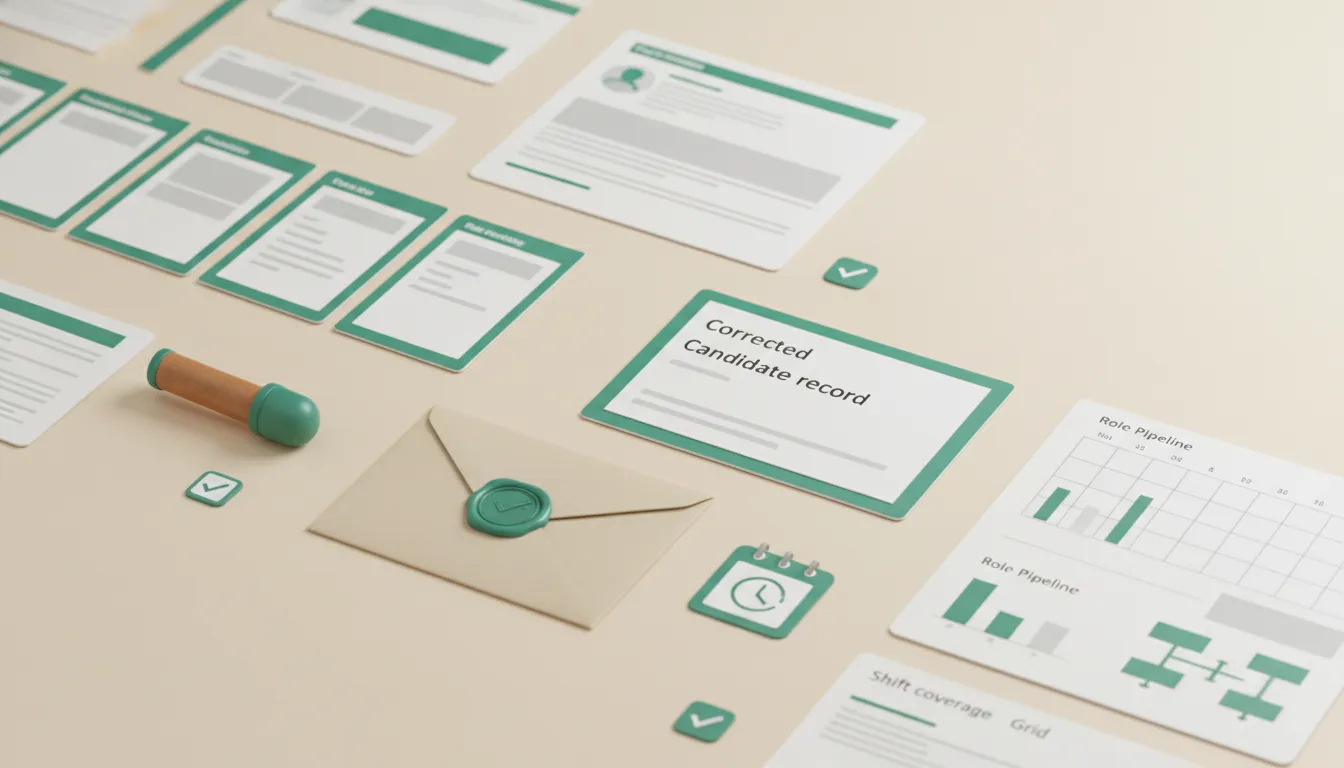
Before I expand authority, I run one controlled recovery drill.
The NIST AI RMF Playbook provides suggested actions for putting those risk functions into practice. I use the same practical posture here: choose the controls that fit the HR use case, test them against real failure conditions, and keep the result visible to the business owner.
The test is practical:
- Stop the workflow without deleting the record or evidence.
- Identify the last confirmed business state.
- Separate actions completed from actions attempted.
- Correct the policy rule, source record, owner, or missing input.
- Replay only the safe portion of the process.
- Prevent duplicate messages, tasks, calendar events, access changes, or offers.
- Confirm the expected HR proof after recovery.
- Record what must change before the next live run.
I also test an unavailable manager, expired credentials, two records for the same person, an edited interview scorecard during processing, a missing consent field, and a send response that is uncertain.
If the team cannot determine whether an external action happened, the workflow should not retry the action blindly.
For a broader review, my AI Operations X-Ray focuses on these ownership and evidence gaps before a large build starts. One repaired handoff is a better first release than an employee-lifecycle diagram nobody can operate.
Decide whether to automate, standardize, or pause
Not every HR problem needs more software.
Automate when the intake is stable, the source record is clear, ownership is named, exceptions are known, and completion can be proved.
Standardize first when managers follow different versions of the process, required fields are inconsistent, decisions live in private messages, or the same status means different things to different teams.
Pause when leadership wants the system to reject, promise, pay, or remove access before the review and recovery controls exist.
A good first release is narrow. It might normalize candidate records, route complete cases, remind the owner, prepare an exception packet, and reconcile outcomes every morning. That is enough to expose where responsibility is leaking.
When not to hire us for HR process automation
Do not hire us for HR process automation when nobody owns the current handoff.
I would also pause when:
- The team cannot name the authoritative record.
- The policy changes depending on who is asked.
- A manager wants to automate a decision that the business cannot explain manually.
- There is no appeal, correction, or exception path.
- Sensitive actions have no approval boundary.
- Success is described only as time saved.
- The business will not review excluded items or data loss.
- The workflow cannot be stopped without losing evidence.
- The company expects a new system to fix unclear management responsibility.
In those conditions, the first engagement should define one operating promise, one owner map, one decision policy, and one proof of completion.
HR process automation creates value when routine movement gets faster and human accountability gets clearer at the same time. If the workflow makes it harder to see who decided, why an item stopped, or how to correct a mistake, it is not reducing HR risk. It is moving uncertainty faster.
FAQ
Frequently asked questions
01What is HR process automation?
HR process automation moves routine records, reminders, approvals, and status updates through a defined people process while preserving human ownership for judgment, exceptions, sensitive decisions, and recovery.
02Which HR process should a company automate first?
Start with one frequent handoff that has a clear owner, stable intake, an authoritative record, visible aging, and a measurable completion signal, such as candidate feedback, onboarding documents, or an approval queue.
03Should HR process automation make hiring decisions?
I start with collection, normalization, routing, reminders, and decision support. I keep rejection, offer, compensation, accommodation, and other sensitive commitments behind a named human decision until the business has proven the controls and review path.
04How should an operator measure HR process automation?
Measure the percentage of handoffs completed on time, items with no owner, exception aging, duplicate or missing records, decision turnaround, and whether the team can reconstruct and recover a failed case.