Field note
Aug 7, 2026
SaaS workflow: the operator control test
A SaaS workflow should protect a business outcome with clear authority, visible exceptions, result-level proof, and a tested recovery path.

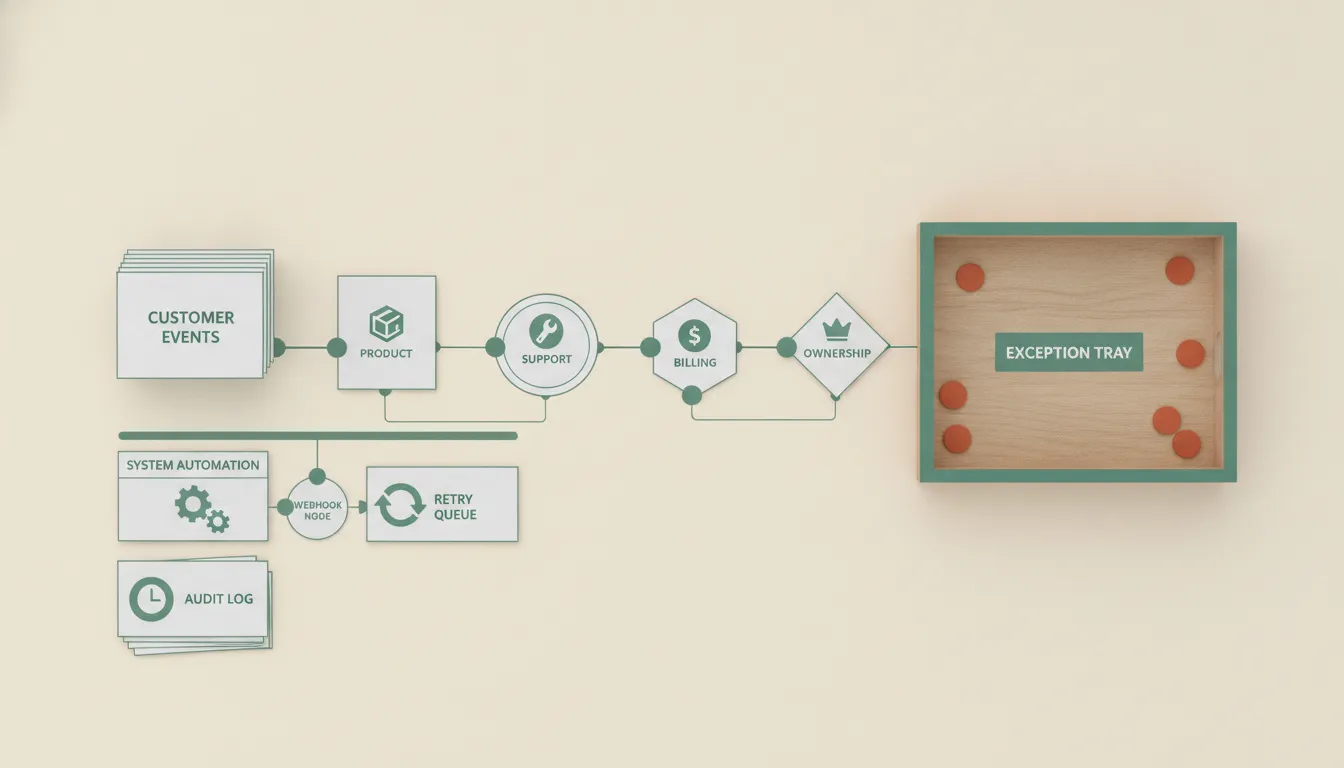
A SaaS workflow can look healthy while the business outcome quietly fails.
That is the risk I care about most. The trigger fires. The automation reports success. The customer record moves. Nobody sees an error. Then billing, access, support, or delivery turns out to be wrong when the business can least afford it.
I saw this on a workflow that tracked customer data usage for billing. The workflow did not throw an obvious failure. A logic issue or backend change stopped assigning usage to one client correctly. The problem surfaced at month end, when the usage charge should have been prepared. By then, the company could not responsibly reconstruct the missing amount and had to absorb one full month of that client's data cost.
That story shaped my rule: a successful run is not business proof.
I treat a SaaS workflow as an operating control, not a chain of integrations. It needs to protect one business promise, show which records have authority, route uncertain work to a person, and verify the result after the last write. If it cannot do those things, it is not ready to run unattended.
Start with the business promise
The first design decision is not which automation tool to use. It is the promise the workflow must keep.
A useful promise is specific enough to inspect:
- Every paid account receives the correct access level within the approved window.
- Every usage event reaches the correct customer record before billing closes.
- Every cancellation request reaches the retention or support owner before another charge.
- Every failed payment creates the approved customer communication and a visible recovery task.
- Every support escalation has a next owner, due time, and closure record.
These are business outcomes. They connect product events to money, customer commitments, and operating ownership.
This is why I frame the work as business process automation tied to an outcome. Connecting software is only the middle. The real job is protecting the promise from intake through proof.
I write the promise before I map the workflow. Then I define what starts the obligation, which event proves completion, and what the operator should see when the normal path breaks.
If the team cannot agree on that sentence, I do not recommend building more automation yet. I would rather use an operations diagnostic to find the first controlled lane than automate a vague process across five systems.
Map authority field by field
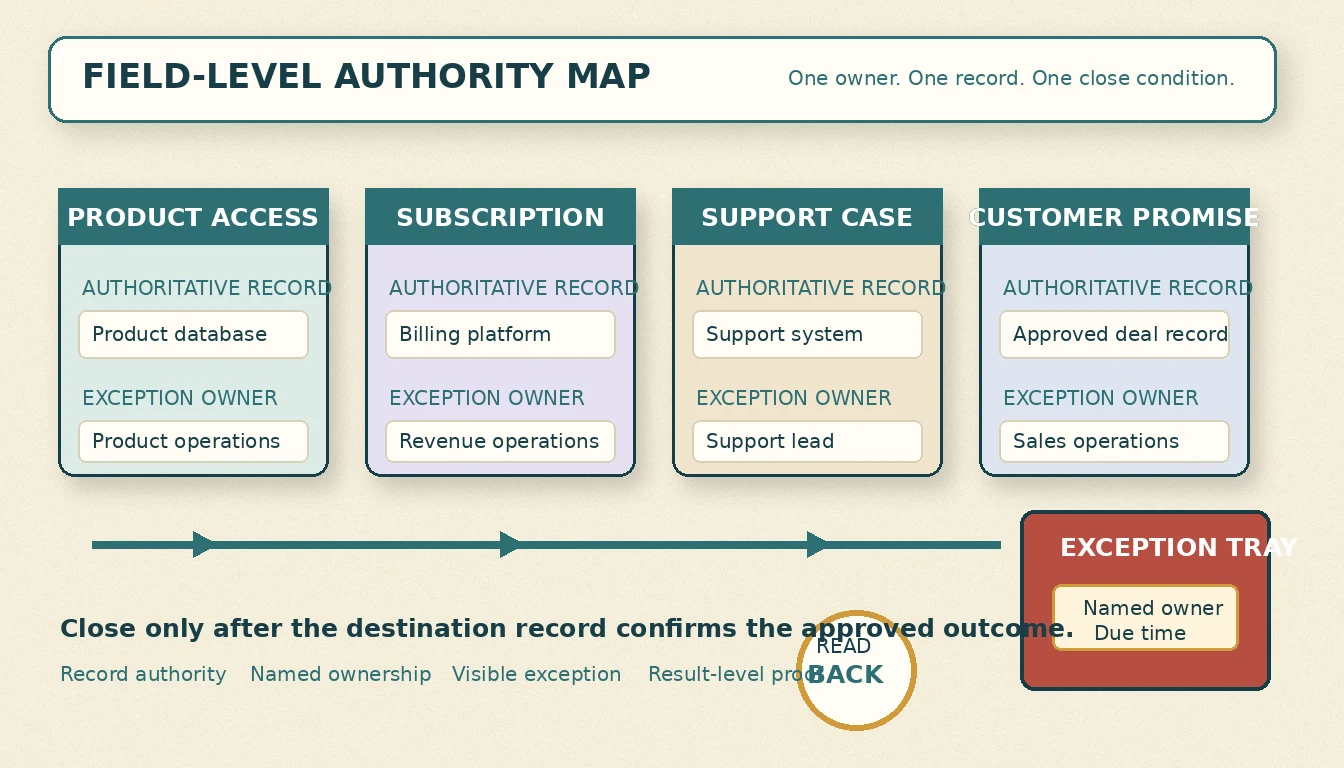
Most SaaS workflows cross more systems than the process diagram admits.
The product database may own access. The billing platform may own payment settlement. The CRM may own commercial context. The support system may own customer issues. The analytics layer may show activity without owning the event that created it.
Saying one platform is the source of truth is usually too broad. I define authority field by field:
| Record or field | Authoritative system | Freshness rule | Exception owner |
|---|---|---|---|
| Subscription status | Billing or subscription service | After confirmed payment event | Finance or revenue operations |
| Product access | Product database | After approved entitlement change | Product operations |
| Usage quantity | Metering record | Before billing close | Finance operations |
| Customer commitment | Signed agreement or approved deal record | Before fulfillment | Sales operations |
| Support severity | Support case record | At triage and escalation | Support lead |
| Cancellation state | Approved cancellation record | Before renewal or charge | Customer operations |
This field-level map prevents a common failure: one system overwrites a valid value because another system looked newer but did not have authority.
The same discipline appears in business process architecture for operators. I am not trying to produce a prettier architecture diagram. I am trying to decide which record wins, who resolves disagreement, and what downstream action is allowed.
Separate observation from authority
A SaaS workflow should earn authority in stages.
I use four levels:
- Observe. Read approved events and records, detect stale work, and surface mismatches.
- Prepare. Assemble context, calculate a proposed value, draft a message, or create a review packet.
- Recommend. Suggest the next action and explain the evidence and uncertainty.
- Act. Change access, update a record, send a customer message, issue a credit, or move the process forward.
The mistake is jumping from an impressive demo to level four.
I prefer to watch the workflow operate at levels one through three first. That is where the team learns whether account identity is stable, events arrive in order, exceptions are classified correctly, and reviewers agree with the proposed action.
This matters even more when AI is part of the flow. An AI agent workflow for operators should prepare and recommend before it earns permission to make consequential changes. Model capability does not erase source-of-truth rules or approval boundaries.
The NIST AI Risk Management Framework is useful here because it puts governance, measurement, and risk management around AI use. My operator version is direct: show the evidence, expose uncertainty, limit authority, and measure the final business result.
Build an exception lane before the happy path scales
The normal path is easy to demonstrate. The exception path is where the workflow earns trust.
I define exception classes before launch:
- Missing event: The expected product, billing, or support event never arrived.
- Unknown account: The event cannot be tied safely to one customer.
- Duplicate event: The same business event appears more than once.
- Stale state: The workflow is about to act on an old subscription, access, or account value.
- Value conflict: Two authoritative-looking records disagree.
- Partial write: One destination accepted part of the update but not all required fields.
- Rejected action: A system refused the write, send, or entitlement change.
- Late arrival: The event arrived after the operating or billing window.
- Approval needed: The proposed action affects money, access, a customer commitment, or a destructive change.
Every exception record should include the affected customer or business event, evidence used, reason code, current owner, due time, allowed decisions, and closure proof.
This is where workflow management for operators becomes practical. The queue is not just a list of failed jobs. It is the operating surface where someone can see what happened, why it matters, and what decision closes the risk.
An alert that only says “workflow failed” is not enough. Neither is a technical log that requires an engineer to reconstruct the business context. The operator needs the customer, promise, impact, owner, and recommended next move first. The OWASP logging guidance calls out operational monitoring and audit trails as core reasons to log application events. I apply that discipline to the business lane, not only the infrastructure.
Reconcile the outcome after the write
The last action in the automation is not the end of the SaaS workflow.
If the workflow updates access, read the entitlement back. If it records usage, confirm the customer, period, quantity, and billing state. If it creates a support task, confirm the owner and due time. If it changes a subscription record, verify the final status in the authoritative system.
I use result-level checks:
- Did the expected record exist?
- Was it attached to the correct customer and business event?
- Did every required field receive the approved value?
- Did the destination confirm the final state?
- Did the workflow create a duplicate?
- Did an exception remain open?
- Is the evidence still available for review?
That is reconciliation automation applied to operator control. It catches the difference between transport success and business completion.
The silent billing failure would have been visible much earlier if the workflow had compared received usage events, assigned customer usage, and billable records before month end. The problem was not only the logic defect. The problem was that no control proved the final record existed for every expected customer.
Run the recovery drill

I do not trust a SaaS workflow because the clean sample works.
I run a recovery drill:
- A normal event completes once.
- The same event arrives twice.
- An event has no stable customer identifier.
- Events arrive out of order.
- One destination accepts the update and another rejects it.
- A value changes after the first read but before the write.
- The billing or product system is unavailable.
- A late event arrives after the normal review window.
- A reviewer rejects the proposed action.
- The workflow is stopped, corrected, and replayed without duplicating the outcome.
- The final record is read back and verified.
- The exception closes only after proof is attached.
Replay is the part teams skip. Retrying without idempotency can create a second charge, credit, message, access grant, task, or usage record. A safe workflow must know whether it is resuming incomplete work or repeating completed work.
I also test the stop control. An operator should be able to pause the lane without deleting evidence or leaving unclear half-completed records behind. The NIST Cybersecurity Framework 2.0 includes both governance and recovery in its core functions. I use the same operating discipline here: decide who has authority before launch, then prove the lane can recover before an incident.
Use a weekly operator scorecard
A SaaS workflow needs a review rhythm even when it is stable.
I review:
- Obligations expected versus outcomes confirmed.
- Exceptions by type, impact, age, and owner.
- Customer or revenue records that could not be matched.
- Automated actions approved, edited, rejected, or rolled back.
- Duplicate events suppressed.
- Partial writes and replay results.
- Oldest unresolved exception.
- Rules that changed during the week.
The scorecard should lead with action needed, not workflow volume. Ten thousand processed events can hide one consequential billing or access failure.
My opinion is firm: I would rather operate a smaller controlled workflow with visible exceptions than a larger autonomous workflow that cannot explain its results.
When not to hire us for a SaaS workflow
Do not hire us for this work when the team cannot name the business promise, the authoritative records, or the person who owns exceptions. I would pause when:
- Nobody owns the business promise.
- The team cannot identify field-level authority.
- Customer identity is too inconsistent to match safely.
- Consequential actions have no approval rule.
- The workflow has no durable exception queue.
- A completed run is treated as proof of success.
- Nobody can stop, replay, or roll back the lane.
- The team wants AI autonomy before reviewing recommendations.
- Billing, access, or customer commitments change without result-level verification.
In those conditions, I start read-only. I observe the events, compare the records, name the exception classes, and build the review surface. The first win is visibility and ownership, not autonomy.
A SaaS workflow earns unattended authority when it can protect one promise, explain every exception, verify the final record, and recover without creating a second problem. Start with the outcome. Define authority. Limit action. Reconcile the result. Test replay. Then expand one controlled lane at a time.
FAQ
Frequently asked questions
01What is a SaaS workflow?
A SaaS workflow is the controlled path that moves a customer or business event through product, support, billing, and operating systems until a defined outcome is complete and verified.
02What should operators check before automating a SaaS workflow?
Check the business promise, field-level source of truth, owner, timing rule, exception classes, approval boundaries, closure proof, and recovery path before allowing automated actions.
03How can a SaaS workflow fail silently?
It can complete technically while assigning data to the wrong account, skipping a record, accepting a partial write, using stale state, or failing to confirm the final business result.
04Should AI act automatically in a SaaS workflow?
Only after observation, preparation, and recommendation modes have proven the source data, exception rules, approvals, and audit trail. Consequential customer, billing, access, and destructive actions should stay controlled.