Field note
Aug 13, 2026
Sales pipeline software for independent dealers
Sales pipeline software should show independent dealers which customer and vehicle need action, who owns it, what is blocked, and what proves the handoff is complete.

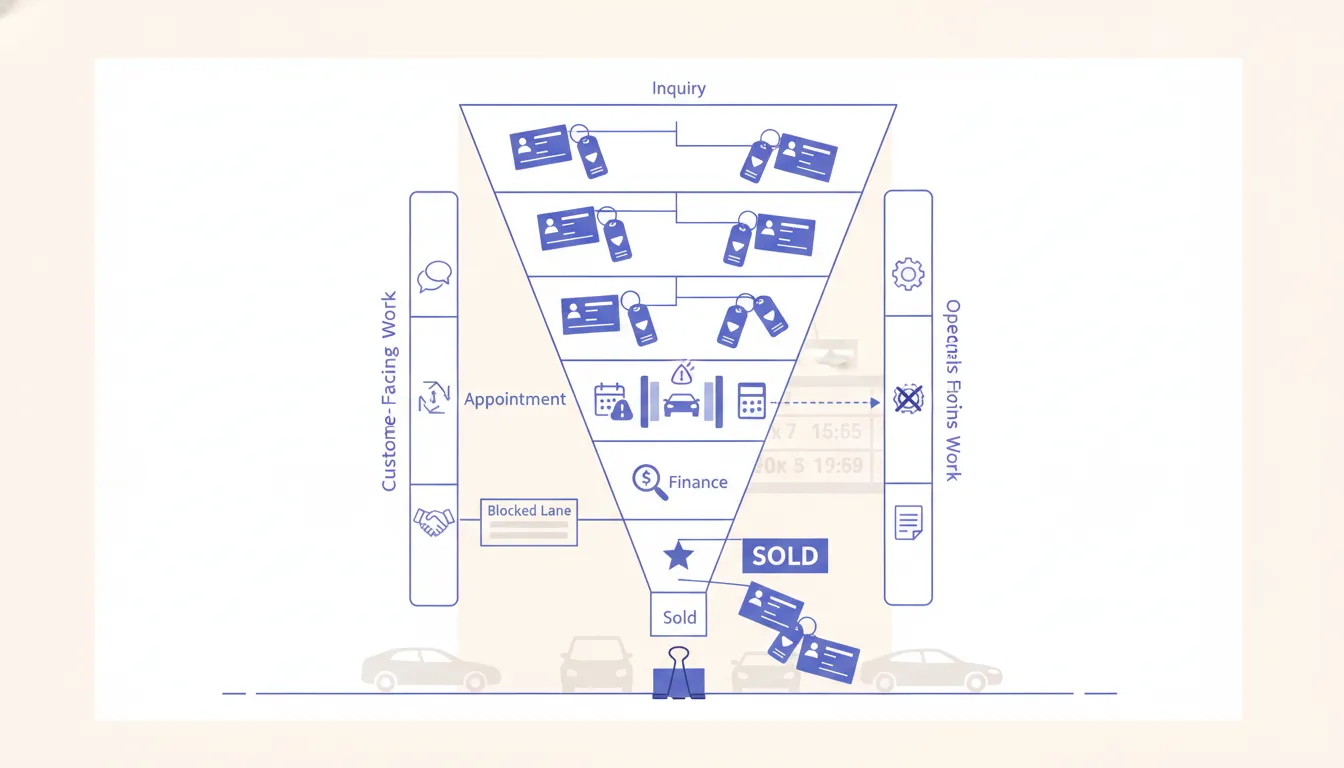
Sales pipeline software is useful when it tells an independent dealer what needs a decision today. It is not useful when it turns the sales meeting into a tour of colored cards.
I start with five questions:
- Which customer and vehicle are we talking about?
- What decision has actually been completed?
- Who owns the next action?
- What is blocking it?
- What evidence lets us move the record forward?
Those questions sound basic. They are also where most pipeline implementations break. A lead can sit in a stage called "contacted" even though nobody accepted ownership. An appointment can look active while the vehicle is sold or still in recon. A finance handoff can look complete because a task was checked, even though the customer still owes a document.
On one dealership operations build, five systems held the data the leadership team needed. The CFO was still hand-pulling reports, and the buyer wanted the numbers to drive meetings and goals. The problem was not the absence of software. The problem was that no shared operating view could explain which record was current, which handoff was blocked, and who had the next decision.
I have built over 500 production-grade workflows. My rule after that volume is simple: a pipeline stage is not a status label. It is a claim that specific work is complete, supported by evidence.
Start with one pipeline promise
Before I compare sales pipeline software, I write one operating promise:
Every valid inquiry reaches a named owner with current vehicle context, a due next action, a visible blocked reason, and proof of the customer handoff.
That promise fits the reality of independent used-car dealers. Their pipeline crosses marketplace leads, website forms, calls, texts, vehicle availability, recon, appointments, trades, finance, lenders, and deal administration.
A vendor may call all of that CRM. I treat it as business process automation, because the result depends on what happens between records and teams.
The promise also gives the buyer a boundary. The software does not need to own every record. It needs to show the correct record, enforce the next decision, and stop when the truth is missing.
Define stages by entry and exit evidence
Most pipeline templates begin with names such as new, contacted, qualified, appointment, negotiation, and won. Those names are too vague for an operating system.
I define every stage with six fields:
- Entry event.
- Required source records.
- Current owner.
- Due time.
- Exit evidence.
- Exception path.
A new inquiry enters when an approved source creates a valid customer intent. It exits only when a person or approved workflow accepts ownership, confirms the vehicle context, and sets the next action.
"Contacted" should not mean that an email was sent. It should state whether the customer received an approved response, whether a reply is pending, and when the next attempt becomes due. My field note on used-car lead response covers why response speed matters, but speed without accepted ownership is only fast activity.
An appointment should not enter the active lane until the date, owner, customer confirmation, and vehicle status are present. It should not exit because the meeting time passed. It should exit as shown, missed with a recovery action, rescheduled, or closed for a documented reason.
A finance handoff should name the decision that is pending. "In finance" can hide a missing document, lender review, consent issue, manager approval, or customer decision. Those are different states with different owners.

Keep the customer and vehicle together
A dealer pipeline is not a generic B2B opportunity board. The customer intent is tied to a vehicle, and that vehicle can change status while the conversation is active.
I want every pipeline record to preserve:
- Original lead source and timestamp.
- Customer identity and consent context.
- Vehicle of interest and stock identifier.
- Current vehicle status, source, and age.
- Conversation history.
- Appointment, trade, and finance context.
- Current owner and accepted timestamp.
- Next action and due time.
- Blocked reason and escalation owner.
- Last verified customer action.
The DMS may own vehicle and deal truth. The CRM may own the conversation. The shop system may own recon. The finance system may own lender progress. The pipeline should not quietly copy those records and become a fifth version of reality.
Instead, I assign one source of truth to each decision. My dealer CRM feature test uses the same rule for permissions and vehicle context. My CRM-to-order handoff test follows the record farther through appraisal, finance, and administration.
When a current system owns reliable records but cannot expose the handoff clearly, I consider legacy system modernization before replacement. A thin operating layer can normalize identifiers, surface exceptions, and create a usable meeting view without forcing a risky system migration.
Make ownership explicit
Assignment is not ownership.
A round-robin rule can place a salesperson's name on a lead. That does not prove the person saw it, accepted it, or has the context to act. I require an accepted timestamp and a due next action.
Ownership also changes by decision. A salesperson may own the customer conversation. An appraisal manager owns the trade value. A finance manager owns a lender decision. A recon lead owns readiness. A general manager owns an exception involving price or policy.
The software should show one current owner for the next decision, not six followers and a shared task list.
When ownership changes, I want a handoff record that states:
- Who released the work.
- Who accepted it.
- What records were verified.
- What decision is due.
- When it is due.
- What happens if it is rejected or ignored.
This is also where I separate reminders from authority. A workflow can remind, summarize, classify, and prepare a draft. It should not make a pricing, credit, compliance, or uncertain availability promise simply because a timer expired. Sales automation needs dealer controls precisely because the fastest path is not always the authorized path.
Give blocked work its own lane
A pipeline that only shows forward movement hides the work that needs management.
I create a visible exception lane for conditions such as:
- Duplicate customer records.
- One customer asking about multiple vehicles.
- Vehicle sold after inquiry.
- Availability or recon status older than the response limit.
- Missing VIN, mileage, photos, or payoff details for a trade.
- Finance handoff waiting on a document or decision.
- Customer opt-out or consent uncertainty.
- Integration update rejected by the destination.
- Assigned owner unavailable.
- Automated response prepared but not approved.
Every exception needs one reason, one owner, a due time, allowed actions, and closure evidence.
A generic red badge is not enough. If the manager has to open every record to understand what is wrong, the pipeline has moved the morning scavenger hunt onto a prettier screen.
The FTC Used Car Rule is a useful reminder that customer-facing vehicle information and disclosures require disciplined handling. I do not let urgency turn stale data into a confident promise.
Run the meeting from decisions, not activity
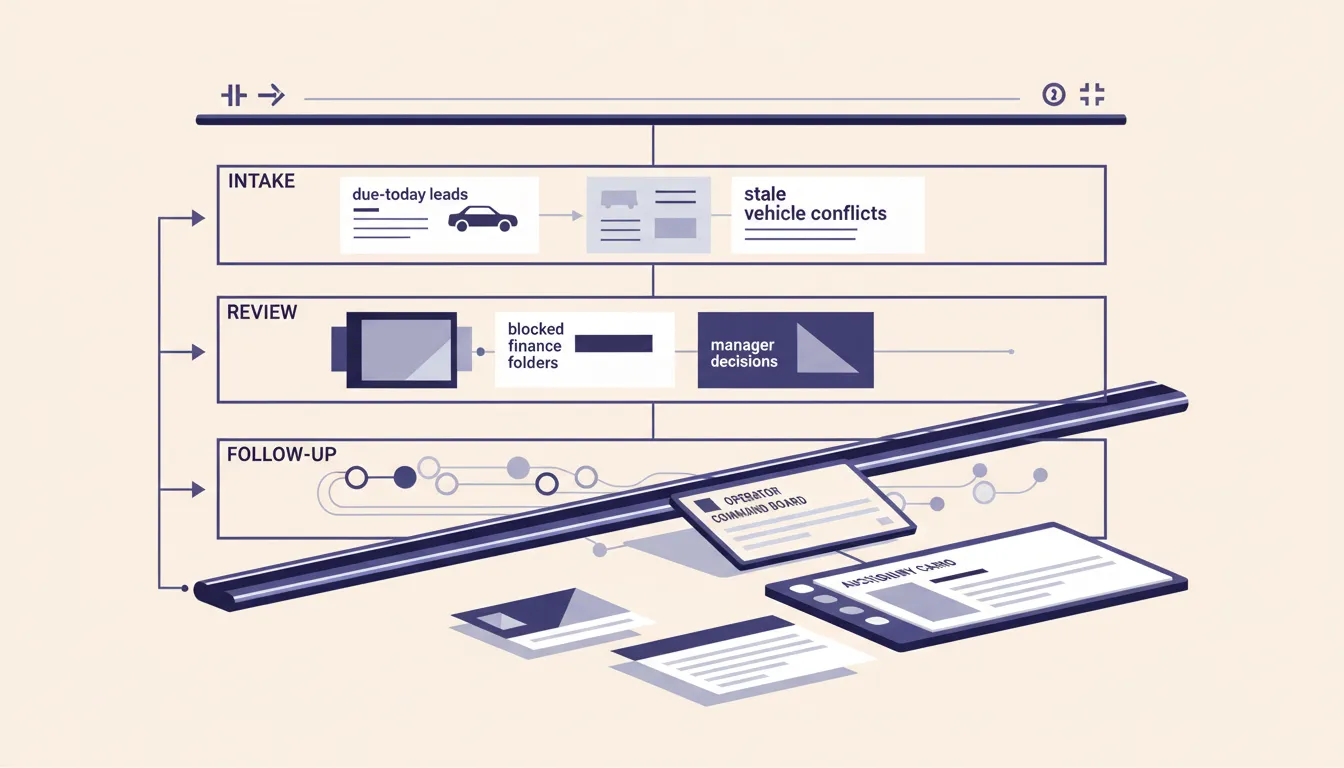
The daily meeting should not review every open opportunity. It should review the records that need a decision.
My meeting view starts with:
- New inquiries without accepted owners.
- First responses past due.
- Appointments within the next operating window.
- Vehicle conflicts or stale availability.
- Trades waiting on appraisal inputs or approval.
- Finance handoffs missing a document or owner.
- Customer replies without a due next action.
- Exceptions older than their escalation threshold.
- Integration failures that changed customer work.
I also show completed outcomes, not just activity. A rising message count can hide a falling appointment show rate. A growing pipeline can hide stale records. A fast first response can hide unsupported vehicle promises.
The software should help a manager ask: What is the oldest unowned decision? Which source creates the most incomplete records? Which owner repeatedly rejects assignments? Which stage accumulates work without exit evidence?
That turns the pipeline into an operating instrument instead of a forecast decoration.
Test failure before automating follow-up
I do not approve sales pipeline software from a clean demo.
I run ten scenarios:
- A normal lead arrives and gets an accepted owner.
- The same customer arrives through a second source.
- The requested vehicle sells after the inquiry.
- Vehicle status becomes stale.
- A trade request arrives without required details.
- A finance handoff waits on a human decision.
- The assigned salesperson becomes unavailable.
- The CRM or DMS rejects an update.
- A manager stops the workflow and corrects the source record.
- The team replays the work without sending a duplicate message.
For AI-assisted classification or drafting, the NIST AI Risk Management Framework provides a useful governance pattern: map the use, measure the risk, manage the controls, and keep oversight visible. I apply that thinking to each automated pipeline action.
The business should own the accounts, data, credentials, rules, logs, and documentation. The manager should be able to stop the workflow without calling the builder. The team should be able to explain why a record moved and why a customer received a message.
The FTC Safeguards Rule guidance also gives dealers a practical reason to test role-based access, credential handling, audit history, incident response, and clean employee offboarding wherever covered customer information enters the pipeline. I am not giving legal advice. I use those controls as a minimum operating standard for sensitive customer workflows.
Use an operator scorecard
I measure whether the pipeline closes operating gaps:
- Percentage of approved sources captured.
- Percentage of inquiries with accepted ownership.
- Time to first qualified response.
- Percentage of active records with current vehicle context.
- Percentage of stages with valid exit evidence.
- Number and age of blocked exceptions.
- Duplicate record and duplicate message rate.
- Appointment show rate by source and owner.
- Trade requests reaching a named appraisal owner.
- Finance handoffs missing a next action.
- Time to detect, stop, and recover from an integration failure.
I review the exceptions weekly. Those records tell me whether the problem is the source data, stage definition, ownership rule, integration, training, or software.
When not to hire us for sales pipeline automation
Do not hire us when the store cannot agree on which system owns customer, vehicle, deal, recon, and finance status.
I would also pause when:
- Lead ownership goes to whoever notices the inbox.
- Vehicle availability cannot be trusted.
- Stage names have no entry or exit criteria.
- Pricing and finance approval boundaries are informal.
- The team wants automatic messages without exception review.
- Shared credentials hide who changed a record.
- No manager owns stale or rejected work.
- The store cannot stop and replay a failed workflow.
Software will not settle those operating decisions. It will automate the disagreement.
The best sales pipeline software gives an independent dealer a current, recoverable view of customer work. It keeps the customer and vehicle together, names the owner of the next decision, exposes blocked work, and proves each handoff before the record moves.
Start with one lead lane. Define the stage evidence. Connect the minimum authoritative records. Run the failure test. Then expand only when the daily meeting becomes shorter, clearer, and easier to act on.
FAQ
Frequently asked questions
01What should sales pipeline software track for an independent dealer?
Track the customer, vehicle, source, current decision, named owner, due time, blocked reason, last verified status, allowed next action, and evidence required to complete the handoff.
02Should sales pipeline software replace a dealer CRM or DMS?
Not automatically. Keep the CRM or DMS when it owns reliable customer, vehicle, deal, or accounting records. Add an operating layer when the real gap is cross-system ownership, exception handling, and meeting visibility.
03Can a dealer automate pipeline follow-up?
A dealer can automate intake, classification, reminders, summaries, and draft preparation. Pricing, credit, compliance, uncertain availability, and final customer commitments should remain inside explicit approval boundaries.
04How should a dealer test sales pipeline software?
Test a normal lead, a duplicate, a sold vehicle, stale status, missing appraisal details, a finance block, an unavailable owner, a rejected integration update, a stop action, and a safe replay.