Field note
Jul 30, 2026
AP automation process: controls before payment
An AP automation process should match the right records, route exceptions, preserve approval authority, and prove the payment outcome before it earns a wider rollout.

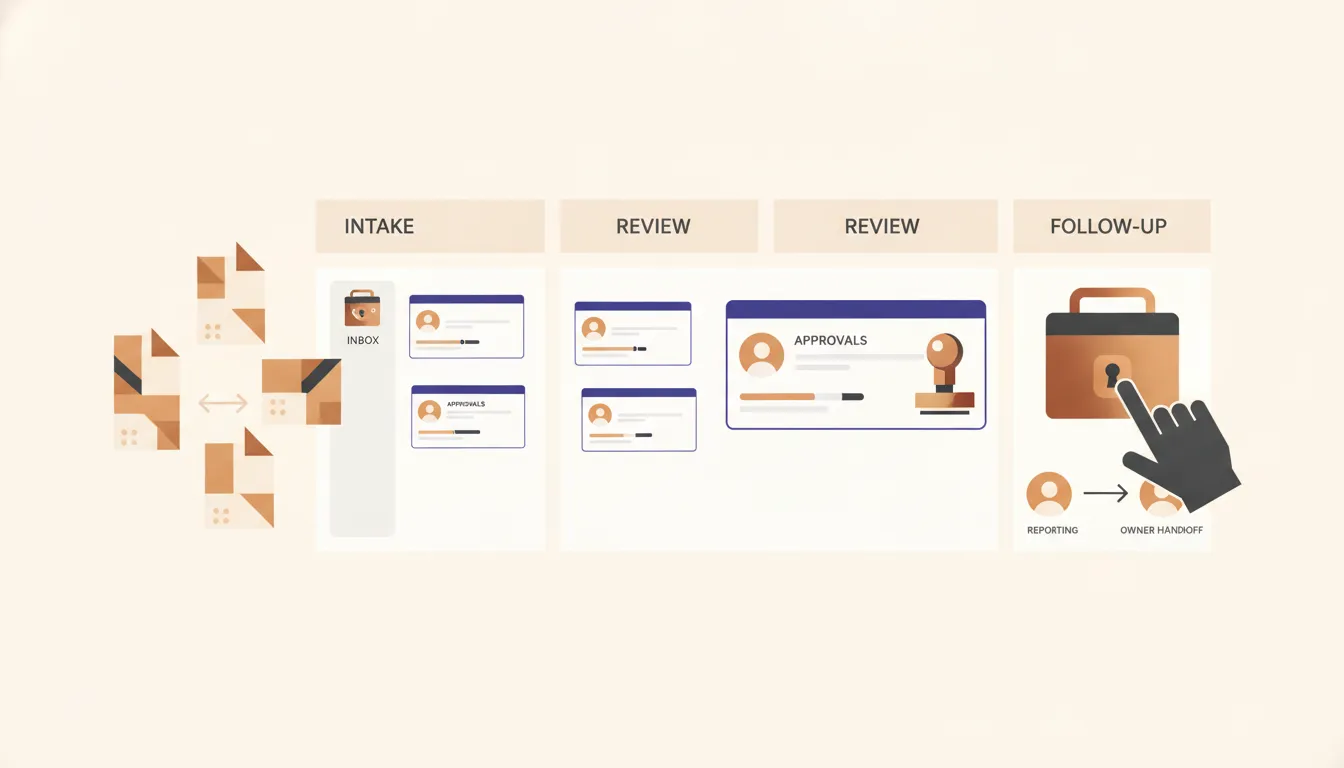
An AP automation process should make the path from supplier invoice to reconciled payment easier to trust. It should not only read documents faster. It should know which records have authority, which differences require judgment, who can approve the obligation, and what proves the payment landed correctly.
I have built invoice-processing workflows that begin with an email and move structured information toward QuickBooks. I have also done finance and accounting automation for a nonprofit. The first version of one intake lane had four steps: receive the email, run the analysis, parse the result into structured fields, and send the record onward.
That four-step spine is useful, but it is not the full AP automation process. Extraction is only the front door. The business still needs to decide whether the invoice belongs to the right supplier, matches an actual purchase and receipt, carries valid terms, has the right approval, should be posted, and can be paid safely.
My opinion is simple: automation should not get payment authority just because it can read an invoice. Authority has to be earned through controls, visible exceptions, and reconciliation.
Map the AP automation process before choosing software
I start with the operating lane, not the product category.
A useful AP automation process usually has these stages:
- Receive the invoice through an approved channel.
- Identify the supplier and check the supplier record.
- Extract invoice number, dates, amounts, terms, tax, currency, and line items.
- Check for duplicates and suspicious changes.
- Match the purchase order and proof of receipt when they exist.
- Route a clean invoice to the right approval owner.
- Send every mismatch into a named exception lane.
- Post the approved obligation to the accounting system.
- Release payment only through the approved authority boundary.
- Reconcile the payment and preserve the outcome record.
That is why I treat AP as business process automation. The value lives across email, supplier records, purchasing, receiving, contracts, approvals, accounting, banking, and management review. No single feature owns the whole outcome.
Before I build, I write one operating promise:
Every valid supplier invoice reaches an approved, posted, and reconcilable state without losing the source documents, authority trail, or exception owner.
That sentence creates a boundary. It tells me what the workflow must prove and where automation must stop.
Decide which record wins for every field
An invoice can look complete and still conflict with the operation.
The supplier master may have one legal name while the invoice uses another. The purchase order may contain one price while the invoice contains a higher price. The receiving record may show fewer units than the supplier billed. The contract may contain payment terms that differ from the document. The accounting platform may already contain the same invoice under a slightly different reference.
A source-of-truth map should define authority field by field:
| Field | Authoritative record | Owner when it conflicts |
|---|---|---|
| Supplier identity and status | Approved supplier master | Procurement or finance owner |
| Bank and remittance details | Controlled supplier verification record | Authorized finance reviewer |
| Ordered quantity and price | Approved purchase order or contract | Purchasing owner |
| Received quantity | Receiving or job-completion record | Operations owner |
| Invoice number and stated amount | Original supplier invoice | AP owner |
| Approval authority | Approval policy and current role map | Finance leader |
| Posted obligation | Accounting system | Controller or bookkeeper |
| Payment outcome | Bank and accounting reconciliation | Finance owner |
This is business process architecture for operators applied to AP. The architecture is not a picture of arrows between applications. It is a set of decisions about authority, ownership, timing, and proof.
I do not let the workflow silently choose whichever field was easiest to extract. When records disagree, the disagreement becomes an exception with a person attached.
The IRS recordkeeping guidance is a useful baseline because it ties supporting documents such as invoices, receipts, and paid bills to the business records they support. I want the automation to preserve that evidence chain instead of replacing it with extracted fields alone.
Make matching a control, not a checkbox
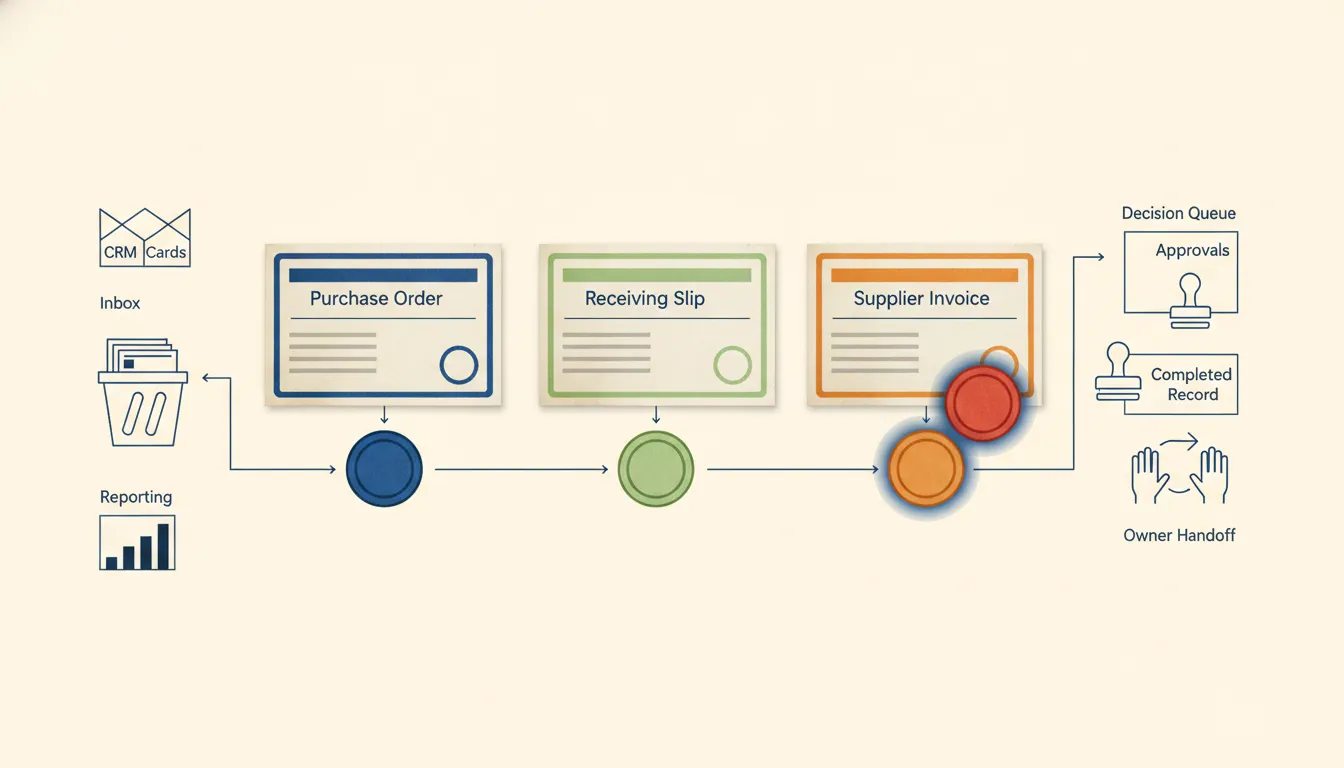
Three-way matching is useful when the business actually creates a purchase order and records receipt. The workflow compares the purchase order, receiving evidence, and supplier invoice before approval.
The control should answer:
- Is this the approved supplier?
- Does the invoice reference the right purchase or job?
- Were the goods or services actually received?
- Do quantity, unit price, tax, freight, and total stay within policy?
- Are the contract terms or approved change orders reflected?
- Has this invoice number, amount, or document already appeared?
- Did any sensitive supplier detail change?
The same logic applies when a formal purchase order does not exist. A service business may match the invoice to a signed agreement, approved estimate, completed work record, or manager confirmation. The records change, but the control question stays the same: what evidence makes this obligation valid?
That is where contract automation controls matter. Supplier terms, renewal dates, rate cards, approved scope, and change authority should not live only in someone's memory while AP is expected to validate the bill.
My rule is to automate clean matches and surface uncertain ones. I do not use confidence language to hide missing evidence.
Build exception lanes before automatic posting
Most AP risk lives outside the happy path.
I want explicit lanes for:
- Duplicate invoice number, amount, or document fingerprint.
- Supplier not found or not approved.
- Missing purchase order, receipt, or completion evidence.
- Quantity, price, tax, freight, or total outside tolerance.
- Bank, remittance, address, or ownership details changed.
- Invoice submitted through an unapproved channel.
- Approval owner missing, inactive, or over their limit.
- Accounting period closed or coding unclear.
- Destination rejected the posting.
- Payment appears released but cannot be reconciled.
Each exception needs the invoice, the conflicting records, a plain-language reason, one current owner, a due time, the allowed decisions, and proof of closure.
A red badge is not an exception process. If nobody owns the decision, the automation has only moved uncertainty into a new queue.
The broader accounting automation operator test is useful here. Finance automation should protect source records, approvals, exceptions, and reconciliation. Speed comes after those controls, not before them.
Keep approval separate from payment release

Approval and payment release are related, but they are not the same authority.
NIST SP 800-53 includes controls for separation of duties and least privilege. I use the same operating principle in AP: no workflow or person should receive more payment authority than the job requires.
A manager may be allowed to confirm that work was completed. A department owner may approve the expense. AP may validate the supplier and coding. A controller may approve the posting. A different authorized role may release payment.
I define those boundaries explicitly:
- What can the system read and classify?
- What can it prepare without approval?
- What can it post after a documented approval?
- What always requires a person?
- Which amount, supplier, currency, or change triggers a higher authority?
- Who can pause the lane?
- Who can safely replay work after a failure?
Sensitive supplier changes deserve a separate verification path. I do not want an emailed bank-detail change flowing directly into a payment record because the extraction was accurate. Accurate extraction can still reproduce fraud accurately.
The business should own the accounts, credentials, data, rules, logs, and documentation. I prefer visible systems that a qualified operator can pause and troubleshoot. No outside builder should become the only person who can explain why money moved.
Test the failure cases before a wider rollout
A clean invoice demo proves very little.
I run a controlled test with real owners and a narrow invoice class. The test includes:
- A normal invoice that should match and route correctly.
- A duplicate with a changed filename.
- An invoice with a price or quantity variance.
- A missing receipt or completion record.
- A changed remittance detail that must stop.
- An approval request above the owner's authority.
- An accounting-system rejection.
- A pause, correction, and safe replay.
- A posted obligation that must reconcile to the final payment.
I want the owner to perform the stop and recovery steps, not only watch the builder do them.
The NIST Cybersecurity Framework organizes risk work around governance, identification, protection, detection, response, and recovery. That is a practical reminder that an AP workflow needs detection and recovery evidence, not only preventive rules.
The workflow should also preserve idempotency. Reprocessing the same approved invoice after a timeout should not create a second posting or payment instruction. A green automation run is not enough. The accepted accounting record and reconciled outcome are the proof.
If the team cannot run these cases, I do not expand the AP automation process to every supplier and business unit.
Measure completed outcomes, not document volume
AP software makes activity easy to count: invoices scanned, fields extracted, workflows run, approvals sent, and hours estimated.
I care about the business outcome.
My first scorecard includes:
- Percentage of valid invoices reaching an approved and posted state on time.
- Duplicate invoices prevented before posting or payment.
- Match rate by supplier and invoice class.
- Number and age of open exceptions.
- Approval turnaround time and override rate.
- Posting rejections and unreconciled obligations.
- Payment errors, reversals, and recovery time.
- Cost per completed, reconciled invoice.
- Time to detect, stop, and recover from workflow failure.
I put those measures into a short recurring review. The report automation scorecard shows the same principle: a management report should make decisions, blocked work, ownership, and proof visible. It should not become another dashboard tour.
The weekly AP review asks which exceptions are oldest, which suppliers create recurring mismatches, which approvals are bypassed, which records disagree, and which control needs to change.
That is how the automation improves instead of quietly accumulating workarounds.
When not to hire us for AP automation
Do not hire us to automate invoice posting or payment when the business cannot answer basic control questions.
I would pause when:
- The supplier master is duplicated or unmanaged.
- Purchase orders and receiving records are routinely missing.
- Approval limits live only in personal judgment.
- Shared credentials hide who approved or changed a record.
- Supplier-detail changes have no independent verification path.
- The accounting system cannot prevent duplicate posting.
- Nobody owns AP exceptions end to end.
- Reconciliation happens too late to catch errors safely.
- The team wants automatic payment before it can run a recovery drill.
In those cases, the right first move is a smaller control project. Clean the supplier record. Name the owners. Define the approval matrix. Choose the first invoice class. Run a manual exception review. Then automate the stable lane.
The AI Operations X-Ray is how I map that starting point. I use it to identify the leaking handoff, the systems that own the records, the approval boundary, and the safest first build.
An AP automation process should earn authority in stages. Start with intake and validation. Add matching and exception routing. Prove approval and posting. Keep payment release controlled. Reconcile the result. Then expand.
That is the operator test. Not how quickly the software can read an invoice, but whether the business can trust, own, stop, and prove the path from invoice to payment.
FAQ
Frequently asked questions
01What is an AP automation process?
An AP automation process receives supplier invoices, extracts and validates fields, matches supporting records, routes approvals and exceptions, posts approved obligations, and preserves proof through payment and reconciliation.
02What should accounts payable automate first?
Start with invoice intake, duplicate checks, field validation, and approval routing for one controlled supplier or invoice class. Keep payment release and unusual exceptions behind human approval until the workflow proves reliable.
03What is the biggest risk in AP automation?
The biggest risk is giving a fast workflow authority it has not earned. A system can extract an invoice correctly and still match the wrong supplier, miss a duplicate, accept changed bank details, or post an obligation without valid approval.
04How should an AP automation process be measured?
Measure accepted invoices, exception volume and age, duplicate prevention, approval time, match accuracy, unreconciled postings, payment errors, cost per completed outcome, and time to detect, stop, and recover from failure.