Field note
Aug 21, 2026
AI agent development: an operator's practical framework
AI agent development starts with one owned outcome, clear authority, acceptance tests, and recovery. Use this buyer framework before commissioning a build.

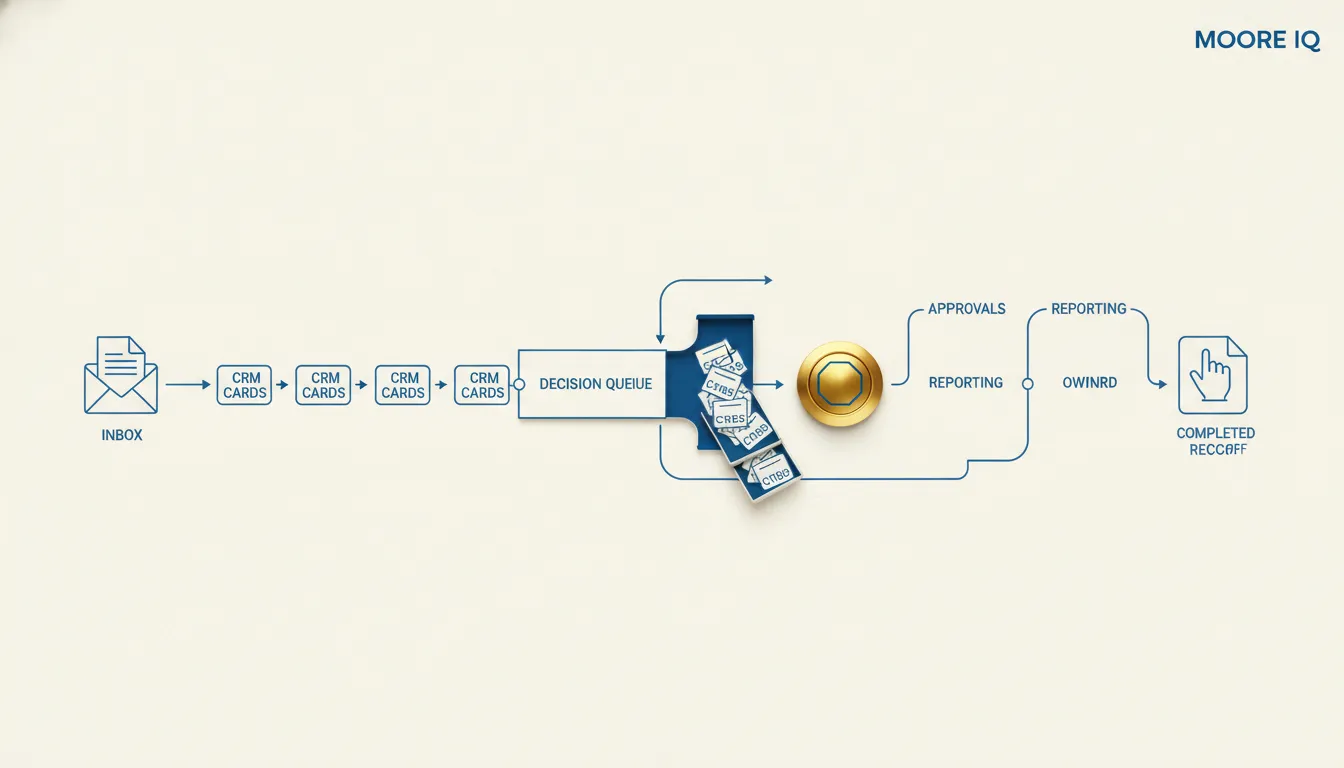
AI agent development should begin with one business result an operator can own, inspect, and stop. It should not begin with a request for “an agent that handles everything.” I have built enough automation to know that giving vague work more autonomy mostly creates a faster way to become confused.
On one client build, I kept the schedule and stop control in a visible workflow layer because the agent runtime was harder for the operator to inspect. The point was not that one tool was more impressive. The point was that the person responsible for the outcome could see when work ran, understand where it failed, and deactivate the lane without opening a development environment.
My rule is simple: an agent earns authority only after the business can define its promise, boundaries, proof, and recovery.
Start with the business promise
A useful agent brief names one result. It does not name a personality.
Good starting promises include:
- Prepare a reply for an approved operator to review.
- Find account exceptions and place them in an owned queue.
- Read an intake packet and identify missing evidence.
- Compare a completed job with billing requirements.
- Research a prospect and return a source-backed brief.
- Reconcile two records and explain every difference.
Each promise has a trigger, a trusted record, a destination, and a person who cares whether the result is right.
A weak brief says the agent should “help with operations.” That can include sales, recruiting, finance, delivery, support, and a small amount of accidental chaos before lunch. If the boundary is not clear, use the AI Operations X-Ray to rank the operating gaps before choosing one.
I also map the process before choosing the agent pattern. Business process architecture exposes the handoffs, competing records, and ownership gaps that a model will otherwise inherit.
Decide whether the work needs an agent
Not every useful automation needs an agent. This is a buying decision, not a vocabulary decision.
A fixed workflow is usually better when:
- The trigger is known.
- The rules are stable.
- The sequence is predictable.
- The destination is fixed.
- Exceptions can be listed in advance.
An agent becomes useful when the route changes based on context, several tools may be needed, or the system must gather and compare evidence before deciding the next step.
Anthropic's guidance on building effective agents recommends starting with simple, composable patterns and increasing complexity only when it improves the result. I agree. I would rather ship a boring workflow that closes the loop than a multi-agent diagram that cannot explain why a customer record changed.
The practical split is:
| Work type | Better starting pattern |
|---|---|
| Stable extraction and field mapping | Fixed workflow |
| Known approval sequence | Fixed workflow |
| Open-ended research with source checks | Bounded agent |
| Exception analysis across several records | Bounded agent |
| Irreversible action involving money or customers | Agent prepares, operator approves |
| Repeated task already handled by native software | Use the native feature |
Define authority before tools
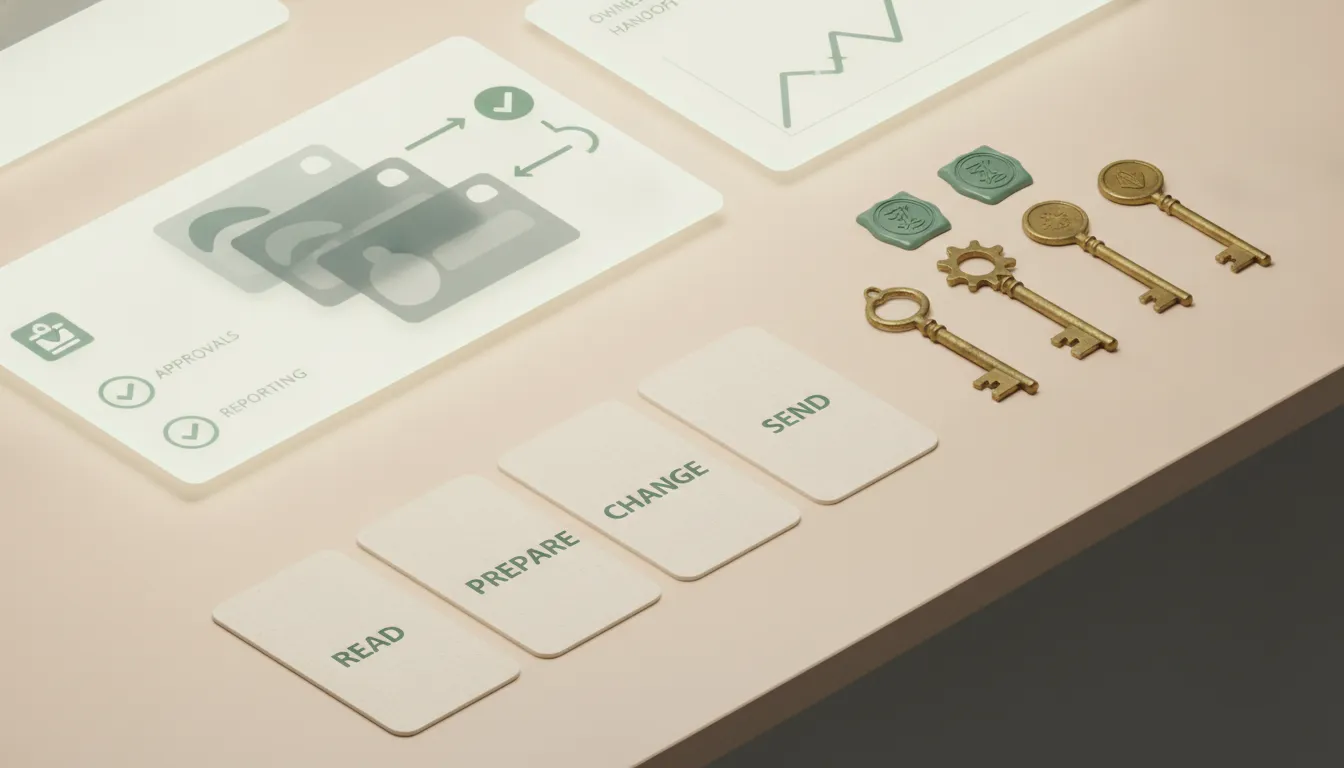
The most important design question is not which model to use. It is what the system may do without asking.
I separate authority into six levels:
- Read: inspect approved records and documents.
- Prepare: draft, classify, calculate, or recommend.
- Approve: accept another system's prepared action.
- Change: update a record or workflow state.
- Send: communicate outside the business.
- Spend: trigger a purchase, campaign, or paid service.
Most first releases should live in read and prepare. The business can compare the agent's work with the current process before granting change or send authority.
For every tool, define:
- Which account the agent uses.
- Which records it may access.
- Which fields it may change.
- Which action requires approval.
- Which event stops the run.
- Which log proves what happened.
- How credentials are revoked.
OpenAI's practical guide to building agents describes models, tools, instructions, orchestration, and guardrails as separate parts of the design. Buyers should expect all of those parts to be named in the scope.
Give one operator real ownership
An agent without an internal owner becomes software that everyone discusses and nobody operates.
The owner does not need to write code. The owner needs authority over:
- The business promise.
- The trusted record.
- The approval policy.
- The exception queue.
- The acceptance examples.
- The pause decision.
- The expansion decision.
This is why I treat an AI automation manager as an outcome owner, not a tool administrator. A developer can repair an integration, but only the operator can decide whether the agent is making the right trade in the real process.
The owner also needs a useful daily view. Show active work, completed work, waiting approvals, failed items, stale items, and the reason each exception exists. A raw execution log is maintenance evidence, not an operating queue.
Build the evidence and recovery path together
The agent should create proof as it works. Do not bolt on reporting after launch.
For each item, preserve:
- The source record and trigger.
- The inputs the agent actually read.
- The rule or instruction version.
- The tools called and their results.
- The approval decision, if any.
- The destination record after the action.
- The exception and recovery status.
NIST's AI Risk Management Framework organizes the work around governance, mapping, measurement, and management. A small business does not need an enterprise committee for every draft assistant, but the control depth should match the consequence.
A research agent and a payment agent should not share the same approval policy. A system that prepares a brief can tolerate a rejected draft. A system that changes customer status can create a chain of downstream actions before anyone notices.
The AI operating system framework is useful here because it treats records, decisions, approval gates, and proof as one control layer instead of separate technical features.
Test the decision boundary, not just the happy path
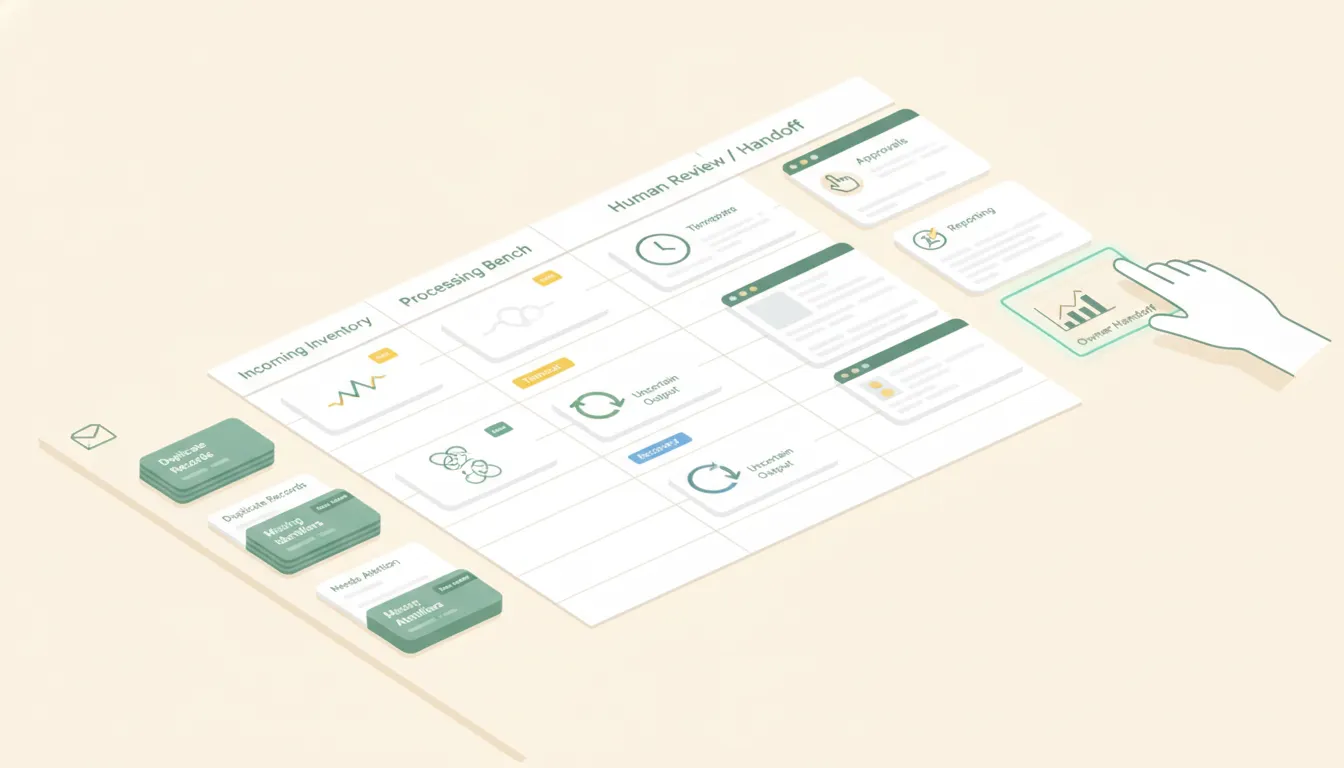
In one recruiting test, only one of 26 jobs passed the first fit gate. That was not a reason to celebrate a very selective agent. It was a reason to ask whether the filter was too strict and whether the business wanted that much data loss.
This is why a green run is weak evidence. The agent can complete every technical step and still make the wrong operating decision.
Before launch, I test:
- A normal item with a known correct result.
- A duplicate event.
- A missing identifier.
- Two trusted records that disagree.
- An uncertain model response.
- A malformed tool response.
- A permission failure.
- A timeout after a partial action.
- An approval that never arrives.
- A paused item being resumed safely.
- The destination record being read back.
- The operator stop control.
The acceptance set should contain real examples, expected decisions, and expected destinations. Keep it after launch. Every prompt, model, tool, and policy change should run against the same set before release.
Anthropic's work on trustworthy agents treats human control, transparency, privacy, security, and alignment with user expectations as product decisions. Those decisions belong in acceptance tests, not only in a policy document.
Compare AI agent development providers on proof
A provider should be able to explain the build without hiding behind model names.
Use this buyer scorecard:
| Buying question | Strong answer | Weak answer |
|---|---|---|
| Business promise | Names one owned result | Promises a digital employee |
| Source of truth | Names the authoritative record | Lists connected apps |
| Authority | Separates read, prepare, change, send, and spend | Promises autonomy |
| Exceptions | Names owner, deadline, and recovery | Says errors are logged |
| Testing | Uses representative cases and destination read-back | Shows a demo |
| Ownership | Client controls accounts, data, and code | Provider keeps the keys |
| Change control | Versions instructions and reruns acceptance tests | Edits prompts live |
| Stop control | Operator can pause one lane safely | Developer must intervene |
The agent workflow guide gives a deeper frame for business promise, authority, approval, and proof. If the work crosses several systems, business process automation services should still begin with one controlled lane.
When not to hire us for AI agent development
You do not need us for this when a native feature, checklist, saved view, or fixed workflow already handles the work reliably.
I would defer a custom build when:
- Nobody owns the result.
- The process changes every week.
- The inputs are unreliable and nobody will correct them.
- The business cannot describe a correct outcome.
- The volume is too low to justify software.
- The proposed agent only produces more content without a business event.
- The provider needs broad access before proving a narrow use case.
- The team wants unattended action before testing prepared output.
Custom AI is not a maturity badge. Sometimes the adult decision is to add a required field, assign an owner, and leave the model out of it.
My recommendation
Commission one bounded agent around a business promise with a named owner, trusted record, explicit authority, representative acceptance set, visible exception queue, and operator stop control.
Start in read or prepare mode. Compare its work against the current process. Verify the destination, not only the run log. Expand authority only after the evidence shows that the agent makes the right decisions and recovers safely when tools or data fail.
That is useful AI agent development. It gives the business a controlled worker inside an understood process, not another intelligent-looking system that becomes mysterious as soon as the demo ends.
FAQ
Frequently asked questions
- 01What is AI agent development?
- AI agent development is the design and delivery of a system that can interpret a goal, use approved tools, make bounded decisions, and produce a verified business result. The work includes process design, data access, instructions, testing, monitoring, ownership, and recovery, not only a model connection.
- 02When should a business use an AI agent instead of a workflow?
- Use an agent when the task requires judgment, the path changes based on context, and the result can still be bounded and checked. Use a fixed workflow when the trigger, rules, steps, and destination are predictable.
- 03How should an AI agent be tested before launch?
- Test representative normal cases plus duplicates, missing identifiers, conflicting records, uncertain model output, tool timeouts, permission failures, and recovery after a partial action. Verify the final business record, not only the agent run log.
- 04Who should own an AI agent inside the business?
- One operator should own the business outcome, approval policy, exception queue, acceptance set, and decision to pause or expand the agent. Technical support can maintain the system, but it cannot replace internal accountability.
- 05When should a business not commission custom AI agent development?
- Do not commission a custom agent when a native feature, checklist, saved view, or fixed workflow already solves the problem, when the process changes every week, or when nobody can define a correct result.