Field note
Aug 29, 2026
AI agent for business: the operator control readiness test
An AI agent for business should own one outcome, respect authority limits, expose failures, and preserve recovery. Use this operator test before rollout.

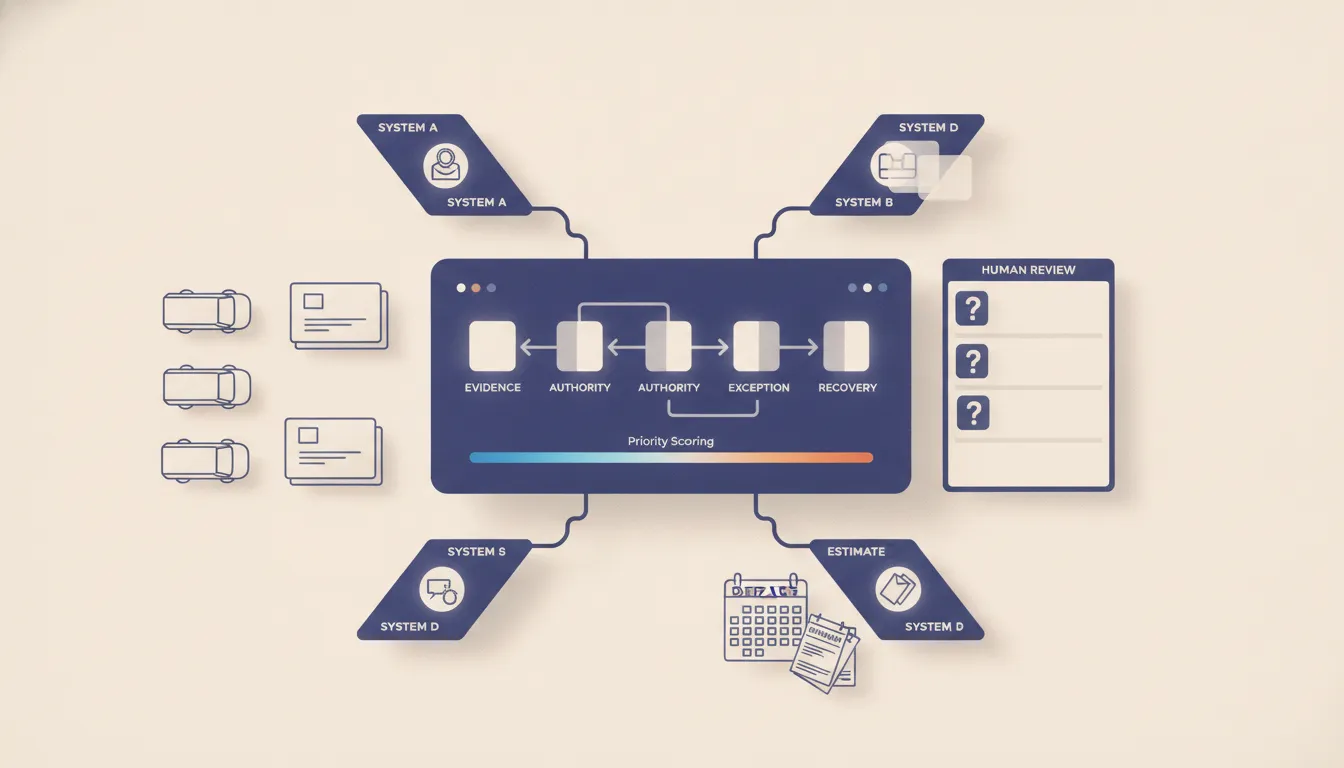
An AI agent for business should own one narrow outcome, work inside clear authority limits, and show its evidence when something goes wrong. It should not be a chatbot with a company logo and access to six systems. I have built enough of those “small assistants” to know that the adjective usually disappears before the first exception does.
My rule is simple: buy the operating lane before you buy the agent.
On one sales-signal build, I split collection into 32 batches of 1,000 records. That collection produced about 300 candidate posts, then a separate workflow analyzed work every 15 minutes in batches of 50. The volume looked impressive. The business value came later, when the system validated the signal, found the right decision-maker, assigned an owner, and prepared an action someone could inspect.
That is the difference between an agent demo and an agent that belongs in a business.
Start with one business promise
Do not start with “we need an AI agent.” Start with a sentence that can become an acceptance test.
For example:
Every qualified inbound request should reach the right owner with the source evidence, a proposed next action, and an alert before the response window expires.
That promise forces useful decisions:
- What makes a request qualified?
- Which system owns the record?
- Who owns the response?
- What evidence must travel with it?
- What may the agent prepare?
- What may it change or send?
- What happens when the evidence is incomplete?
I use the broader business process automation service for lanes that cross several tools, but the starting point is never the tool stack. It is the operating result.
The AI operations X-Ray is useful for the same reason. It makes the broken handoff visible before anyone starts drawing an elaborate agent architecture around it.
Deloitte's agentic AI overview describes agents in terms of autonomy, reasoning, and action. Those capabilities matter, but a buyer still needs to decide where autonomy ends. The business promise gives that decision a boundary.
Keep the system of record authoritative
An agent can read email, a CRM, spreadsheets, support tickets, documents, and calendars. That does not mean it should become the new source of truth for all of them.
Before rollout, name the authoritative record for:
- Identity.
- Status or stage.
- Ownership.
- Due date.
- Approval.
- Completed action.
- Financial or compliance impact.
The agent may collect evidence and prepare updates across several systems. When two records disagree, one system still has to win.
This is where many agent projects create quiet trouble. The assistant stores its own memory, the CRM stores the official stage, and a spreadsheet stores what the team actually trusts. Three versions of the truth are not intelligence. They are a meeting waiting to happen.
My preferred pattern is to let the business system remain authoritative, then put the agent around the handoffs. It watches, prepares, checks, and escalates. Write-back happens only under explicit rules.
The AI agent workflow field note goes deeper on this pattern. The agent is an operating participant, not a replacement database.
Separate assistance from authority
I define agent authority in five levels:
- Read: retrieve records and source evidence.
- Prepare: summarize, classify, draft, or assemble a proposed update.
- Recommend: state the next action and why.
- Notify: place the recommendation in front of a named owner.
- Act: change a record, send a message, approve work, or trigger another system.
The first four levels are not risk-free, but they make good pilot territory. The fifth level deserves specific evidence rules and recovery controls.
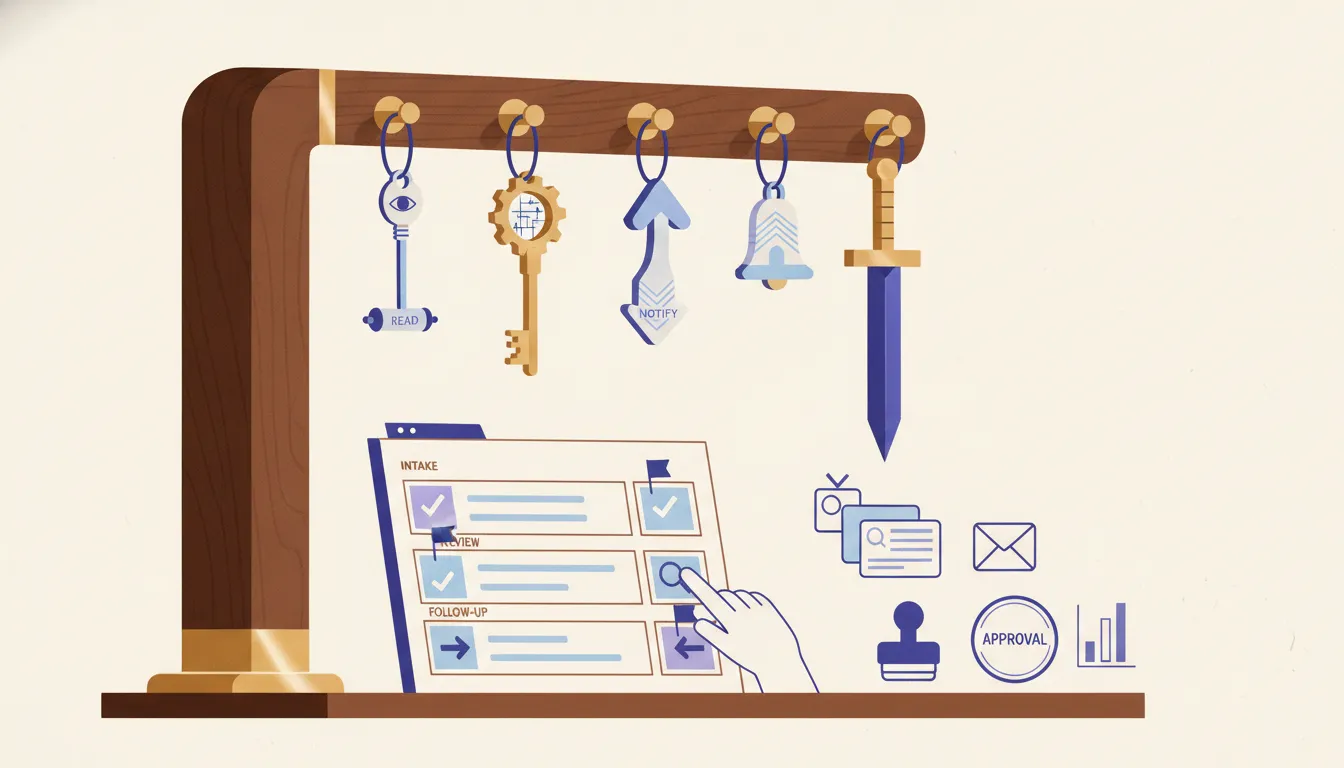
A sales agent may draft a reply without sending it. A support agent may recommend a refund without issuing it. An operations agent may identify a duplicate without deleting either record. A recruiting agent may surface a stale candidate without rejecting anyone.
This separation keeps a convenient feature from becoming hidden decision authority.
Microsoft's Copilot Studio documentation separates knowledge, actions, channels, testing, and management. I think buyers should preserve that separation in the operating design too. The fact that a platform can expose an action does not answer whether the agent should be allowed to use it.
Give the agent one named owner
An agent without an owner becomes shared infrastructure, which often means nobody owns its failures.
The owner should be accountable for:
- The business promise.
- Source access and permissions.
- Decision and action boundaries.
- Exception age.
- False positives and false negatives.
- Provider and integration cost.
- Changes to prompts, rules, and tools.
- Recovery after a failed run.
- Retirement or replacement.
This is an operating role, not a prompt-editing hobby. The AI automation manager ownership test explains why ownership has to cover outcomes and recovery, not just whether the workflow ran.
On the sales-signal build, collecting the posts was only one component. A validator still had to decide whether each signal matched the buyer profile. A separate step had to identify a decision-maker. Another workflow had to deliver the result to the right person. If any gate failed silently, the collection count could stay high while the commercial outcome stayed at zero.
The named owner watches the whole promise across those gates.
Build evidence into every action
A business agent should be able to answer four questions before a consequential action:
- What source record triggered this?
- Which rule or evidence supports the proposed action?
- What uncertainty remains?
- Who can correct or stop it?
Do not settle for a confidence score by itself. A number without visible evidence can make a weak match look official.
For a lead-routing agent, evidence might include the original inquiry, firmographic fields, matched service, territory, and account owner. For a finance agent, it might include the invoice, purchase order, vendor record, approval state, and discrepancy. For a support agent, it might include the customer message, account state, relevant policy, and prior contact.
NIST's AI Risk Management Framework organizes risk work around governing, mapping, measuring, and managing. My practical version for one agent is smaller: name the promise, preserve the evidence, measure the exceptions, and make recovery part of the design.
Test exceptions before adding autonomy
A clean demonstration proves the happy path. A failure drill proves whether the agent belongs in operations.
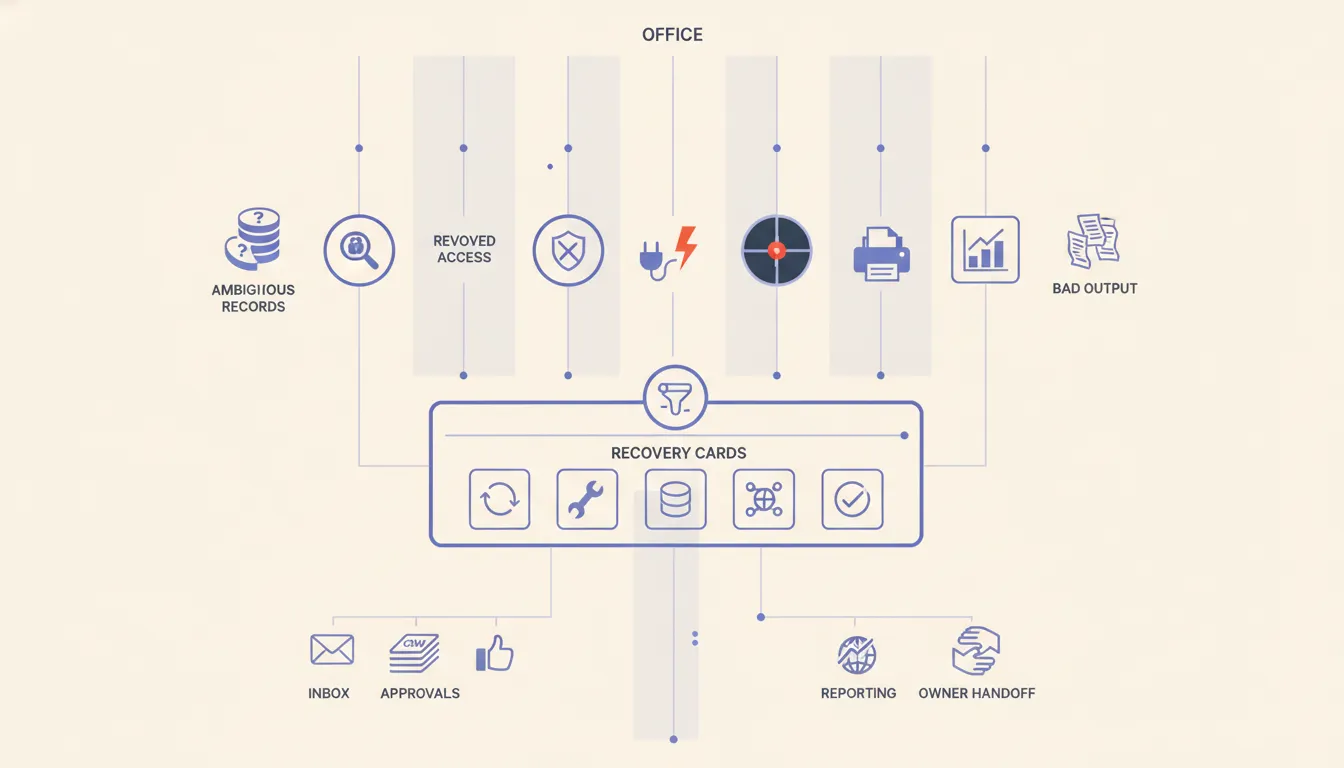
I would test at least these scenarios:
- Ambiguous identity: two records could match, so the agent stops instead of choosing.
- Missing evidence: the recommendation is withheld and the owner sees what is absent.
- Revoked access: the connector fails visibly without pretending the work completed.
- Provider outage: retries stop at a defined ceiling and create an owned exception.
- Bad model output: malformed or unsupported content cannot become a system update.
- Duplicate event: the same trigger does not create two actions.
- Stale instruction: an old rule cannot override the current system state.
- Human correction: the owner can repair the record and replay the work safely.
- Exit test: the business can export its rules, evidence, history, and credentials.
The open source AI agent ownership test covers the last point in more detail. I prefer client-owned servers, code, data, and credentials because ownership makes recovery and exit practical. Open source is not automatically safer, but dependency visibility is better than captivity dressed up as convenience.
Measure outcomes, not agent activity
Agent dashboards tend to count runs, tokens, tasks, messages, and tool calls. Those numbers explain system activity. They do not prove business value.
For one operating lane, I would measure:
- Qualified outcomes completed.
- Time from trigger to owner action.
- Correct routing rate.
- Exception rate and exception age.
- Human correction rate.
- Duplicate or unsupported actions prevented.
- Failed jobs recovered.
- Operating cost per completed outcome.
On that sales-signal system, 32 collection batches were not the score. Neither were roughly 300 candidate posts. The score began after validation: usable signals delivered to the correct owner with enough evidence to act.
The business automation software buying test applies the same rule to platforms. Feature breadth is secondary to control over a real operating result.
When not to hire us for an AI agent
You do not need us when one packaged product already owns the workflow, the standard integrations fit your rules, and the team can configure permissions, evidence, approvals, audit history, export, and recovery without custom work.
In that case, buy the product. Keep the first promise narrow, test the exceptions, and assign an owner.
You also should not build an agent around a process that changes every week. Automation will preserve that instability and make each change more expensive. Fix the operating rule first.
Custom work becomes reasonable when:
- The promise crosses several systems.
- The business needs its own matching or authority rules.
- Standard integrations lose evidence or ownership.
- Consequential write-back needs guarded conditions.
- Exceptions require firm-specific routing and recovery.
- The business needs client-owned infrastructure and a clear exit path.
My final readiness test
I would approve an AI agent for business only when the buyer can prove seven things:
- One business promise defines success.
- One authoritative record remains clear.
- Every consequential action carries visible evidence.
- Authority levels are explicit.
- One person owns the outcome and exceptions.
- Failure and recovery have been tested.
- The business can exit without losing its records, rules, or credentials.
The best agent demo will show what the model can do. The better buying decision asks what the business can control when the model is uncertain, the connector fails, or the process changes on a very ordinary Tuesday.
FAQ
Frequently asked questions
- 01What is an AI agent for business?
- An AI agent for business observes a defined operating lane, uses approved tools and data, prepares or takes bounded actions, and reports evidence and exceptions to an owner. It is useful when the business promise, authority, and recovery path are explicit.
- 02What should a business automate with an AI agent first?
- Start with a repeated handoff that has a visible cost and a named owner, such as stale leads, missing documents, unanswered support issues, or overdue approvals. Keep the first lane narrow enough to test with real exceptions.
- 03How much authority should an AI agent have?
- Begin with read, prepare, recommend, and notify authority. Add write or send authority only after the evidence rule, approval boundary, audit history, retry ceiling, and rollback path have been tested.
- 04How do I measure whether an AI agent works?
- Measure the business promise, not model activity. Track completed outcomes, correct routing, exception age, human correction, failure recovery, and the cost of operating the lane.
- 05When should I use packaged agent software instead of a custom build?
- Use the packaged product when one tool already owns the workflow, its standard actions fit your rules, and it provides the permissions, evidence, export, and recovery controls you need. Custom work is reasonable when the operating lane crosses systems or needs specific authority rules.