Field note
Jul 29, 2026
Business automation software: the operator buying test
Business automation software should prove one business outcome, preserve ownership, surface exceptions, and recover safely before it earns a wider rollout.

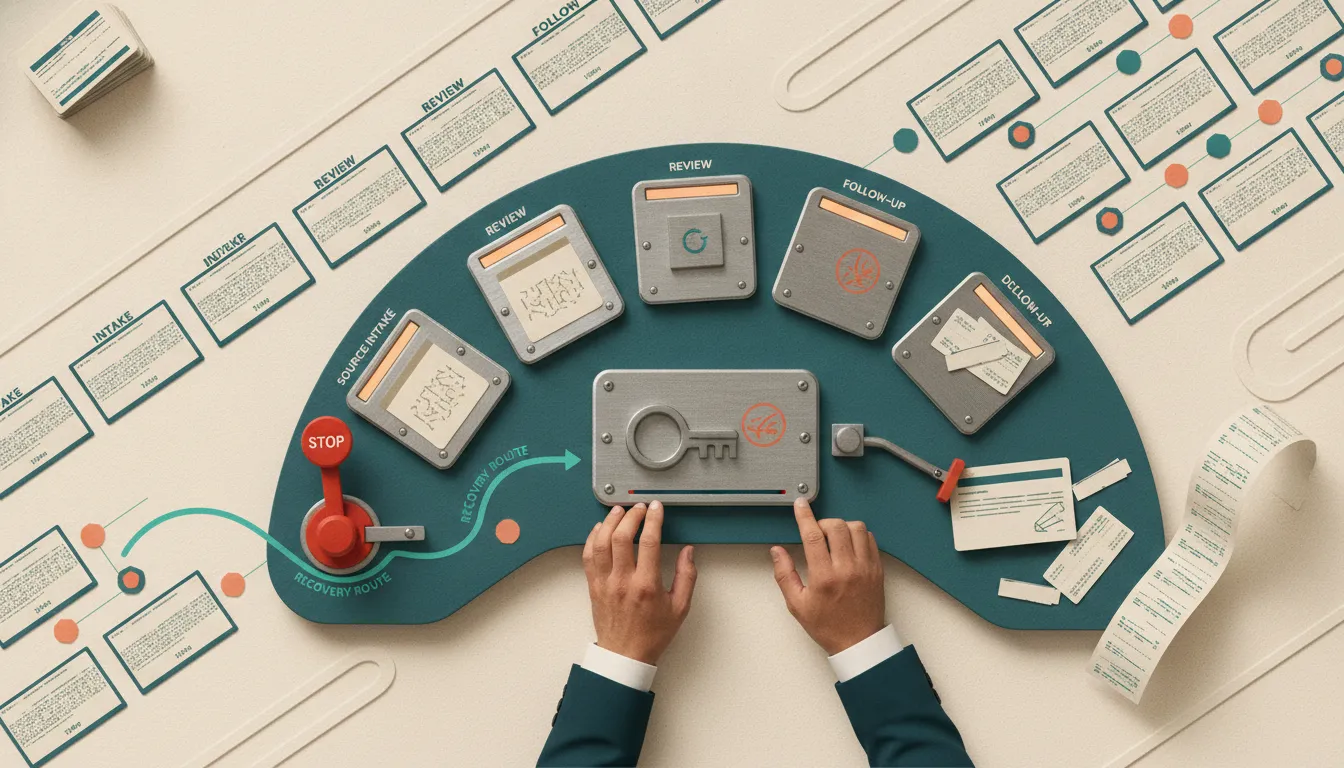
Business automation software should make one important lane of work easier to trust. It should move a real business promise from trigger to outcome, keep the right person in control, surface the work that does not fit the normal path, and prove what happened.
That is the buying test I use.
I have seen teams buy automation software because the demo looked fast, the integration list looked long, or the vendor promised one place to run everything. Those are useful signals, but they do not tell me whether the software can carry the actual operation.
On one advertising operations project, six people were responsible for 100 accounts. The problem was not a lack of dashboards. The team was good at keeping the accounts running, but the volume left too little time to identify trends and decide what to do differently. The useful automation was an analyst layer that turned account data into a recurring briefing with answers, not another screen the team had to remember to check.
My opinion is simple: software is not automation just because it can connect two tools. It earns a place in the operation when it produces a controlled outcome the team can understand, own, stop, and improve.
Start with one business promise, not a software category
A search for business automation software can lead to CRM platforms, workflow builders, robotic process automation, AI agents, project tools, reporting systems, and large suites that claim to cover all of them.
I would not begin there.
I begin with one promise the operation already cares about:
- Every qualified lead reaches a named owner within ten minutes.
- Every completed field job reaches billing with the required evidence.
- Every approved purchase reaches the right supplier exactly once.
- Every customer request receives a decision or a named next action.
- Every weekly management brief reconciles to the systems that own the records.
A promise gives the buying decision a boundary. It tells me which records matter, which people touch the work, which exceptions can hurt the business, and what proof has to exist at the end.
My business process automation work starts with that operating lane. I do not want a buyer comparing hundreds of features when the real question is whether one expensive handoff can become more dependable.
If the first lane is still unclear, I use the AI Operations X-Ray to rank opportunities by business impact, process readiness, ownership, and risk. A small diagnostic is cheaper than making a large platform carry a process nobody has defined.
Map the five controls before you watch a demo
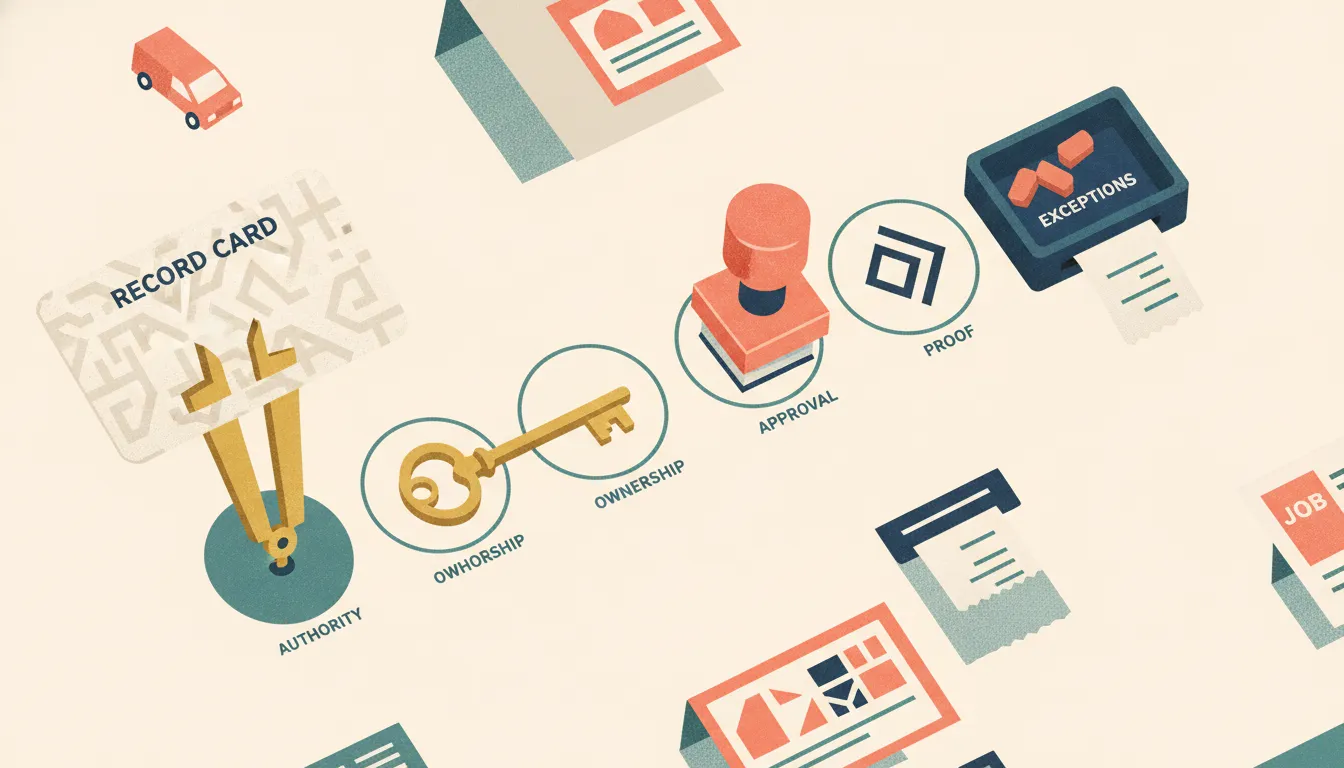
Before I watch a product demo, I write down five controls.
1. The source record
Which system owns the customer, job, invoice, candidate, asset, approval, or other record?
The automation can read from several systems, but one rule has to win when records disagree. Without that authority, the software can synchronize uncertainty at machine speed.
This is the same control issue I use when evaluating business process management software. A broad platform does not become the source of truth just because it has the most screens.
2. The named owner
Who owns the promised result?
I want a person or role, not a department name. The owner needs authority to change the rule, resolve an exception, approve a risky action, and decide when the workflow should stop.
3. The approval boundary
Which actions can happen automatically, which need review, and which must always stay with a person?
Money movement, legal commitments, pricing changes, record deletion, access changes, customer promises, and unusual cases deserve explicit boundaries. The software should present enough context for a reviewer to make a decision without reconstructing the whole case.
4. The exception path
What happens when the record is incomplete, the integration times out, the customer replies with something unexpected, or the destination rejects the update?
Every workflow creates exceptions. Useful software gives each exception a category, owner, age, next action, and closure record. A red badge without ownership is only decoration.
5. The outcome receipt
What proves the promise happened?
A green run history proves that code executed. It does not prove that the invoice was accepted, the lead was contacted, the job was scheduled, or the report matched the source data. I want evidence from the destination that accepted the result.
These controls turn a product demo into an operating test. I can ask the vendor to run a realistic record through the normal path, an approval, an exception, and a recovery instead of watching the cleanest possible happy path.
Require ownership before the software becomes infrastructure
I prefer systems the client owns. That means the business controls its accounts, credentials, data, code when custom code exists, documentation, and vendor relationships.
Ownership also has to be practical.
I look for:
- Exportable records in a usable format.
- Business-owned administrator accounts and billing.
- Role-based access that does not depend on one outside builder.
- Logs that explain what changed and why.
- Visible recurring costs, usage limits, and retry behavior.
- A way to pause the workflow without deleting its state.
- A tested path to replay safe work after a failure.
- Documentation an operator can use during a real incident.
The questions overlap with the controls I recommend when evaluating AI automation companies. A buyer should know what remains usable if the relationship ends, who can revoke access, and how another qualified person would take over.
CISA's Secure by Design guidance treats customer security as a core business requirement and places responsibility on the technology producer instead of shifting the burden to the customer. I apply the same mindset to automation ownership. Safe defaults, clear access, useful logs, and recovery are part of the product, not optional cleanup after launch.
I also use the NIST Cybersecurity Framework as a simple check that the operating design covers governance, protection, detection, response, and recovery. Automation software should not make any of those responsibilities harder to see.
Run a real workflow stress test
A sandbox with fake records can confirm that buttons work. It cannot confirm that the operation works.
I run a limited test with real records, named owners, and a short review window. The test includes:
- A normal record that should complete without intervention.
- An incomplete record that should stop or route for review.
- A duplicate that should not create the business action twice.
- A restricted action that should require approval.
- A destination failure that should retry safely or escalate.
- A rule change that should be documented and reversible.
- A stop and recovery drill that the business owner can perform.
That structure follows the same principle as an AI agent workflow for operators: one promise, explicit permissions, approval gates, exceptions, and proof before the system is trusted to act.
I would rather prove one lane for two weeks than configure ten departments and discover that nobody agrees on the records or rules. A narrow test exposes the process debt while the change is still cheap.
Measure outcomes instead of software activity
Business automation software often makes activity easy to count. Runs, tasks, records, messages, logins, and generated drafts all look productive.
I care more about what the business received.
My first scorecard includes:
- Percentage of promised outcomes completed within the agreed window.
- Median time from trigger to accepted result.
- Number and age of open exceptions.
- Approval turnaround time and override rate.
- Duplicate, missed, or unreconciled records.
- Operator adoption and documented workarounds.
- Cost per completed business outcome.
- Time to detect, stop, and recover from failure.
The six-person team responsible for 100 accounts did not need more activity. It needed more decision capacity. The right system reduced the time spent collecting and sorting information so the team could focus on trends, risks, and action.
That is the standard I use. If software increases run count but adds another queue people have to babysit, it has shifted the work instead of improving it.
Put the software into an operating cadence

Even good software degrades when rules, teams, vendors, and data change.
I put the workflow into a short weekly review. The owner checks:
- Which promised outcomes passed, failed, or cannot be verified?
- Which exceptions are oldest or most expensive?
- Which approvals are waiting or being bypassed?
- Which records disagree with the source system?
- Which costs, retries, or volumes moved outside the expected range?
- Which changes shipped, and what test evidence exists?
- Which access review or recovery drill is due?
- Should this workflow be simplified, paused, expanded, or retired?
That is the operating layer behind workflow management for operators. I do not use the review to tour green dashboards. I use it to make decisions about unresolved risk, process performance, and ownership.
The NIST AI Risk Management Framework is useful here because it treats governance, mapping, measurement, and management as ongoing work. For a small business, that does not require a large committee. It can become one owner, one exception queue, one scorecard, and one weekly control review.
When not to hire us for business automation software
Do not hire us to build or configure a broad platform when the team cannot name the first business promise. I would rather tell you to document the process first than charge you to automate ambiguity.
I would also wait when:
- The source records are unreliable or duplicated.
- Nobody owns the process end to end.
- Approval rules live only in personal judgment.
- The vendor cannot demonstrate exception handling or recovery.
- The software requires replacing a reliable system before it can prove value.
- The business cannot export its records or control administrator access.
- The expected value depends on every team changing behavior at once.
- The buyer is counting features because no outcome baseline exists.
In those cases, I would document the lane, fix the source record, assign ownership, and run a smaller test first.
Business automation software should earn expansion. Start with one promise. Map the source record, owner, approvals, exceptions, and proof. Run normal work and failure cases. Require business ownership. Then measure whether the operation became faster, clearer, and easier to recover.
If it passes that test, buy or build the next lane. If it does not, do not let a sunk implementation turn weak software into permanent infrastructure.
FAQ
Frequently asked questions
01What is business automation software?
Business automation software moves, checks, routes, or drafts work across a defined process. Useful software connects a business promise to source records, named owners, approvals, exceptions, and evidence that the intended outcome happened.
02How should a small business choose automation software?
Choose one high-value workflow, define its current baseline and operating rules, then run a controlled test with real records and real exceptions. Expand only when the software proves the outcome and the business can own, stop, and recover it.
03Should a business replace its current systems before automating?
Usually no. Keep the current system of record when it is reliable, then build a controlled operating layer around the handoffs that leak time, revenue, or accountability. Replace the platform only when the record itself is the constraint.
04What should business automation software measure?
Measure completed business outcomes, processing time, exception volume and age, approval quality, record accuracy, adoption, cost per outcome, and time to detect, stop, and recover from failure.