Field note
Sep 25, 2026
AI phone answering service: test the call, not the demo
An AI phone answering service needs more than a good voice. I test delays, transfers, CRM records and outages before trusting it with real customer calls.

I judge an AI phone answering service by whether a caller reaches a useful next step: an accurate answer, a confirmed appointment, a person who accepts the handoff, or a message someone owns. A good voice is necessary. It is not the acceptance test. I can make a demo sound reassuring and still give myself a very expensive answering machine.
The buying question is not whether the assistant can talk. It is whether the business can account for what happened after it talked.
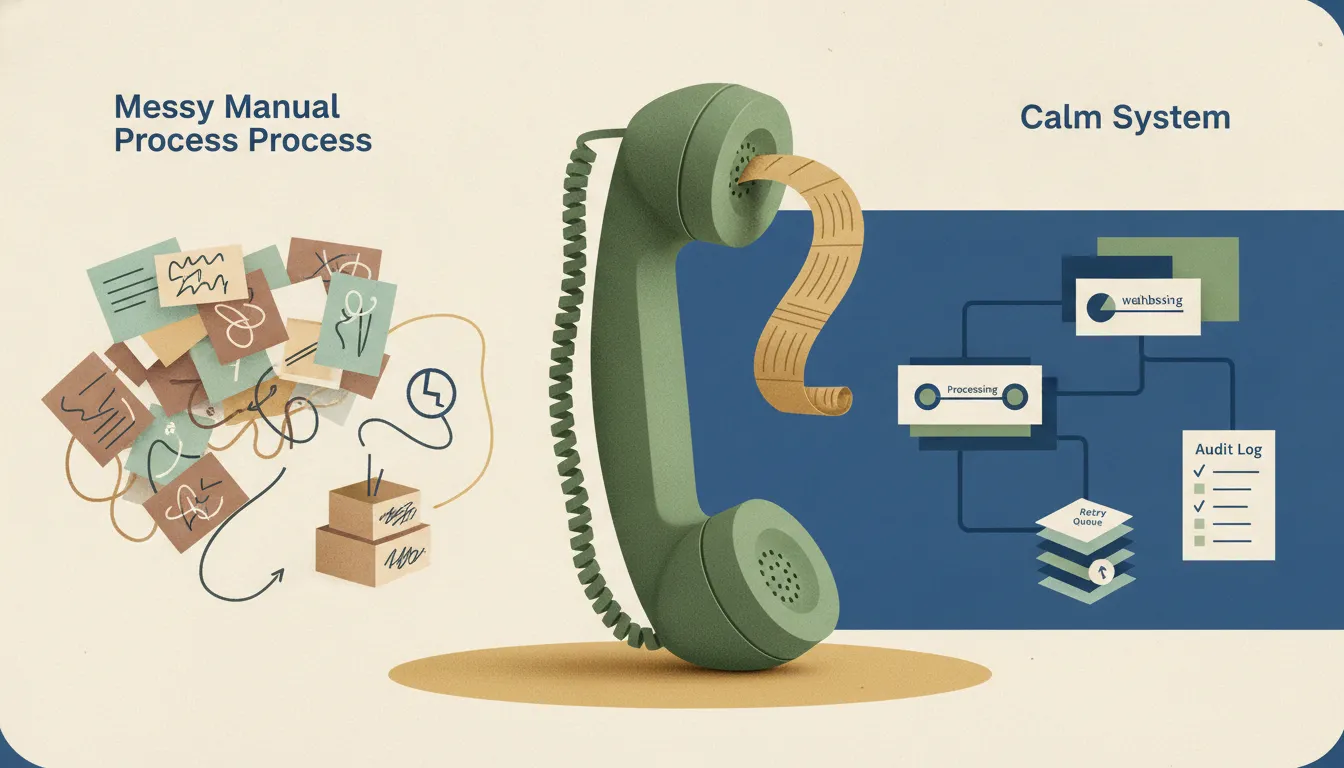
What a pleasant demo can hide
On one bilingual phone-intake build, I had a complaint about the Spanish voice even though the conversational voice was already a native Spanish voice. The problem was earlier in the call. A prerecorded greeting mixed English and Spanish using the English voice.
Changing the conversational voice would not have fixed that greeting. I removed the recording from that path and made each language use its own live voice. The caller experiences one service, not the separate components I happened to build.
I also found two model round trips where one would do: one to save a detail, another to produce the reply. The delay was not a reason to buy a more impressive model. I needed to stop making the caller wait for unnecessary work.
I cut the reply gap from 4.2 seconds to about 1 second on that build. That was a measured improvement on that implementation, followed by a client test call, not a promise about every caller or every network. I still had to fix rough edges that the real phone line exposed.
My point is simple: I would rather shorten the path than decorate the pause. A fluent answer that arrives after the caller has started asking whether anyone is there is still a bad interaction.
This is why I approach phone intake as business process automation, not as a voice purchase. The conversation, the record and the next person's work need to agree.
How I would evaluate an AI phone answering service
I start by writing the service boundary in plain language. Which questions can it answer? Which details can it collect? Which commitments can it make? Which requests must it stop trying to handle?
For a service business, that could mean answering hours and coverage questions, collecting a reason for calling, then offering an approved appointment. For a sensitive intake process, I would draw the boundary much earlier. Collecting a request does not give the assistant permission to make a professional judgment.
I use the same distinction in my explanation of what business buyers should expect from AI agents: access to information and authority to take action are different decisions.
Then I ask the operator to choose a realistic call, not the vendor's most polished script. I want a caller who interrupts, gives information out of order and asks for a person halfway through. I want the test to end inside the business system, not when the voice demo ends.
My buying record looks like this:
| What I test | What I need to see before calling it passed |
|---|---|
| A routine question | An answer from approved business information, without a made-up promise |
| A name or detail given early | The detail retained, without asking the caller to repeat it unnecessarily |
| A request for a person | An accepted handoff or an honest message-taking path |
| An appointment request | A real available slot and one confirmed booking in the right calendar |
| A failed CRM update | A visible unresolved item, not a success message hiding the failure |
| A service outage | A usable fallback and an independent record of the attempted call |
I would use that record to compare a packaged service, a custom implementation and a human answering service. I would not compare them on the number of feature ticks alone.
Natural conversation starts before the first answer
The greeting belongs in the test. So does the transition from greeting to conversation, the pause after a question, and the moment a caller switches language.
I would call the actual business-facing number from an ordinary phone. A browser microphone test can help during development, but it cannot stand in for the carrier path. I would include quiet speech, background noise, an interruption and an unfamiliar name without treating a tiny test set as proof of universal accuracy.
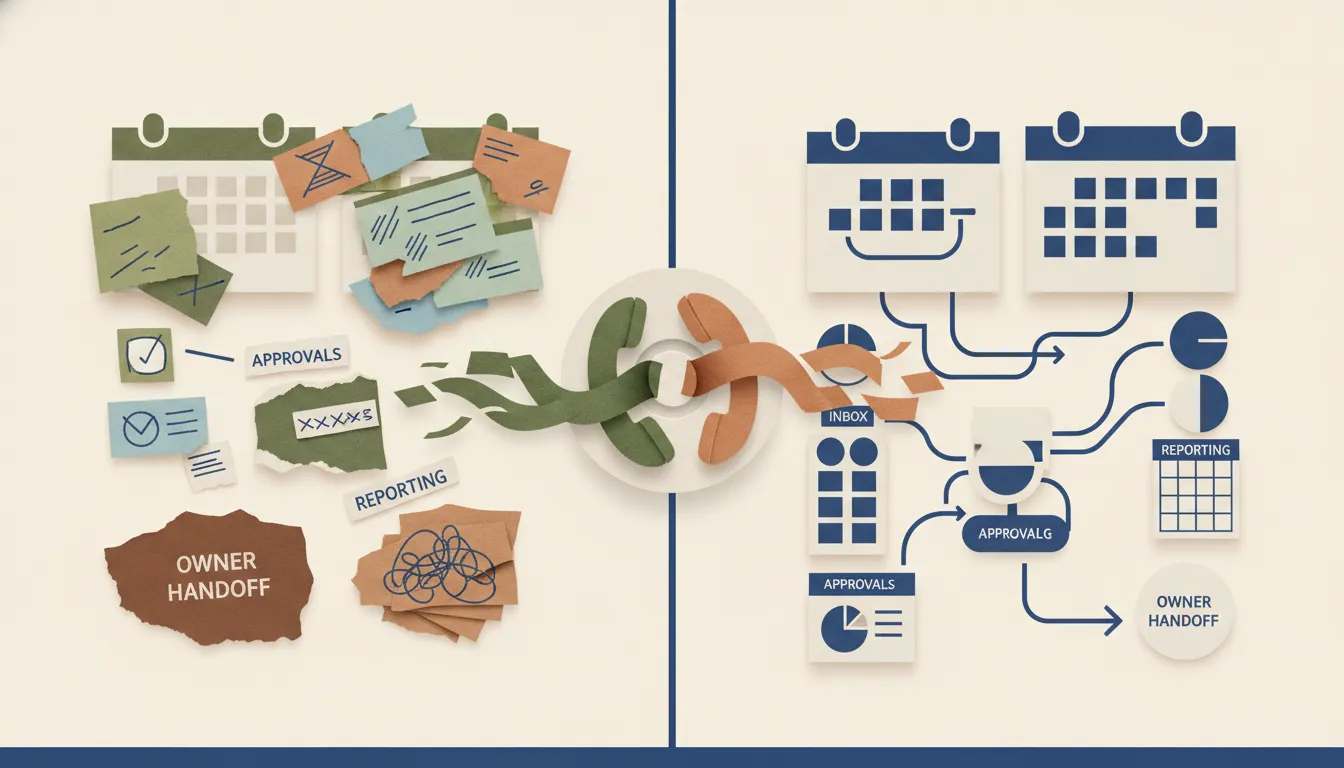
I also want to hear what happens when the service does not understand. I do not want it to invent the missing detail. I do not want endless requests to repeat a sentence either. I would agree on a bounded recovery path and then move to a person or message-taking when that path is exhausted.
If the service supports several languages, I would have someone fluent in each enabled language review the whole experience. A translated script and a selectable voice are inputs to that test. They are not the result.
For intake where the wrong question or promise can create a serious problem, I use a narrower legal-intake buying test. The important issue is what the service may do when it is unsure, not how confident it sounds.
A connected call is not an accepted handoff
In a controlled test, I had a receiver leg complete after 16 seconds without accepting the transfer. The receiver answered and spoke, but never gave the required acceptance. I recorded the transfer as declined and saved the callback instead of counting a success.
That was a synthetic acceptance test, not a report of a real customer interaction. It exposed a distinction I want any buyer to insist on.
Twilio's call-status documentation explicitly says a completed call can have been answered by a person, a phone menu or voicemail. I cannot turn that carrier status into proof that a staff member took responsibility.
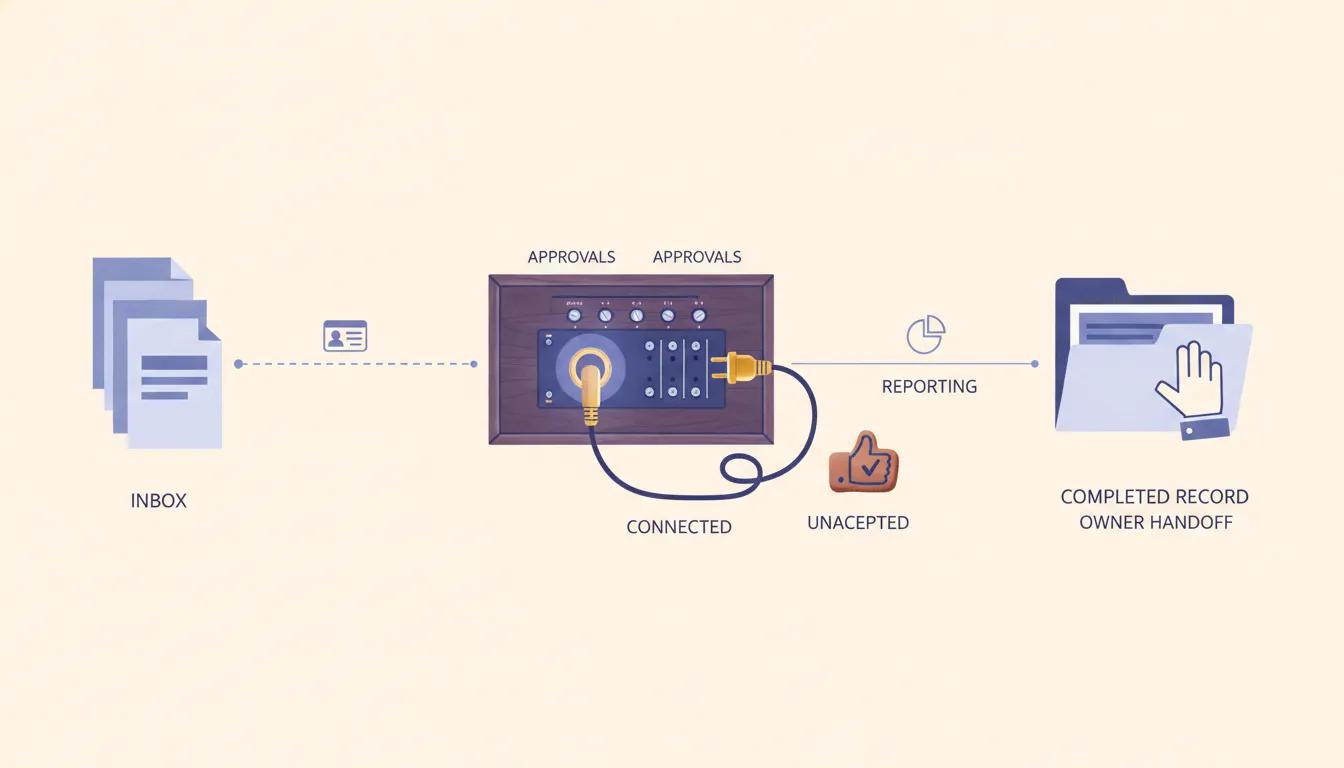
I separate the attempt, the answer, the acceptance and the completed business action. If nobody accepts, the caller needs an honest next step. A callback request is not a callback promise, and a message taken is not an appointment booked.
The underlying phone system can support those branches. Twilio's dialing behavior distinguishes busy and unanswered destinations and allows the original caller's flow to continue afterward. I still have to decide what that continuation should say and who owns the resulting work.
On the bilingual build, I later kept transfers dormant while real staff destinations were still missing. The assistant took a message. I would rather ship that limited, truthful behavior than announce a handoff to a person nobody had actually configured.
The operator decision comes first: who receives urgent calls, who receives routine callbacks, and what happens outside their coverage? Automation cannot supply a staffed destination by sounding confident about one.
The CRM record is part of the phone service
I do not accept “we integrate with your CRM” as the end of the demonstration. I ask to open the resulting record.
I want the caller's stated need, the details actually collected, the next action, the owner and the outcome. I want uncertainty left visible rather than filled with an AI guess. If a caller says they are an existing customer but the lookup cannot confirm it, I would not let the system attach their information to the nearest plausible match.
I also want to see what happens when the save fails. The call may have gone well while the CRM was unavailable. The retry must not create a second customer or appointment, and someone must be able to see the item that could not be saved.
My rule is that a quiet workflow is not proof of a healthy workflow. I look for the error path before I trust the happy path. That is the same ownership problem I discuss in back-office automation: if the next system rejects the work, it must still belong to someone.
I would make the vendor replay one failed save in a controlled test and show the final record afterward. A screenshot of a green automation run does not answer that question.
Prove which calls never reached the application
An application cannot reliably list a call it never received. That is why I keep the carrier's record separate from the assistant's activity view.
In a controlled outage test, I made the voice service unavailable and verified that a separately hosted carrier fallback answered. I did not count the healthy operations screen as proof that the caller was safe. I checked the call path itself.
Twilio documents timeout and fallback controls for this kind of failure. The buyer does not need to configure those settings personally. I would still ask where the fallback runs and whether it shares the component whose failure it is supposed to survive.
Then I reconcile the records. Which carrier calls have an application record? Which application calls have a saved outcome? Which outcomes require staff action? A difference is a question to investigate, not a number to smooth away.
On a separate reporting check, I compared 360 phone calls in one view with 359 in another. That difference alone did not prove a dropped customer. It did prove I could not simply assume the two views agreed.
I use that same discipline in an operator reporting scorecard. I want the definition and source behind a total before I let it drive a staffing or service decision.
What I would buy, and when not to hire us
I would choose a packaged answering service when approved answers are straightforward, message-taking is enough, and the existing integration passes the real call test. I would choose human coverage when judgment and sensitive conversation dominate the work. I would consider a custom system when the difficult part is a specific handoff across existing systems that a packaged service cannot prove.
You do not need us if a standard service reliably answers the questions, records the message and gets it to the right person. I would not pay for custom orchestration merely to give a phone line an AI label.
I would also pause the project if nobody owns callbacks, the business cannot agree on what the assistant may promise, or recording and retention decisions are unresolved. I would get the relevant legal and privacy review for that business rather than call a product compliant because its website uses the word.
For cost, I compare the whole operating arrangement: platform or hosting, phone usage, speech and model usage, integration maintenance, and the staff time needed for exceptions. I do not assume a lower per-minute price wins if the team must repair every handoff.
Before buying, I would write one page covering permitted actions, forbidden promises, human destinations, failed-save ownership and outage behavior. Then I would use it during a supervised pilot with real operating conditions, without pretending that a few successful calls establish an uptime guarantee.
If the team is unsure which part of intake is actually costing it time or opportunities, I would start with the AI Operations X-Ray rather than replace the whole front desk.
My acceptance question stays the same: after the caller hangs up, can I show what happened, what remains unresolved and who is responsible? If I cannot, I have an answering demo. I do not yet have an answering service.
FAQ
Frequently asked questions
01Can I get AI to answer my business phone calls?
Yes. I would start with a defined call type, approved answers and an explicit route to a person or callback queue. I would not forward every call until those routes have been tested on the real line.
02How much does an AI call answering service cost?
I compare the full operating cost: subscription or infrastructure, phone usage, speech and model usage, integration maintenance and staff handling of exceptions. I scope custom work around the systems and acceptance tests involved rather than quote a universal build price.
03Can AI replace a human receptionist?
I would let AI handle a bounded set of routine calls before considering any staffing change. Sensitive decisions, unclear requests and failed handoffs still need an accountable person. Answering more calls does not prove those calls were resolved.
04Do AI answering services integrate with my CRM?
Some do, but I ask to see the exact record created in the target CRM. A connector badge does not prove correct customer matching, duplicate prevention, retry handling or assignment to the right owner.
05What happens when the AI answering service goes down?
I require a fallback that does not depend on the failed application, plus a way to reconcile carrier calls against application records. I test the outage deliberately in a controlled window and verify what the caller actually hears.