Field note
Jul 26, 2026
Legal intake services: an operator buying test
Legal intake services should protect response speed, qualification, confidentiality, ownership, and consultation follow-through without hiding exceptions.


Legal intake services are usually sold as coverage. Someone answers the phone, captures a name, asks a few questions, and books a consultation.
I think coverage is the minimum. The real buying question is whether the service creates a reliable operating path from first contact to an owned outcome.
A potential client can call after hours, submit two forms, mention an urgent deadline, ask a question the intake team cannot answer, miss the consultation, or reveal information that changes how the matter should be handled. If the system only records a message, the firm still owns a pile of invisible decisions.
The gap is not theoretical. A 2024 secret-shopper study summarized by the Illinois Supreme Court Commission on Professionalism found that only 33% of firms responded to emails and 48% were unreachable by phone. That is not just a marketing problem. It is an intake operating failure.
On one intake-style build, I reduced the basic path to four stages: receive the inbound message, analyze it, create a structured record, and send it to the next system. The automation was simple. The hard part was deciding what information belonged in the record, what required human review, and what counted as a completed handoff.
That is still my rule. Legal intake services should not be judged by how smoothly the happy path sounds. They should be judged by ownership, exceptions, and proof.
Define the legal intake promise before comparing providers
Before I compare a receptionist service, intake team, software platform, or automation build, I write one operating promise.
A useful promise might be:
Every new inquiry receives an appropriate response, becomes one trusted record, reaches a named owner, and gets a documented outcome within the firm's approved time window.
That promise is stronger than “answer every call.” It covers web forms, email, text, chat, referrals, voicemail, and calls. It also forces the buyer to define what appropriate means.
I want the firm to answer six questions first:
- Which channels count as new inquiries?
- What response window applies during and after business hours?
- Which facts may the intake team collect?
- What creates an immediate human escalation?
- Which system owns the trusted intake record?
- What outcome closes the intake loop?
The outcome cannot be “entered into the CRM.” A record can exist while nobody follows up. A better outcome is consultation booked, declined with an approved reason, referred through an approved lane, waiting on named information, or escalated to a named person.
This is the same discipline I use in business process automation services. I start with the business promise, record authority, owners, approvals, exceptions, and proof. The tools come after that.
Separate answering from qualification and representation
A warm voice on the phone matters. It is not the entire job.
Legal intake services can collect approved facts, confirm contact details, identify the broad matter type, capture timing, schedule a consultation, send approved information, and move a record into the firm's follow-up lane. They should not improvise legal advice, promise an outcome, decide representation, or hide uncertainty.
I split the operating path into distinct decisions:
- Response: Did the person receive the right acknowledgment for the channel and time?
- Identity: Can the team distinguish this person and inquiry from duplicates?
- Matter fit: Does the inquiry match the firm's approved practice, geography, and basic criteria?
- Urgency: Does a deadline, safety issue, custody issue, detention, filing event, or other approved signal require escalation?
- Conflict handling: Has the firm defined what the intake service may collect before a lawyer or approved team member reviews potential conflicts?
- Consent and communication: Has the person agreed to the approved communication method and notices?
- Consultation: Who owns booking, preparation, reminders, rescheduling, and no-show recovery?
- Representation decision: Who is authorized to accept, decline, or refer the matter?
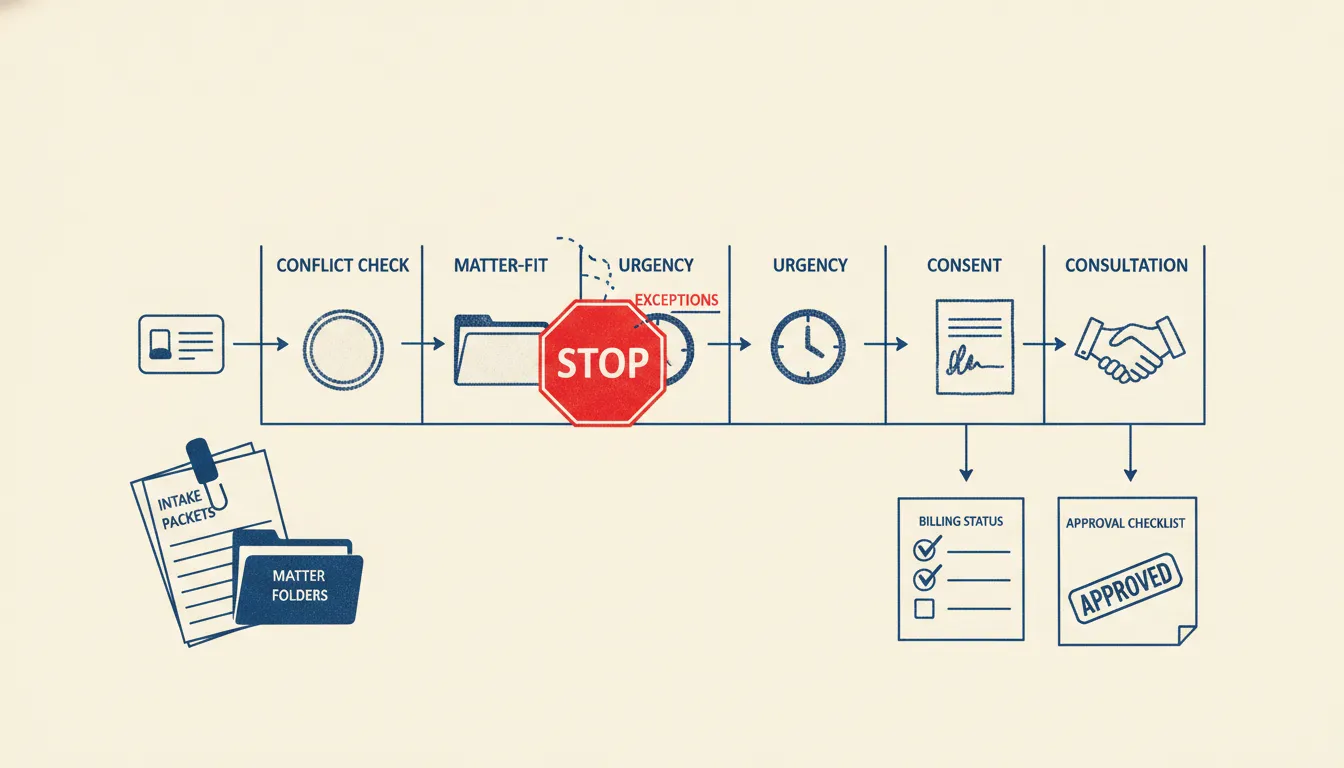
This separation protects both speed and judgment. Automation can move facts, detect missing fields, prepare a summary, create reminders, and surface an exception. A person still owns legal judgment and sensitive decisions. The firm's collection, access, and escalation rules should reflect its confidentiality duties under ABA Model Rule 1.6, with counsel defining the actual policy.
If a vendor uses AI in the intake path, I also want a documented risk owner, testing plan, and incident lane. The NIST AI Risk Management Framework is a practical public frame for governing, mapping, measuring, and managing those risks.
If a vendor says its AI “handles intake,” I ask exactly which of those decisions it handles, which it only prepares, and which it routes to a human. Vague answers are a buying warning.
Declare the source of truth before connecting the stack
A law firm may already have a phone provider, website forms, chat, email, scheduling, practice-management software, a CRM, document storage, e-signature, payment tools, and reporting.
Adding legal intake services without declaring record authority can create more work. The provider may keep one contact record, the CRM another, and the practice-management system a third. Staff then reconcile spelling, phone numbers, matter types, consultation times, and status by hand. A practical n8n workflow automation pattern for law firms should preserve that authority instead of creating another record owner.
I use a small authority map:
- Person record: Who is contacting the firm, and what contact information is current?
- Inquiry record: What happened, through which channel, and when?
- Matter-fit record: Which approved criteria were met, missing, or escalated?
- Appointment record: Which consultation time is current, and who owns changes?
- Consent record: What did the person agree to receive or share?
- Outcome record: Was the inquiry booked, declined, referred, paused, or escalated?
- Matter record: When does an inquiry become a matter, and which system creates it?
The business process architecture I use with operators starts with those authority decisions. Otherwise, an integration just copies ambiguity faster.
This is also where I separate a tool problem from an architecture problem. If nobody owns the no-show queue, buying better scheduling will not fix it. If two systems can change the consultation status, adding another connector may make the conflict worse.
Test the after-hours recovery lane
After-hours coverage is valuable because urgency and buyer intent do not follow office hours. But answering is not recovery.
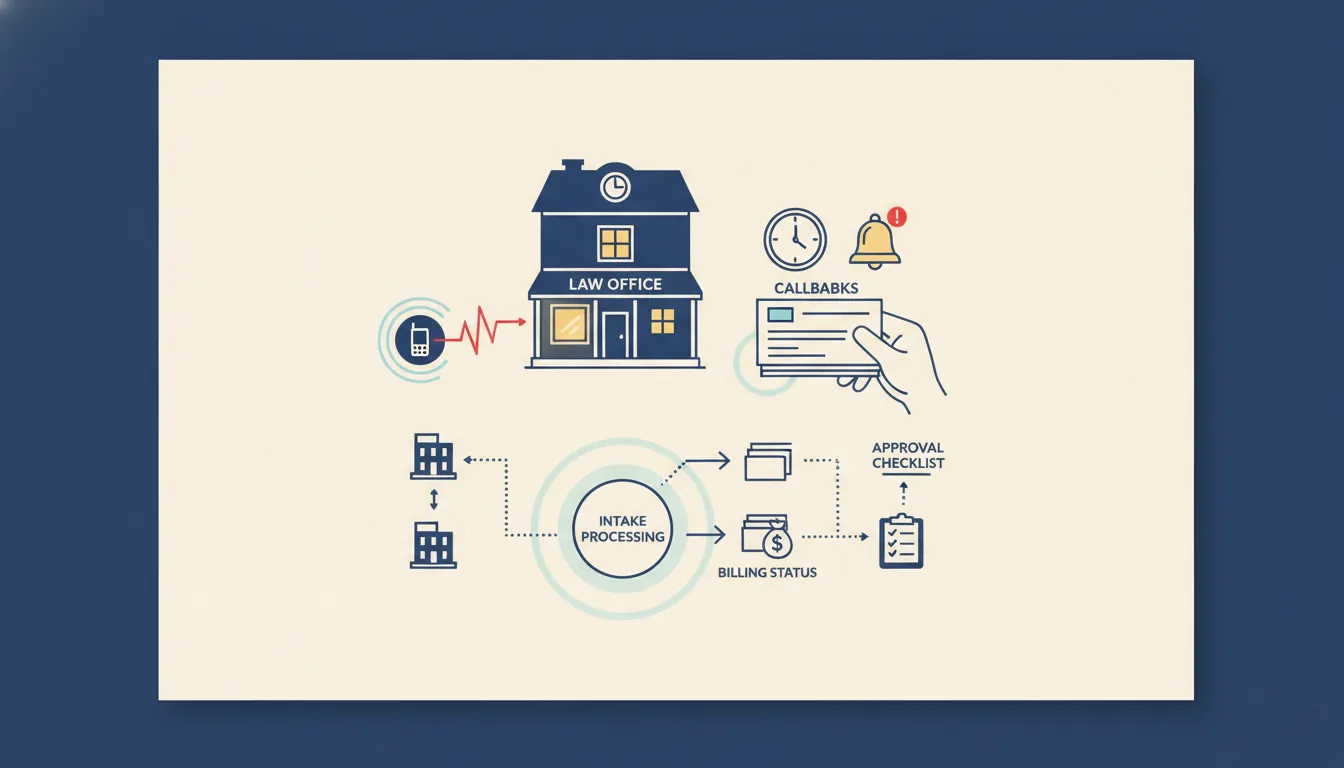
I want the provider to demonstrate what happens when:
- A call arrives after hours and nobody can complete the intake.
- The caller disconnects before giving a name.
- The same person calls again and submits a web form.
- The person reports an approved urgency signal.
- The next available consultation is outside the firm's response promise.
- The CRM or calendar rejects the update.
- The assigned person does not acknowledge the escalation.
- The caller needs a language or accessibility accommodation.
A useful recovery lane creates a timestamped record, attempts the approved response, deduplicates what it can, marks what it cannot determine, assigns one owner, sets the next action, and alerts again when the owner does not acknowledge it.
I do not accept “the webhook succeeded” as proof. The destination record has to exist with the right owner and status. I also do not accept “a text was sent” as a closed loop. The operator needs to know whether the person responded, booked, declined, or still needs follow-up.
That is practical workflow management for operators. A board full of contacts is not control. Clear ownership, an exception lane, and proof of completion are control.
Score legal intake services on operating controls
I use a two-point test for each control. Zero means the failure is hidden or left to memory. One means the team can recover through a documented manual step. Two means the system detects the issue, preserves the record, assigns an owner, and proves the outcome.
Score these ten areas:
- Channel coverage: phone, form, email, text, chat, and referral sources enter one reviewable lane.
- Response timing: business-hour and after-hours promises are measurable.
- Record authority: person, inquiry, appointment, consent, outcome, and matter records have declared owners.
- Qualification: the script uses approved criteria and preserves uncertainty.
- Human boundaries: legal advice, conflicts, sensitive disclosures, and representation decisions escalate correctly.
- Duplicate control: repeat contacts merge or surface for review without deleting history.
- Exception recovery: failed messages, failed writes, urgent signals, and unacknowledged assignments remain visible.
- Consultation follow-through: reminders, rescheduling, preparation, no-shows, and next actions have owners.
- Reporting: operators can see response time, booked consultations, unresolved inquiries, aging, and failure reasons.
- Portability: the firm can export its records, scripts, outcomes, and audit history.
My opinion is firm: the client should own the operating system, data, credentials, and exit path. A provider can deliver a managed service, but the firm should not lose its intake history or operating logic when the contract ends.
When not to hire us for legal intake services
Do not hire us for a legal intake build when the firm cannot agree on practice fit, urgency rules, who may say what, consultation ownership, or what happens after a no-show. A vendor will not resolve those disagreements. It will encode them inconsistently.
I would also pause when inquiry volume is low enough for one trained person to own the lane, current response times are reliable, and the team can see every open exception. A shared script, one intake form, one calendar, and a daily review may be enough.
Sometimes the right first move is narrower:
- Route every channel into one queue.
- Create one approved intake record.
- Assign every inquiry to one owner.
- Add an after-hours acknowledgment and callback lane.
- Reconcile failed CRM and calendar updates each day.
- Review no-shows and aging inquiries on a fixed schedule.
That creates evidence before a larger contract. It also shows whether the gap is staffing, process, software, or integration.
If the team needs help deciding where the failure actually lives, I use an AI Operations X-Ray to map the handoffs, owners, exceptions, and next build priority before recommending a bigger system.
Legal intake services should win because the firm responds reliably, protects judgment boundaries, creates one trusted record, gives every inquiry an owner, and can prove what happened next.
If the provider cannot show that under failure conditions, call coverage alone is not enough.
FAQ
Frequently asked questions
01What are legal intake services?
Legal intake services receive potential-client inquiries, collect approved information, qualify and route matters, schedule consultations, and document follow-up for a law firm.
02Should a legal intake service give legal advice?
No. The service should follow the firm's approved script, collect information, route urgency, and escalate questions that require a lawyer or authorized team member.
03What should a law firm test before hiring an intake provider?
Test after-hours calls, duplicate contacts, conflict indicators, urgent deadlines, language needs, failed CRM updates, rescheduling, nonresponsive leads, and human escalation.
04Can legal intake services work with an existing CRM?
Yes, if the firm declares which system owns the contact, matter, appointment, consent, and follow-up record and verifies that every integration update is accepted.