Field note
Aug 10, 2026
AI workflow automation: the operator authority test
AI workflow automation should define what the system may read, prepare, change, send, and spend before speed or autonomy becomes the goal.

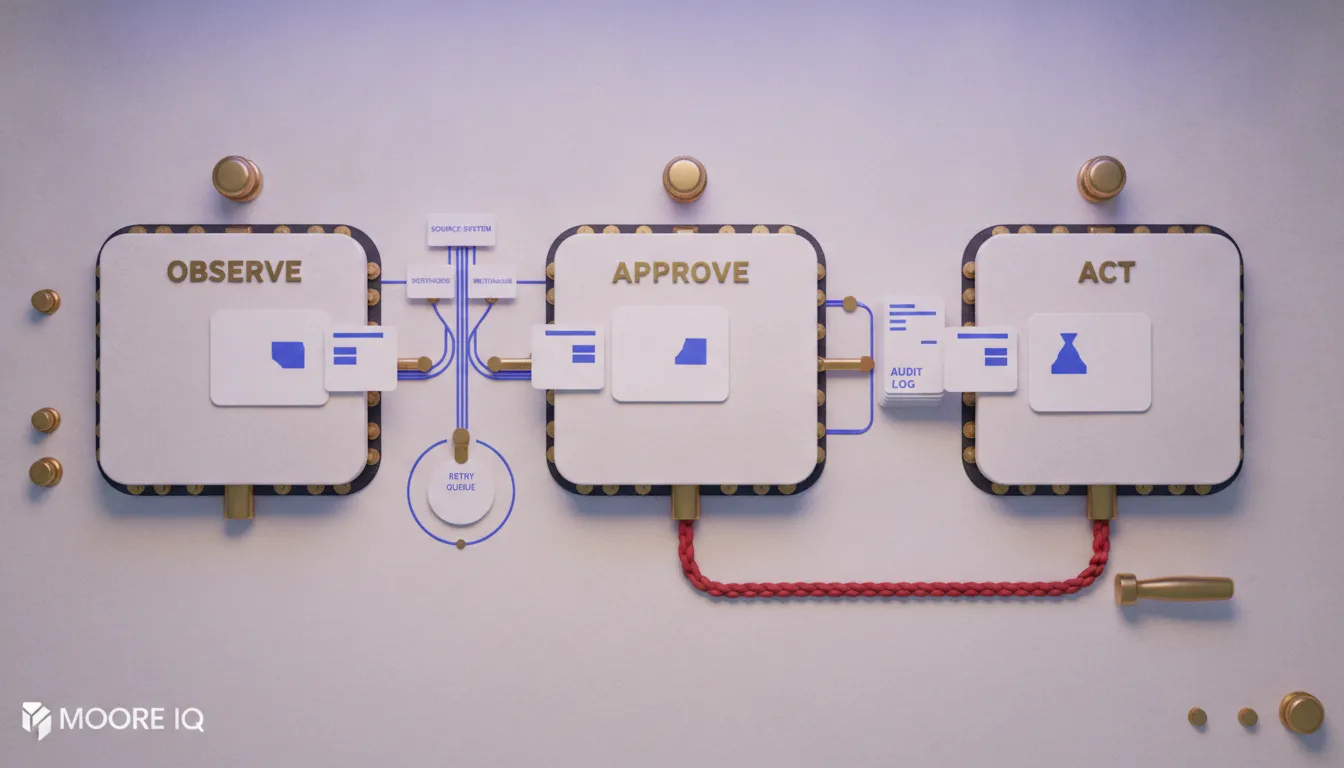
AI workflow automation should begin with an authority decision, not a model decision.
Before I let a workflow touch live operations, I want to know what it may read, what it may prepare, what it may change, what it may send, and what it may spend. I also want to know who can stop it and how the team will prove what happened.
That is the operator test. A workflow can look intelligent and still be unsafe, expensive, or impossible to recover. It can also be technically simple and create real value because the authority boundary is clear.
I learned this lesson on a synchronization between CE21 and GoHighLevel. The workflow ran every six hours, but one full run took roughly three hours because the reliable incremental window was not available. I kept the batch size at nine records to stay under the systems' rate limits. The schedule was working, but the schedule alone did not make the operating design good.
After building more than 500 production-grade workflows, my rule is firm: a successful run is not the same thing as a trustworthy business outcome.
Start with one operating promise
I do not start AI workflow automation with a list of tools. I start with one sentence the operator already cares about.
Examples include:
- Every qualified lead receives a reviewed response before the next business day.
- Every candidate handoff has a next owner and a visible aging clock.
- Every service request reaches the correct role before the response window closes.
- Every job marked complete has the evidence required for billing.
- Every invoice exception has a reason, owner, and resolution trail.
That sentence creates a boundary. It tells the team what the workflow is protecting and what is outside the first release.
This is the same distinction I make in my field note on an AI agent workflow for operators. The agent is not the starting point. The business promise, source of truth, and authority boundary come first.
For one promise, I want six decisions:
- Intake. Which event or record starts the work?
- Authority. What may the workflow read, prepare, change, send, or spend?
- Source of truth. Which record wins when systems disagree?
- Owner. Who owns the normal lane and who owns exceptions?
- Proof. Which field, timestamp, file, or status confirms completion?
- Recovery. How does the team stop, reverse, replay, or repair the workflow?
If those decisions are missing, the first project is operating design. It is not AI implementation.
Write an authority contract
An authority contract is a plain-language list of allowed actions and forbidden actions. It should be understandable by the manager who owns the business outcome, not only by the person building the workflow.
I use five practical authority levels:
- Read. The workflow may inspect approved records and detect changes.
- Prepare. It may summarize, extract, compare, classify, or draft.
- Recommend. It may suggest priority, next action, or routing with a reason.
- Change. It may create tasks or update low-risk records under defined rules.
- Commit. It may send a message, submit a transaction, promise a date, spend money, or trigger another external action.
The mistake is treating those levels as one permission called automation. They are not equivalent.
The NIST AI Risk Management Framework organizes AI risk work around governing, mapping, measuring, and managing. My operator version is practical: govern the authority, map the business context, measure the result, and manage the failures before increasing autonomy.
A workflow that reads an inbox and drafts a reply creates a different risk than one that sends the reply. A workflow that identifies an invoice mismatch creates a different risk than one that releases payment. A workflow that recommends a schedule creates a different risk than one that promises a customer arrival window.
My ownership opinion is direct. The operator should own the accounts, code, data, credentials, logs, approval rules, and stop control. I like self-hosted systems when they improve that control, but self-hosting is not the goal by itself. The goal is a system the business can inspect, maintain, and recover without being trapped.
The operator buying test for business automation software is useful before signing a contract because a long feature list does not answer who owns the authority model or what happens during failure.
Give every action a named owner

AI workflow automation becomes dangerous when responsibility disappears between the system and the team.
For every material action, I assign three roles:
- Workflow owner: accountable for the business promise and review habit.
- Exception owner: responsible when the normal lane cannot continue safely.
- Technical owner: responsible for health, credentials, logs, retries, and repair.
One person can hold more than one role in a small company. The roles still need to be explicit.
I also separate approval from notification. A message saying something happened is not an approval gate. A real gate records the decision needed, who may make it, which version they reviewed, when they decided, and what action became allowed afterward.
That operating surface is the heart of workflow management for operators. A queue should show the item, reason, owner, age, allowed decision, and proof requirement. Without those fields, AI simply creates faster ambiguity.
The authority map should answer questions such as:
- May the workflow draft a customer reply but not send it?
- May it update a non-risk status but not change deal value?
- May it prepare a quote but not choose margin or delivery terms?
- May it create a vendor record but not approve payment?
- May it retry a failed read without approval but require review before replaying a send?
- May it call a paid service up to a documented limit, then stop?
Those are business decisions. The builder should not invent them alone.
Design the exception lane before the normal lane
The happy path is usually easy to automate. The value and risk live in exceptions.
I define the stop conditions before I expand the normal lane. Common stop conditions include:
- A required field is missing.
- Two approved records disagree.
- The customer request falls outside the known category.
- A price, date, identity, or permission cannot be verified.
- The action crosses a financial or customer-facing threshold.
- The workflow has seen the same item before but cannot prove closure.
- A downstream system is unavailable.
- The workflow cannot preserve idempotency and may repeat an external action.
A stop is not a broken automation. A stop can be the safest and most valuable output.
The exception record should include the original input, the reason it stopped, what the workflow already did, what it did not do, which owner must decide, and what action becomes legal after that decision.
This is where I apply secure-by-design thinking. CISA's Secure by Design guidance argues that safety should be built into products rather than pushed onto customers. My workflow version is similar: safe defaults, limited authority, visible evidence, and an easy stop should be part of the design. They should not depend on a frontline operator remembering a hidden rule.
Prove outcomes, not activity
Workflow logs are necessary, but they are not enough.
A log can prove that a step ran. It may not prove that the customer received the right message, the CRM kept the correct owner, the invoice was reconciled, or the job reached the next accountable person.
For each operating promise, I choose one business proof and one technical proof.
Examples:
- Business proof: the approved reply is attached to the correct lead record. Technical proof: the send provider returned one message identifier.
- Business proof: the invoice exception has a resolution and approver. Technical proof: the accounting update completed once.
- Business proof: the candidate has a named next step. Technical proof: the ATS record and calendar event share the correct identity.
- Business proof: the job is billing-ready. Technical proof: all required evidence files exist and the status update succeeded.
I also want reconciliation. A daily or weekly review should compare what entered the workflow, what completed, what stopped, what retried, and what remains unproved.
That review also supports the accountability and traceability principles in the OECD AI Principles. In operating terms, the team should be able to identify the responsible owner, reconstruct a material action, and explain why the workflow was allowed to take it.
That review catches silent failure. A workflow can stay green while the business result drifts. I have seen logic continue running while a client's usage was not assigned correctly. The problem appeared at month end, after the business had already absorbed the cost. Monitoring uptime would not have caught the missing commercial record.
Run a recovery drill before adding autonomy
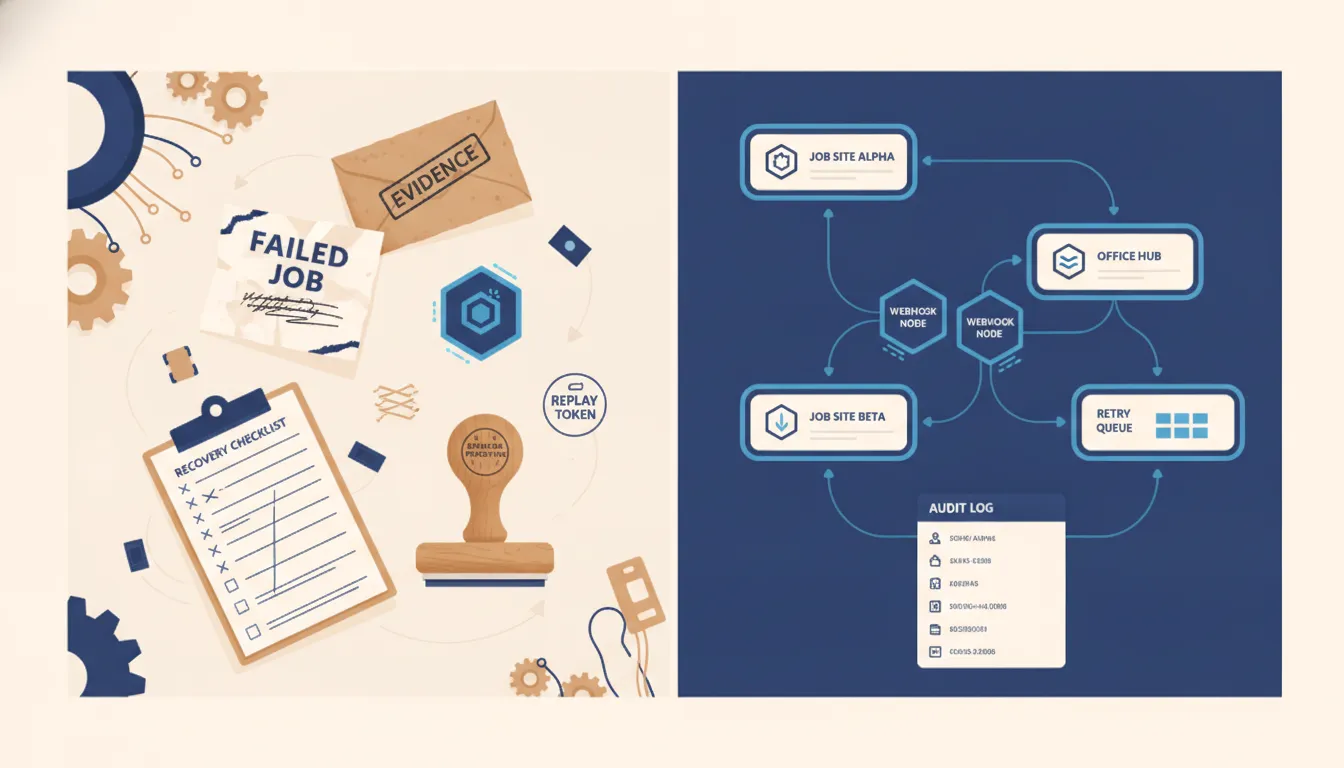
I do not widen authority until the team has recovered one controlled failure.
A useful recovery drill tests:
- Stop the workflow without deleting evidence.
- Identify the last known good business state.
- Separate completed actions from attempted actions.
- Correct the source record or business rule.
- Replay only the safe portion.
- Prevent duplicate messages, charges, tasks, or updates.
- Confirm the business proof after recovery.
- Record what should change before the next run.
This is where a durable orchestration layer matters. n8n consulting can be useful when the workflow needs visible execution history, retries, credentials, branching, schedules, and technical recovery. The tool still needs an authority contract and business proof. Orchestration cannot decide those for the operator.
I test recovery under uncomfortable conditions: expired credentials, stale data, a partial API outage, an approver who is unavailable, a duplicate event, an edited record during processing, and a send step whose response is uncertain.
If the workflow cannot answer whether an external action happened, it should not retry blindly.
Decide whether to buy, build, or pause
AI workflow automation does not always require custom software. The right decision depends on authority and operating fit.
Buy when the process is standard, the vendor exposes the required permissions and logs, records can be exported, approval gates match the business, and recovery is documented.
Build when the advantage lives in company-specific rules, several systems must be reconciled, the operator needs precise authority boundaries, or the vendor cannot expose enough proof.
Pause when the process has no owner, data is unreliable, exceptions live in personal memory, leadership wants autonomous action before review, or nobody can define reversal.
My SaaS workflow control test helps expose the middle ground. A subscription product can be the right component without becoming the source of truth or the only place the business can see what happened.
For a custom engagement, business process automation services should start with the operating contract, not a promise to connect every tool. One narrow promise with clear authority is more valuable than a large diagram with no accountable owner.
When not to hire us for AI workflow automation
Do not hire us for AI workflow automation when the company cannot name the owner of the current work.
I would also pause when:
- The team cannot identify which record is authoritative.
- Leadership wants the system to send, spend, or commit before reviewing safer outputs.
- Nobody owns exceptions.
- Success is described only as hours saved, with no business completion signal.
- The team will not preserve logs or review failed runs.
- The workflow depends on undocumented founder memory.
- A vendor must hold all credentials, data, and operational history with no practical export.
- The business cannot explain how to stop or reverse the first automated action.
In those conditions, I would map one handoff first. An AI Operations X-Ray can identify the leaking intake, missing owner, duplicate entry, or unproved completion before a larger build starts.
The first useful release should be small enough to inspect every day. Give it one intake, one promise, one source-of-truth rule, one authority level, one exception queue, one proof field, and one recovery drill.
Then expand authority one decision at a time.
AI workflow automation creates an advantage when it makes responsibility clearer while work moves faster. If authority becomes vague, the workflow is not ready for more intelligence. It is ready for a better operating contract.
FAQ
Frequently asked questions
01What is AI workflow automation?
AI workflow automation uses AI inside a controlled business process to classify, extract, compare, draft, recommend, or act while following defined sources, permissions, approval gates, exception rules, and proof requirements.
02What should a business automate first with AI?
Start with one frequent operating promise that has a named owner, stable intake, an authoritative record, visible exceptions, and a measurable completion signal.
03How much authority should an AI workflow have?
Begin with authority to observe and prepare. Add authority to recommend, update, send, or spend only after accuracy, approval, logging, stop controls, and recovery have been tested.
04When should AI workflow automation stop for human review?
It should stop when required data is missing, approved records disagree, confidence is not enough for the business risk, an action crosses a permission threshold, or the workflow cannot prove what happened.