Field note
Jun 29, 2026
Business process management software for operator control
Business process management software should give operators ownership, handoff control, exception review, and proof before it becomes another workflow tool in the stack.

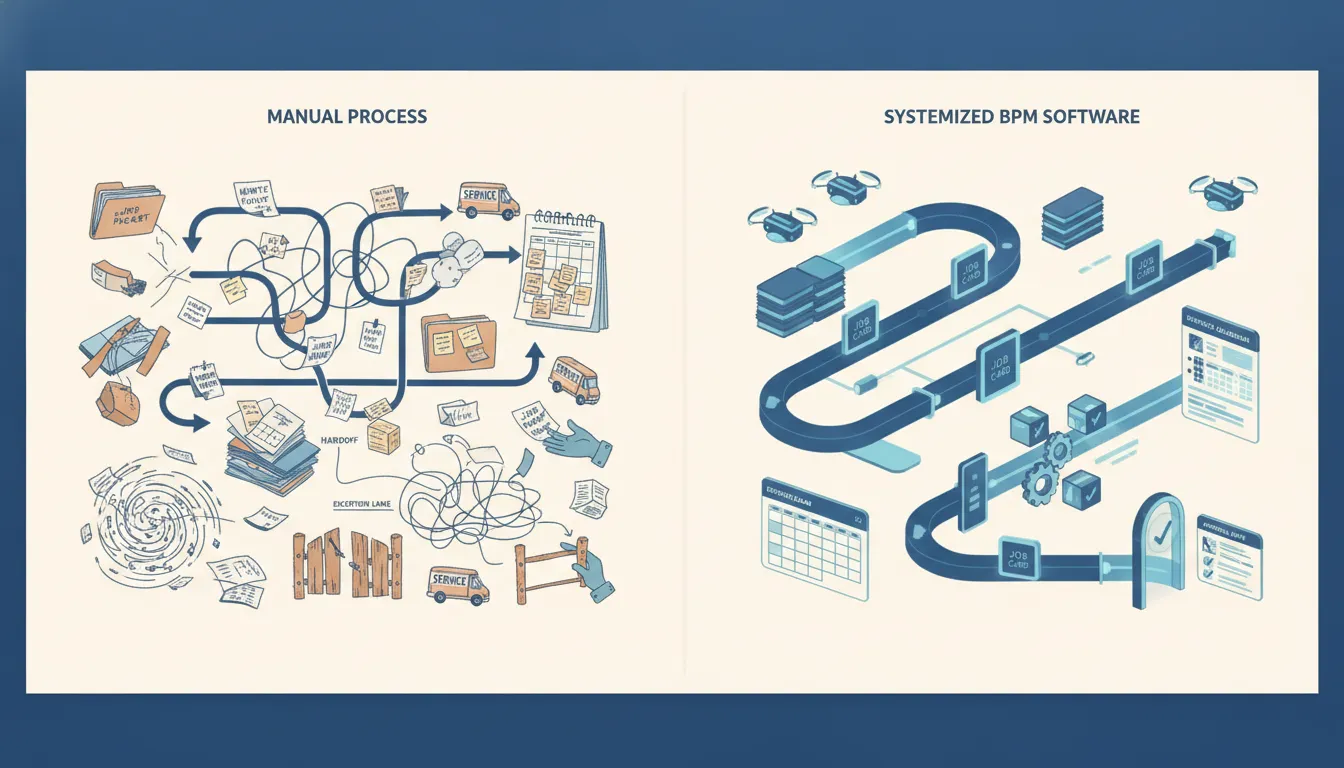
Business process management software sounds like a tool decision.
I do not look at it that way.
I look at it as an operating control decision. If a process is already unclear, software will not magically make it clean. It will usually move the confusion into a prettier interface with more notifications.
IBM describes business process management as a discipline for analyzing, improving, and optimizing business processes. That definition is useful, but the operator question is more direct:
Who owns the lane?
Which system is the source of truth?
What can move automatically?
What needs approval?
Where does the proof live?
If those answers are fuzzy, I would not start with a business process management software shortlist. I would start with business process automation around one messy handoff and prove the control model before expanding.
I have seen this in back office systems over and over. On one CE21 to GoHighLevel sync, the real issue was not just moving records from one place to another. The issue was that contacts were missing, member levels had to land correctly, event dates were formatted different ways, and the downstream CRM workflow depended on clean records. If I automated the happy path without fixing those ownership questions, the process would have looked automated while still being unreliable.
My rule is simple: automate the handoff, but keep the decision owner visible.
Start with the process lane, not the platform

A process lane is the narrow path from request to outcome.
It might be lead intake to booked call. Invoice received to approved payment. Work order request to vendor dispatch. Candidate found to client submission. Contract request to signed agreement. Customer issue to resolved ticket.
That lane needs a map before it needs a platform.
For each lane, I want to know:
- What starts the process?
- Which system receives the request first?
- Which fields are required before work can move?
- Which system owns the customer, job, invoice, candidate, contract, or asset record?
- Which decision points need a human?
- What happens when the process is blocked?
- What proof should leadership review later?
That is why business process architecture matters before a BPM purchase. Architecture is where the team names the owner, source system, exception path, and reporting layer. Software can enforce those rules, but it cannot invent them in a trustworthy way.
If nobody owns the lane, the BPM tool becomes a shared hiding place. Everyone can see the status, but nobody is accountable for the next move.
A better first move is to choose one process that already leaks time or money. Then define the lane clearly enough that software can help instead of covering up the mess.
Do not confuse workflow movement with process control
A lot of teams think they need business process management software when what they really have is uncontrolled workflow movement.
A task moves from inbox to spreadsheet to CRM to Slack to a folder to a report. It is technically moving, but the process is not controlled.
Control means the system can answer questions like:
- Who is responsible right now?
- What information is missing?
- Which rule allowed this to move?
- Which approval blocked it?
- Which record should be trusted?
- What changed since the last review?
- What proof is attached to the outcome?
That is the difference between a task board and workflow management for operators. A task board shows activity. A controlled workflow shows ownership, state, and the next decision.
This is where I like owned, visible systems. All code, data, credentials, and operating rules should stay somewhere the operator can inspect. I am not against packaged tools, but I do not like black-box processes where the business cannot see why something moved, failed, skipped approval, or changed state.
The same point applies when AI gets added to BPM software. The NIST AI Risk Management Framework is a good reminder to govern, map, measure, and manage AI systems. In operator language, that means AI can summarize, classify, score, and draft, but the workflow still needs visible rules and named approval owners.
The first automation layer should make exceptions obvious
The wrong goal is to make every process fast.
The right goal is to make normal work boring and exceptions obvious.
A useful first BPM automation layer can:
- Validate required intake fields.
- Create or update the correct source record.
- Route the work to the right owner.
- Flag missing information before it spreads.
- Draft a review packet for the human decision maker.
- Escalate overdue approvals.
- Attach proof to the customer, job, invoice, contract, or asset record.
- Produce a weekly exception report.
That is enough to create real operating value without rebuilding the whole company.
I use this pattern because I have seen what happens when teams try to automate too wide too early. One manual operation had 20 accounts with zero automation. People could only check them once or twice per day because the work took too long. With automation, the process could be monitored four or five times per day, with 24-7 visibility.
The lesson is not that everything should run without people. The lesson is that the system should watch the lane, catch the exception, and bring the right packet to the right owner before the business finds out late.
That is a stronger business process management software requirement than another dashboard.
Replace less, wrap more, prove first
Business process management software can be the right answer when the team has a mature process and needs a stronger operating layer.
But a full replacement is not always the right first move.
If the current CRM, finance system, spreadsheet, email inbox, shared drive, dispatch board, or reporting tool still works well enough, I would rather wrap the leaky handoff first. That is where legacy system modernization fits. The business can keep the systems people already use while adding routing, validation, exception handling, and proof around the places that break.
For example, a practical first layer might:
- Turn an email request into a clean intake record.
- Match the request to an existing customer or job.
- Ask for missing fields before the team starts work.
- Route approval based on amount, risk, location, or customer tier.
- Push the approved state into the CRM or finance system.
- Send the proof record into a weekly operator report.
That is not a massive BPM transformation. It is a controlled operating lane.
This is also why I like the workflow optimization scorecard before a rebuild. Score the handoff first. If the problem is ownership, software replacement will not fix it. If the problem is data quality, the first automation should clean the intake. If the problem is approval latency, the first automation should make the review packet clear and easy to approve.
What the weekly proof review should show
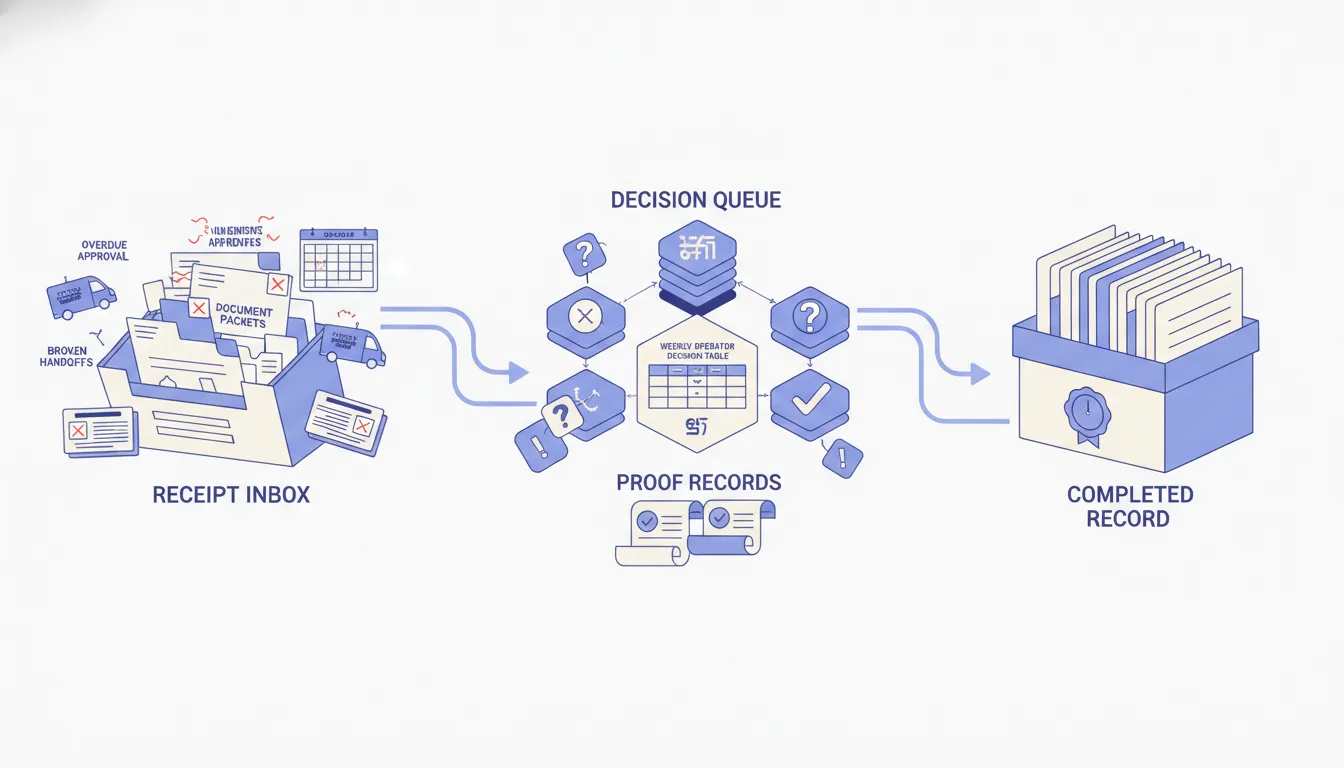
Business process management software should not only move work. It should teach the operator where the process keeps breaking.
That means the weekly review matters.
A good weekly proof review should show:
- New process volume by lane.
- Items completed automatically.
- Items waiting on a human decision.
- Items blocked by missing data.
- Approvals that missed the target time.
- Records that failed to sync.
- Exceptions by owner, customer, location, or work type.
- Decisions made and proof attached.
This is where report automation becomes part of the BPM system. If leadership has to rebuild the same spreadsheet every Friday, the process is not controlled yet. The operating layer should produce the review packet automatically so the team can make decisions instead of hunting for status.
I also care about process discipline here. ISO 9001 frames management systems around a process approach and continual improvement. A small operator does not need to turn that into corporate theater. But the principle is right: define the process, measure it, improve it, and keep proof.
That is the part many BPM projects skip. They model the ideal process, launch the tool, and never build the review loop that shows whether the business actually got better.
When not to hire us for business process management software
Do not hire us if the team is hoping the tool will decide ownership for them.
Do not hire us if leadership has not picked the source of truth.
Do not hire us if every exception still needs a meeting because the approval rules are political.
Do not hire us if the problem is really a broken CRM migration, messy intake form, missing required fields, or a report nobody trusts.
In those cases, start smaller. Build one controlled lane. Prove that the intake is clean, the routing is visible, the human approvals are clear, and the proof review works.
Before expanding, look for operating proof that names the source of truth, routing rules, human approvals, and verification method. The evidence-backed case-study library shows how those controls are documented without turning estimates into outcomes.
The operator scorecard before choosing BPM software
Use this scorecard before buying, replacing, or expanding business process management software.
Give each line a named owner.
- Process lane: Which exact process are we improving first?
- Trigger: What starts the process?
- Source of truth: Which system owns the main record?
- Intake quality: Which fields are required before work moves?
- Routing: Who owns the next step at each state?
- Approval gates: Which decisions need a human?
- Exception path: What happens when data is missing, confidence is low, or a rule is violated?
- Proof: What evidence must be attached before the item is complete?
- Reporting: What should leadership review every week?
- Maintenance: Who owns the rules after launch?
If those answers are blank, the next step is not a software demo.
The next step is an AI Operations X-Ray. Use it to find the process lane that leaks the most time, revenue, or trust. Fix that lane first. Then decide whether business process management software should replace the stack, wrap the stack, or stay out of the way.
FAQ
Frequently asked questions
01What is business process management software?
Business process management software helps teams model, run, monitor, and improve repeatable business processes across systems, people, approvals, and reports.
02When should a company buy business process management software?
Buy it when the team can name the process owner, source systems, approval rules, exception paths, and reporting needs. If those are unclear, fix the operating lane first.
03Is BPM software the same as workflow automation?
No. Workflow automation moves tasks. BPM software should control the larger process, including ownership, handoffs, status, proof, and improvement loops.
04What should operators automate first?
Start with the process lane where missed handoffs, slow approvals, duplicate entry, or unclear proof already cost time, revenue, or trust.