Field note
Aug 8, 2026
CRM for remodelers: the operator buying test
A CRM for remodelers should control the path from homeowner inquiry to estimate, approved change, completed work, and final payment.

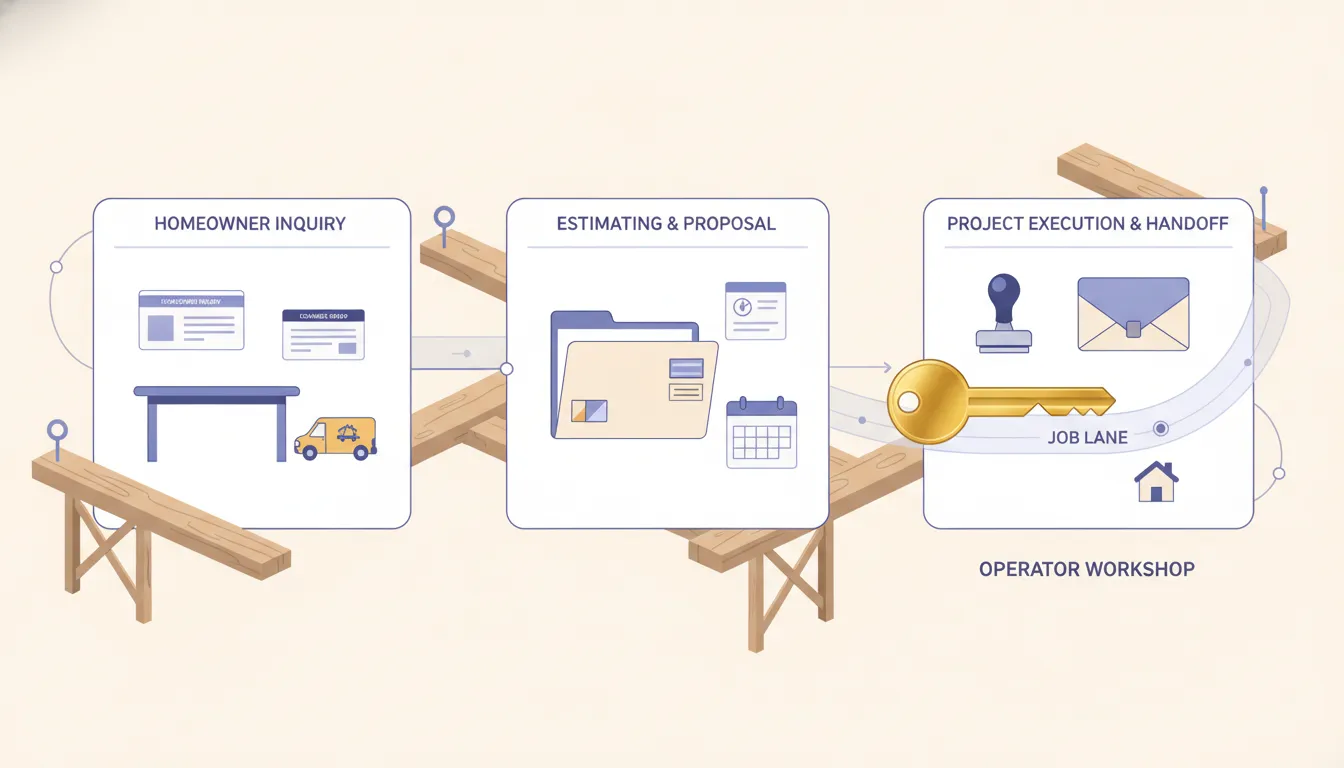
A CRM for remodelers should do more than remember names and send follow-ups. It should protect the operating path from a homeowner inquiry to a scoped estimate, an approved project, controlled changes, completed work, and final payment.
That path is where a remodeling company makes or loses trust.
A lead can arrive from a website, referral, marketplace, phone call, or text. A site visit can produce photos, measurements, preferences, and an early budget. The estimate may live in another tool. The project schedule may live somewhere else. Customer decisions can sit in email. Change orders can move through text messages. Accounting sees the job only when somebody remembers to prepare the invoice.
A basic CRM can show a clean pipeline while the real job is already leaking.
I saw the cost of stale operating records on a CRM integration I built. The source sync ran every six hours and took about three hours to complete. That meant the important design question was not whether the records could move. It was whether the person using the destination could see how old the data was, which system had authority, and what needed to stop when the records disagreed.
That experience shaped my rule for a CRM for remodelers: keep the record stable, make the handoff visible, and never hide uncertainty behind a green status.
Start with the remodeling promise
Before I compare CRM products, I write the business promise the system must protect.
For a remodeler, a useful promise might be:
Every qualified homeowner inquiry receives an owned next step, every estimate reflects the approved scope, and every project reaches production and billing with its decisions attached.
That sentence is more valuable than a feature list because it sets a boundary. It connects the sales pipeline to job delivery and cash.
I break it into five operating stages:
- Inquiry accepted. The company has enough information to decide whether the opportunity fits.
- Site visit owned. A named person, scheduled time, property, scope, and preparation list are visible.
- Estimate controlled. The current scope, assumptions, options, exclusions, owner, and follow-up date are clear.
- Project handed off. The signed commitment, deposit status, selections, schedule assumptions, and unresolved issues reach production.
- Job financially closed. Approved changes, completion evidence, final invoice, and payment status agree.
This is why my automation work for trades contractors starts with the handoffs around leads, quotes, job documentation, follow-up, and collections. The goal is not to install more software. The goal is to keep the business promise visible from first contact through payment.
If the team cannot agree on that path, I do not recommend a large CRM migration yet. I would use an operations X-Ray to find the first leaking lane, define the owners and records, and fix one stage before expanding.
Make the lead-to-estimate handoff measurable
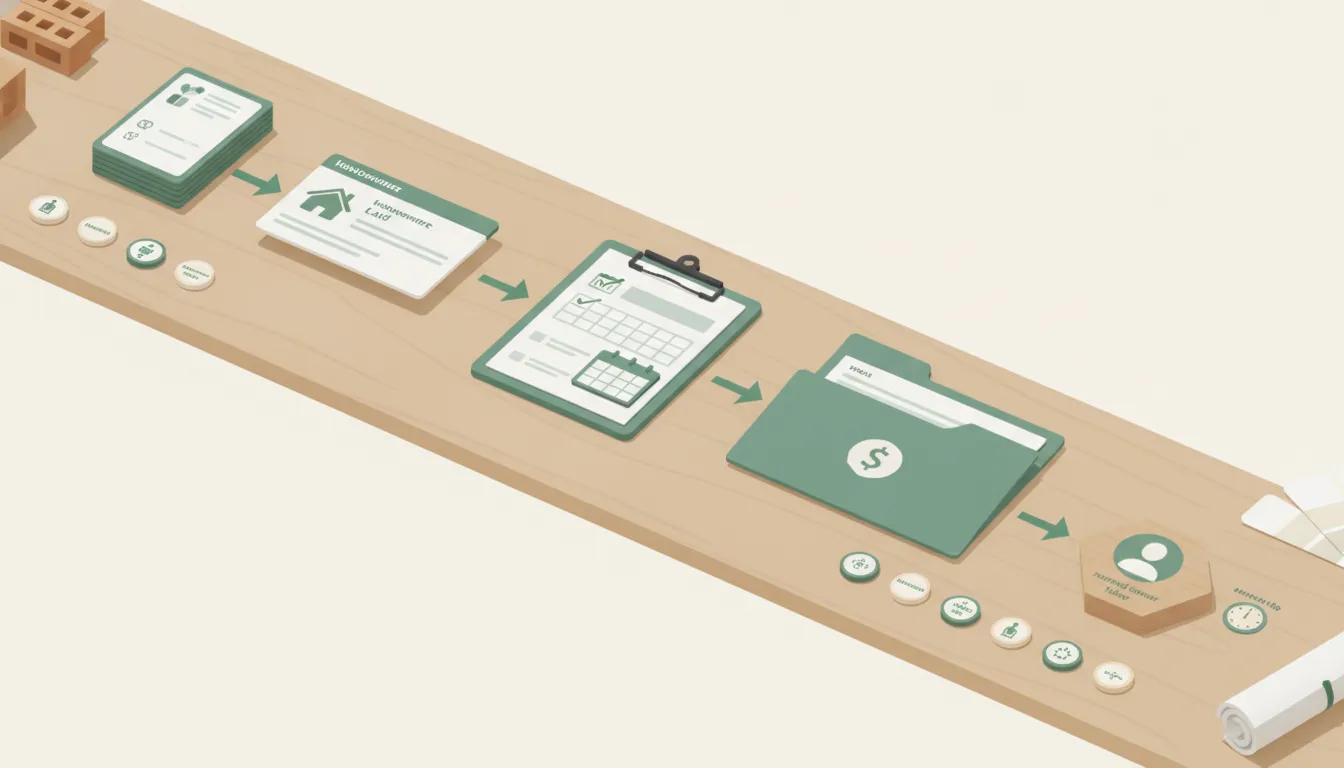
The first buying test is not whether the CRM has automated email. It is whether the company can prove what happened after the inquiry arrived.
I want the CRM to answer:
- Which channel produced the inquiry?
- Which property and project type does it concern?
- Is the work inside the company's service area and project fit?
- Who owns qualification and by what time?
- What information is missing before a site visit?
- Which person owns the estimate after the visit?
- When is the next homeowner commitment due?
- What reason closes a lost or deferred opportunity?
This is where remodelers often discover that they do not have one pipeline. They have a marketing inbox, the owner's phone, a scheduler, an estimating product, personal email, and a spreadsheet used for the Monday meeting.
A CRM for remodelers should not pretend those systems do not exist. It should control the handoff between them.
I use one durable opportunity identity across the path. The homeowner and property matter, but the project is the operating object. A past customer can have a kitchen project, a later addition, and a warranty issue. Treating the contact as the job mixes different promises together.
That is the same reason I tell home builders to track jobs, not just contacts. The CRM should preserve the commercial relationship while the project record carries scope, decisions, ownership, and proof.
For qualification and follow-up, automation can collect approved information, detect missing fields, prepare a site-visit brief, draft a response, and surface a stale estimate. It should not invent a budget, promise a start date, or declare a homeowner qualified when the evidence is incomplete.
Declare which system owns each record
A remodeling company can have a capable stack without having an operating system.
The CRM may own the inquiry and communication history. Estimating software may own pricing and proposal versions. Project software may own schedule, tasks, photos, and daily activity. Accounting may own invoices and payments. A signed document may own the approved scope. The latest customer text may contain a decision that has not reached any of them.
I map authority field by field:
| Record or decision | Authoritative source | Exception owner |
|---|---|---|
| Homeowner and property identity | CRM or approved customer record | Sales operations |
| Current scope and exclusions | Approved estimate or contract | Estimator or project owner |
| Project schedule | Project system after production acceptance | Project manager |
| Approved change | Signed change record | Project manager and finance owner |
| Job cost and invoice status | Accounting system | Finance owner |
| Completion evidence | Project record with required proof | Project manager |
This is business process automation tied to real records. I am not trying to make the CRM win every argument. I am deciding which record wins each argument and which person resolves a conflict.
My opinion is firm: the business should own the accounts, data, credentials, rules, logs, and documentation behind this system. A remodeler should not need the original builder or one software salesperson to explain why an estimate moved, why a message sent, or why a job looked ready to invoice.
Treat the won deal as the middle
Many CRMs are built around a sales finish line. The opportunity becomes won, the celebration fires, and the sales workflow ends.
For a remodeler, that is the middle.
The won-to-production handoff should include:
- Signed scope and exclusions.
- Deposit status and payment evidence.
- Property, access, and homeowner communication details.
- Selected options and open selections.
- Permit, engineering, or design dependencies.
- Expected start window and the authority behind it.
- Known material and trade dependencies.
- Unresolved assumptions from estimating.
- Current owner and next decision.
The company does not need every detail in the CRM. It needs proof that the right detail reached the right authoritative system and owner.
The broader construction management software buying test applies here. Job truth, changes, trade handoffs, exceptions, and billing readiness matter more than how many modules a vendor can demonstrate.
I also want the receiving project manager to accept the handoff. Creating a project record is not acceptance. A useful control confirms that the required fields exist, the documents open, the deposit state is correct, and unresolved items have owners.
Put change orders behind a hard control

Change orders expose weak CRM design quickly.
A homeowner asks for different tile. A wall condition changes the work. A trade finds hidden damage. The schedule moves. The project manager discusses a solution. Somebody starts work before the price, scope, or approval reaches the right record.
I use a hard control:
- Capture the requested or discovered change with the original evidence.
- Identify the affected scope, cost, schedule, material, and trade.
- Route the change to the person allowed to price and approve it.
- Preserve the homeowner decision and signed record.
- Update the production and financial records only after approval.
- Confirm the changed records agree.
- Keep disputed, incomplete, or rejected changes in a visible exception lane.
The CRM can coordinate the conversation and owner. It should not become the unofficial pricing system or silently replace the signed scope.
Some projects also carry compliance evidence that cannot be reduced to a pipeline stage. The EPA Renovation, Repair and Painting Program sets requirements for firms performing covered work in pre-1978 homes and child-occupied facilities. My operating point is not to make the CRM interpret the rule. It is to preserve the property context, certified owner, required records, and stop condition so the team does not treat compliance as a forgotten note.
This is also where AI needs a boundary. AI can summarize a site note, extract a requested change, compare documents, draft a customer update, and flag missing approval. It should not commit the company to price, scope, schedule, or legal language without review.
The NIST AI Risk Management Framework is useful because it treats trustworthiness as part of design, use, and evaluation. My operator version is simple: show the evidence, expose uncertainty, name the approver, and keep a stop control.
Connect field evidence to financial closure
A remodeling CRM is not finished when the project starts. It should help the business know when the project is truly ready to close.
Field work creates photos, daily notes, completion records, customer decisions, punch items, warranty questions, trade invoices, and material changes. Those records may live in project software rather than the CRM, which is fine. The control is whether the sales, production, and financial records reconcile.
The field service software control test is relevant because field reality has to survive offline work, changing conditions, dispatch handoffs, and completion proof. A checked box is not enough when the job still has an open punch item or an unsigned change.
Before a job becomes billing-ready, I check:
- The approved scope and completed scope agree.
- Every approved change appears in the project and financial records.
- Rejected or disputed changes remain visible.
- Required photos, signatures, inspections, or acceptance records exist.
- Open punch items have owners and due dates.
- Trade and material costs are attached to the right job.
- The invoice amount comes from the authoritative financial record.
- The customer communication reflects the actual project state.
The Small Business Administration's finance guidance emphasizes proper bookkeeping and understanding business finances. For remodelers, the CRM should support that discipline by making the commercial and project handoff traceable. It should not create a parallel ledger.
Run the uncomfortable demo
I do not judge a CRM for remodelers from the clean path.
I test:
- The same inquiry arrives from two channels.
- A homeowner has two properties and three possible projects.
- The site visit occurs, but measurements or photos are missing.
- The estimate changes after an old version was emailed.
- A salesperson leaves before the homeowner decides.
- A signed project reaches production with an open selection.
- The customer requests a change by text.
- Work uncovers a condition outside the original scope.
- A change is approved in one system but missing from accounting.
- The project system rejects an update.
- The automation is paused, corrected, and replayed without creating a duplicate.
- A completed job is missing proof and must not close.
For each test, I want a visible reason, current owner, due time, allowed decision, and closure proof.
That is workflow management built for operators. A pipeline stage is not control unless the team can see why the work is there, who owns the next move, and what proves it can leave.
Use a buyer scorecard
Before buying or replacing a CRM for remodelers, score these controls from zero to two:
- Zero: The work is hidden, informal, or dependent on memory.
- One: The team has a documented manual control and named owner.
- Two: The system detects the condition, preserves evidence, assigns the owner, and verifies closure.
Score these ten areas:
- Inquiry identity and duplicate handling.
- Qualification rules and missing information.
- Site-visit ownership and preparation.
- Estimate version and follow-up control.
- Record authority across CRM, estimating, project, and accounting systems.
- Won-to-production acceptance.
- Change-order approval and reconciliation.
- Field evidence and open exceptions.
- Billing readiness and financial handoff.
- Stop, correction, replay, and data export.
The highest feature count does not win. The smallest system that closes the costly control gap without creating duplicate work wins.
When not to hire us or buy a larger CRM
Do not hire us for a major CRM build when the company cannot name who owns qualification, estimates, production acceptance, change approval, or billing readiness.
I would pause when:
- Every salesperson uses a different stage definition.
- Estimate versions cannot be identified reliably.
- The signed scope is not easy to find.
- Project managers do not accept handoffs.
- Customer decisions stay in personal text threads.
- Change approval is informal.
- Accounting receives job updates only at month end.
- Nobody reviews stale or disputed work.
- The team wants automatic customer commitments before it can run a recovery drill.
Those are operating decisions first.
A CRM for remodelers earns its place when it protects the full promise. Start with one leaking lane. Name the record and owner. Keep consequential decisions controlled. Prove the handoff. Test failure and recovery. Then expand only after the team can trust what the system says.
FAQ
Frequently asked questions
01What should a CRM for remodelers track?
It should track the homeowner, property, project, scope, estimate status, site visit, decisions, approved changes, next owner, communication history, production handoff, billing readiness, and unresolved exceptions.
02How is a remodeling CRM different from a basic sales CRM?
A basic sales CRM often stops at the won deal. A remodeling CRM must preserve the job context through estimating, selections, scheduling, change orders, field evidence, closeout, and payment.
03Should remodelers replace project management software with a CRM?
Not automatically. Keep capable estimating, project, and accounting systems as authoritative records, then use the CRM and automation layer to control the handoffs between them.
04What should remodelers automate first?
Start with one measurable leak such as inquiry response, site-visit scheduling, estimate follow-up, approved change-order handoff, or billing-ready closeout. Keep unusual and consequential decisions with a named person.